
Live updates: Follow the latest on Israel-Gaza
Even before the ceasefire had taken hold, Zaynab Bzeih had begun the journey back to her home in Zebqine in south Lebanon. She and her family arrived in the early hours of Wednesday from the northern city of Tripoli, where they had fled to escape Israel’s intense bombardment.
Her father was reluctant at first – Israel’s air strikes had intensified in the hours before the ceasefire was set to begin. The road to the south was still dangerous. They reached Zebqine at 4.30am, just 30 minutes after the ceasefire took effect.
“I told my father I would walk to the south if they left me behind,” she said. “We were the first ones back in the village.”
Thousands like Zaynab had taken the long road to return home, after more than 13 months of border fighting that Israel escalated into all-out war on September 23, followed by a ground invasion a week later. As of November 24, at least 3,768 people have been killed in Lebanon by Israeli strikes, according to Lebanon's Health Ministry.
Early on Wednesday, the motorway to the south was clogged with cars full of families, many with mattresses hastily tied to the roofs. This was despite warnings from the Israeli army urging people not to return to villages they had been forcibly evicted from during the war.
Evidence of the conflict was visible everywhere. From Beirut, drivers heading south passed through Dahieh’s lingering thick smoke, the remnants of a night of heavy Israeli bombing just before the ceasefire began.
Not surprisingly, emotions ran high: families shed tears of joy, while groups of people cheered passing cars. Some men handed out posters of Parliament Speaker Nabih Berri, the head of the Amal movement – a Hezbollah ally – who negotiated the ceasefire on behalf of the Lebanese militant group. Several cars waved Hezbollah and Amal flags.
Yet, those returning knew they had little to go back to.
Zaynab’s village has borne the brunt of the war. Israeli air strikes levelled several houses, leaving behind piles of rubble and shrapnel mixed with the belongings of their owners – football jerseys, teddy bears and books. There is no electricity or water in the village, but Zaynab is hopeful that Hezbollah will help residents rebuild quickly.
“We can rely on the Resistance,” she said, defiantly. “All houses are uninhabitable, either destroyed or badly damaged. It’s a mix of sadness and joy. Joy to come back to our home, but sadness for all the losses and the martyrs.”
Just hours after the ceasefire took effect, The National drove through south Lebanon and visited two other villages, Bint Jbeil and Qana. Scenes of massive destruction were repeated across the southern region. In Bint Jbeil, an Israeli strike had reduced a mosque to rubble, splitting its minaret in two, leaving the upper part delicately perched on top of a pile of debris. The adjacent hospital was also damaged. Repeated attacks had obliterated entire neighbourhoods.
“Why did they even target this neighbourhood?” asked Ahmad Halloum, 55, who had come back after weeks of displacement only to find his hometown in Qana reduced to rubble. “It’s a residential area with only old houses – nothing to do with anything military. This makes me want to cry.”
-
Residents walk through the destruction in the southern Lebanese village of Zibqin. AFP -
Batoul Sleem meets her father Mohammed Sleem after spending two months apart, in Tyre, Lebanon. Reuters -
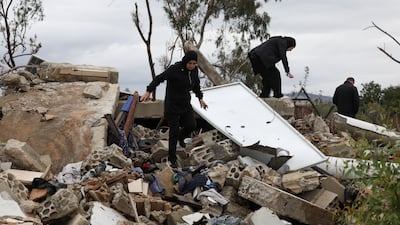
Assaad Bzih, a displaced Lebanese resident, and his family walk on rubble near their destroyed home in Zibqin. Reuters -
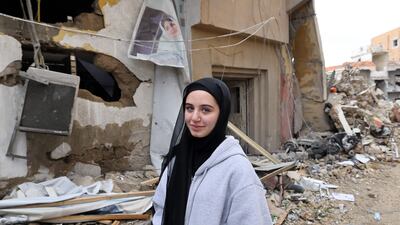
A woman stands next to destroyed buildings in the southern town of Qana. AFP -

A girl gestures as she returns to her home in a car decorated with a portrait of Hezbollah's former leader Hassan Nasrallah. AFP -

The minaret of a mosque stands amid the destruction of the southern Lebanese border village of Shebaa. AFP -
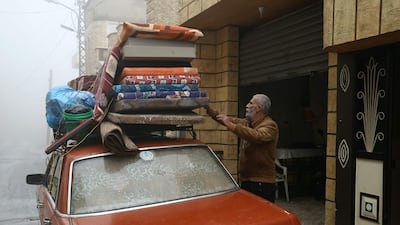
A resident who fled from Shebaa unloads personal belongings upon returning home. AFP -
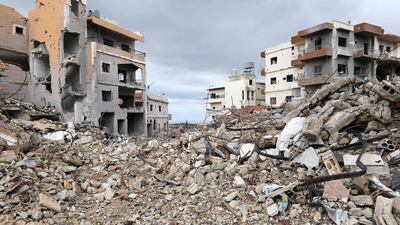
The town of Qana was repeatedly hit by Israeli bombardment AFP


Shocking destruction
The UN has denounced patterns of destruction in Lebanon similar to those seen in Gaza, where civilians “pay the ultimate price”.
“We are seeing the same patterns that we saw in Gaza, the same means and methods of warfare being used,” Jeremy Laurence, spokesman for the UN's human rights commissioner, said last month.
In November, UN peacekeepers deployed along the Israeli-Lebanon border said they had witnessed the “shocking” destruction of border Lebanese villages. Israel said it was attacking “terrorist infrastructure sites” and accused Hezbollah of using the civilian population as a “human shield”. It repeated its war goal was to “degrade Hezbollah” and allow the return of northern residents displaced by Hezbollah attacks.
In a televised speech, Israeli Prime Minister Benjamin Netanyahu claimed victory over Hezbollah, which the Lebanese militant group denied.
From a sports stadium in Bint Jbeil, Hassan Fadlallah, a Hezbollah MP, said that Israel had “failed' to achieve its objectives” in Lebanon, meaning it did “not win the war”. Mr Fadlallah declared victory in front of a group of reporters, speaking in the same stadium where late Hezbollah leader Hassan Nasrallah once delivered a famous speech following the Israeli army's withdrawal from Lebanon in 2000.
Not only Hezbollah was impacted by the war. Destroyed homes, collapsed water towers and downed power lines are proofs of the price civilians have had to pay as a result of the group's war. In Lebanon, Israeli raids have destroyed at least 37 villages. A World Bank report has estimated the cost of damage at $2.8 billion, with more than 99,000 houses partially or fully destroyed.
“We will stay here and rebuild whatever happens,” Zaynab said.

