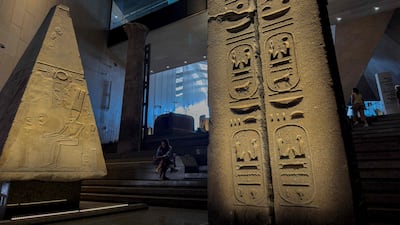

The air was cool, a welcome respite from the hot, dry desert air that lies just beyond the walls of the Grand Egyptian Museum, when it welcomed the first round of visitors to its newly inaugurated galleries on Wednesday.
As visitors made their way through the 12 galleries, the sound of multiple languages filled the air – a gentle hum of conversation in Spanish, French, German, Chinese, and Japanese, echoed against the museum’s marble floors and high ceilings.
Tour guides, leading groups of tourists through the exhibits, explain the history and significance of the artefacts. The newly opened galleries, which span nearly 19,000 square metres, are home to thousands of artefacts, each one meticulously curated and displayed to showcase the rich history and culture of ancient Egypt.
Austrian tourist
The scale and variety of the collection is breathtaking, with towering stone statues and intricate carvings that seem to stretch forever.
“My mum and I love Egyptian history and we have been coming since I was a child,” says Lilie, a 28-year-old Austrian tourist who was at the museum opening. “This is by far the best museum we have seen on all our visits. It almost doesn’t feel like Egypt.”
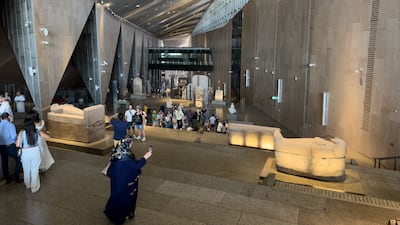
To reach the galleries, visitors must first ascend the Grand Staircase, a majestic structure that is a work of art in itself. The staircase is lined with hundreds of pieces, including statues and coffins, dating from different periods of Egypt’s diverse history.
-
The Grand Egyptian Museum in Giza, during a trial partial opening on October 15. EPA -
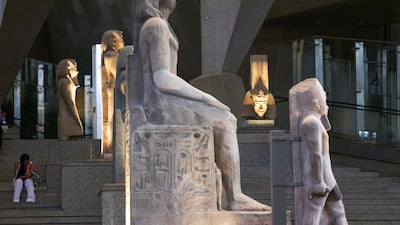
A tourist sits beside pharaonic statues. Reuters -
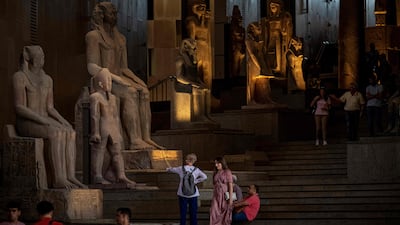
The Grand Staircase is lined with hundreds of pieces, including statues, coffins and reliefs. AFP -
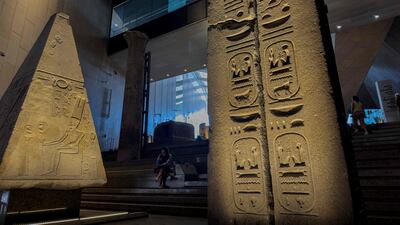
More statues along the Grand Staircase of the museum. AFP -
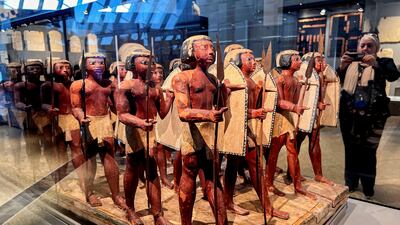
The galleries are divided into four rows, each one covering a different historical period. Reuters -
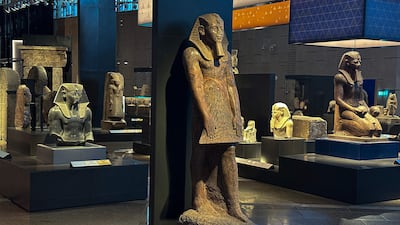
The grand opening of the museum, which has been delayed several times, is still pending an official announcement. AFP -
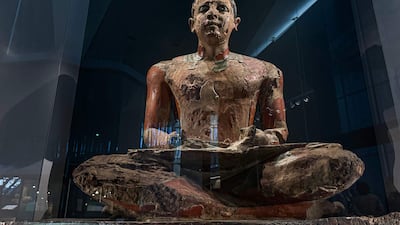
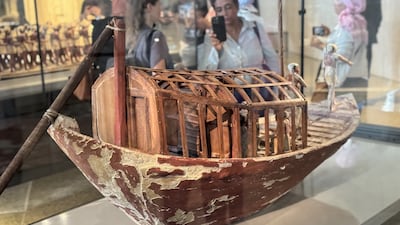
Two halls remain closed, one dedicate to the collection of King Tut, and another with two ships, believed to have belonged to King Khufu. AFP -
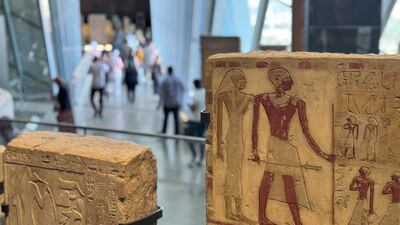
Egypt has invested $1 billion in the project. EPA -
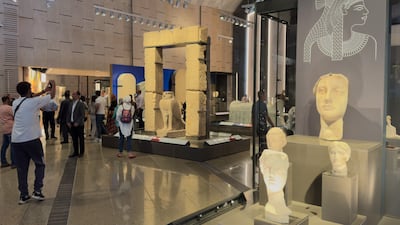
Tickets are 200 Egyptian pounds for Egyptians and 1,000 pounds for foreigners. EPA -
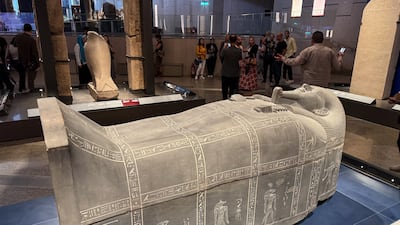
Notable pieces include a colossal statue of the god Ptah statues of the cat-headed Sekhmet, the goddess of war. EPA -
Visitors can see stone tools and grinding stones from the Neolithic and Paleolithic periods. EPA -
There is also a collection from the Green Sahara period, when the desert was reportedly covered in lush vegetation. EPA


The galleries are divided into four rows, each one covering a different historical period. The first row houses artefacts from the earliest periods of Egyptian history, dating back to 700,000 BCE.
Visitors can see stone tools and grinding stones from the Neolithic and Paleolithic periods, as well as a stunning collection of artefacts from the Green Sahara, a period when the desert was reportedly covered in lush vegetation.
The second row of galleries takes visitors on a journey through the Middle Kingdom, with artefacts dating from 2034 to 1550 BCE. Here, visitors can see daggers from the Middle Kingdom, as well as a tablet recounting the wars waged by King Kamose against the Hyksos, Asiatic people who ruled Egypt for a century before being driven out.
The third row of galleries is dedicated to the New Kingdom, with artefacts dating from 1550 to 1070 BCE. This period saw the rise of some of Egypt's most famous pharaohs, including Hatshepsut and Ramses II.
Some of the more notable pieces from this era on display include a colossal statue of the god Ptah, unearthed in Memphis, and multiple statues of the cat-headed Sekhmet, the goddess of war.
The fourth and final row of galleries is where artefacts from the Greco-Roman period can be found. This portion houses pieces dating to between 332 BCE to 395 CE. Here, a Roman Palmyrene bust can be observed in addition to a number of statues. The style is instantly distinguished from the more Egyptian pieces on display.
According to Dr Eissa Zidan, the director of Restoration and Transfer of Antiquities at the Grand Egyptian Museum and one of the galleries’ curators, the new exhibits are a major milestone in the museum's development.
"We wanted to give people another part of the museum to enjoy while they wait for the grand opening," he said. "These halls will remain open until the grand opening of the whole museum. We are still waiting on the political leadership to give us the OK," he told The National.
The museum's grand opening, which has been delayed several times, is still pending an official announcement from the Egyptian government.
Two halls remain closed to visitors, one will house the complete collection of Egypt’s most celebrated pharaoh, King Tut, and another will showcase two massive ships, believed to have belonged to King Khufu, the pharaoh who built the Great Pyramid.
“It is not the most opportune time to hold a grand opening. As we all know there are multiple wars going on that continue to be deeply concerning for everyone. Holding a grand opening for a project of this magnitude would necessitate a large celebration, and the present time isn’t appropriate for that,” Dr Zidan said.
However, despite another delay in the much-anticipated opening of the museum, Dr. Zidan is confident that the new galleries will be a major draw for visitors, both from Egypt and around the world.
"The response from visitors after the first day of visits was opened on Wednesday has far exceeded our expectations," he said. "People can't believe their eyes. The first visitor to enter the new galleries when we opened them on Wednesday was a German tourist who I spoke to, and he was astounded by the quality of the experience offered compared to other museums that visitors have come to be more familiar with."
The display cases, which were imported from outside Egypt, in addition to the climate control system, are two particular points of pride for the curator. "The one comment I have received repeatedly is praise for the display cases," Dr Zidan said.
A meticulous climate control system was also essential for the preservation of the pieces on display, some of which are among the country’s most valued possessions. The system implements different temperature, humidity and light parameters for each display based on the type of artefacts it houses.
"We have to tailor the conditions to the specific needs of each artefact," Mr Zidan said. “Each has its own specific requirements for temperature, humidity, and light levels, and our system is designed to meet those needs. It's all about creating a stable and controlled environment that will help preserve these priceless artefacts for generations to come."
Perhaps the biggest attest to pharaonic Egypt is the museum’s size and opulence, a testament to the $1 billion investment that has gone into creating this world-class institution.
It is a behemoth of a building that rivals the Great Pyramid – which is visible just across a small expanse of desert from the GEM’s windows – at least in terms of sheer scale.

