History professor Mostafa Hamarneh, a member of the Jordanian Senate, and former confidant of the late King Hussein, at his home south of Amman. Khaled Yacoub Oweis / The National

Former confidant of Jordan’s King Hussein calls for non-violent end to Israel-Gaza war


Khaled Yacoub Oweis
  • English
  • Arabic

Live updates: Follow the latest on Israel-Gaza

Arabs and Jews and all those who believe in coexistence must start working together to create a “paradigm shift" that alters a balance of power needed to end the Israel-Palestine conflict, Jordan senator Mustafa Hamarneh said.

The only way to save the region from the current “mess” is a bottom-up effort to amend the support Israel still has in western countries, Dr Hamarneh, a senior social sciences researcher and confidant of King Hussein, said in an interview at his villa near Amman on Thursday. A victory for the Democrats in the US presidential elections in November "would help build alliances in support of the Palestinians", he said.

Global public opinion has changed since that start of the Israel-Gaza war and a “re-evaluation of the Zionist narrative” in the United States, especially among US Jews, could help end the conflict peacefully, he said.

Dr Hamarneh is one of very few Jordanians still advocating engagement with Israelis. But the history professor is also a realist, cautioning that such non-violent coalition could take decades to become politically effective. While some Arab leftists and Israeli marxists "played with these ideas in the 1970s and 1980s", they remained non-starters, he said.

"The only people who are ready for this today are the Palestinians," Dr Hamarneh said. "And because of who they are and what they've been going through, they can lead this process."

When Dr Hamarneh helped King Hussein prepare for Jordan’s participation in the 1991 Madrid Conference, it was difficult to imagine that Israel's leadership could turn more right wing. The first Palestinian uprising was continuing as the meeting for a Middle East settlement convened in the Spanish capital. Israel’s prime minister, the Likud leader Yitzhak Shamir, participated because of pressure by US President George H.W Bush.

Washington wanted long-term stability in the region after a US-led coalition expelled Saddam Hussein’s forces from Kuwait in the Gulf War.

In 1992, Labour leader Yitzhak Rabin replaced Mr Shamir as prime minister. The two men had a long military and political career, but Mr Rabin grew more receptive to peace. He concluded the interim 1993 Oslo Accords with Yasser Arafat, and a peace treaty with Jordan a year later. Both agreements were a result of the Madrid process, although Oslo was negotiated in secret.

“Israel did produce peacemakers back then", compared to the current government, led by Prime Minister Benjamin Netanyahu, of "only murderers and killers", pursuing the Gaza war, Dr Hamarneh said.

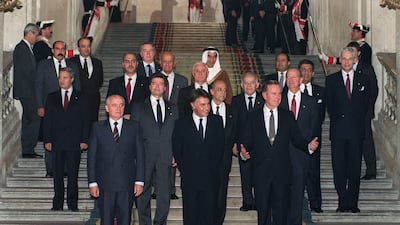
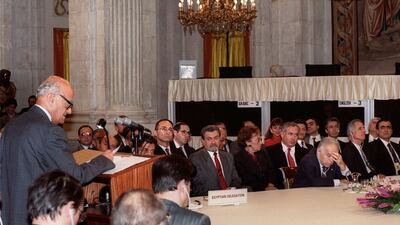
  • Heads of states and heads of delegations at the Middle East Peace Conference in Madrid on October 30, 1991. Pictured front row from left to right: Soviet President Mikhail Gorbachev, Spanish Prime Minister Felipe Gonzalez and US President George Bush. Second row from left to right: Syrian Foreign Minister Faruq Al Sharra, Lebanese Foreign Minister Faris Bouez, his Soviet counterpart Boris Dmitriyevich Pankin, Israeli Premier Itzhak Shamir, US State Secretary James Baker and his Egyptian counterpart Amr Moussa. AFP
    Heads of states and heads of delegations at the Middle East Peace Conference in Madrid on October 30, 1991. Pictured front row from left to right: Soviet President Mikhail Gorbachev, Spanish Prime Minister Felipe Gonzalez and US President George Bush. Second row from left to right: Syrian Foreign Minister Faruq Al Sharra, Lebanese Foreign Minister Faris Bouez, his Soviet counterpart Boris Dmitriyevich Pankin, Israeli Premier Itzhak Shamir, US State Secretary James Baker and his Egyptian counterpart Amr Moussa. AFP
  • Gorbachev delivers a speech. EPA
    Gorbachev delivers a speech. EPA
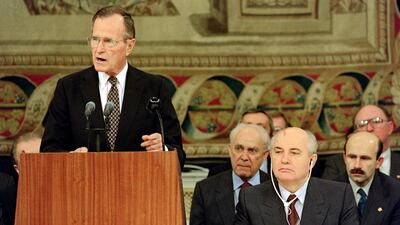
  • Bush addresses delegations as Gorbachev listens. AFP
    Bush addresses delegations as Gorbachev listens. AFP
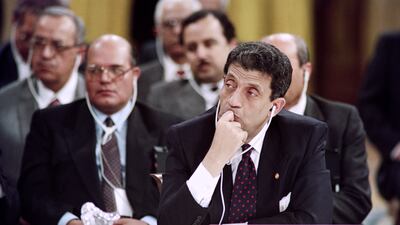
  • Former Egyptian Minister of Foreign Affairs Amr Moussa. AFP
    Former Egyptian Minister of Foreign Affairs Amr Moussa. AFP
  • Former Spanish president Felipe Gonzalez delivers the inaugural speech. AFP
    Former Spanish president Felipe Gonzalez delivers the inaugural speech. AFP
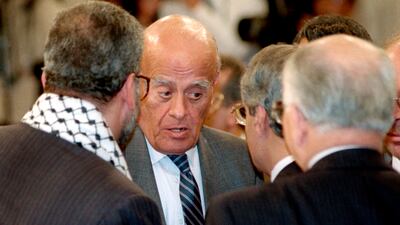
  • Head of medical services in the Gaza Strip from 1957 to 1960, Dr Haidar Abdel Shafi, addresses delegates. AFP
    Head of medical services in the Gaza Strip from 1957 to 1960, Dr Haidar Abdel Shafi, addresses delegates. AFP
  • Former Palestinian negotiator Haidar Abdel Shafi. EPA
    Former Palestinian negotiator Haidar Abdel Shafi. EPA
  • Former Syrian Foreign Minister Faruq Al Shara. AFP
    Former Syrian Foreign Minister Faruq Al Shara. AFP
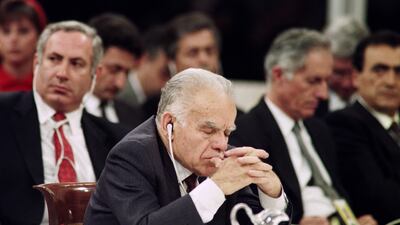
  • Former Israeli Prime Minister Yitzhak Shamir. AFP
    Former Israeli Prime Minister Yitzhak Shamir. AFP
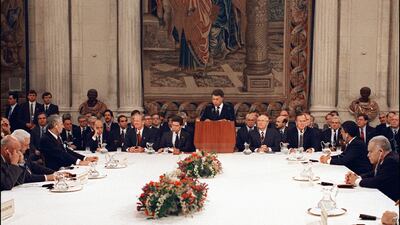
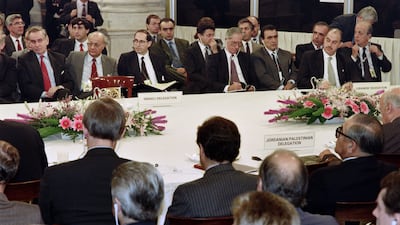
  • The Jordanian-Palestinian delegation (seen from back) faces the Israeli delegation. AFP
    The Jordanian-Palestinian delegation (seen from back) faces the Israeli delegation. AFP

Violence must stop

While the Boycott, Divestment, Sanctions (BDS) movement needs to be strengthened, as part of pressure on Israel to halt its use of violence, the Palestinian armed struggle would also need to stop to attract Israelis to the alliance, Dr Hamarneh said. After he advised King Hussein on the strategy for Madrid, Dr Hamarneh became head of the Centre of Strategic Studies at the University of Jordan, a position he held for 15 years.

After Mr Netanyahu formed his first government in the second half of the 1990s, most members of “the pro-peace camp in Jordan literally went underground", Dr Hamarneh said. "They could not defend their position vis-a-vis the Arab-Israeli conflict within the policies implemented by Netanyahu", who accelerated settlement expansion and land seizures.

Mr Netanyahu's ascendancy as the dominant political figure in Israel has tarnished the reputation of Israel as a whole, although the country is not monolithic, he said.

"If anybody today in Amman or Cairo invites Illan Pappe or Gideon Levy or Amira Hass, we'll be subjected to tremendous pressure and accusations of being zionists or imperialist lackeys," he said, referring to Mr Pappe, an Israeli historian whose 2006 book The Ethnic Cleansing of the Palestinians was translated to Arabic, and journalists Mr Levy and Ms Hass, who reported extensively on Palestinian plight.

“On the other hand, the Zionists used the bombings [by Hamas and other militant groups] as a further testament that the Arabs and the Palestinians don't want peace, but annihilation, which was not the case,” Dr Hamarneh said, cautioning that members of the traditional Left in Israel had also become wary of peace after the October 7 attack by Hamas on Israel, which killed 1,200 civilians.

The death toll from the Israeli invasion of Gaza stands at 42,000, according to health officials in the Hamas-ruled territory.

Dr Hamarneh, who has degrees in economics and history, and has taught in Washington, spoke in a straightforward voice. Opinion polls and data collection he conducted over 15 years at the Centre of Strategic Studies have become a rare independent barometer of conditions in the country.

In 2000, permanent status talks stipulated by the Oslo deal failed, following an impasse after deadlock between Yasser Arafat and Ehud Barack, then the Israeli prime minister. The second Palestinian uprising erupted in the same year and no progress has been made since.

“We need to move forward now, and all those people who share the same values of living in peace together need to form alliances to implement this vision,” Dr Hamarneh said. "Ultimately we will definitely be on the right side of history. Our message is a human, nonviolent and not rooted in any bigoted ideologies."


Politics in the West
The specs: 2018 Jeep Grand Cherokee Trackhawk


Price, base: Dh399,999
Engine: Supercharged 6.2-litre V8
Gearbox: Eight-speed automatic
Power: 707hp @ 6,000rpm
Torque: 875Nm @ 4,800rpm
Fuel economy, combined: 16.8L / 100km (estimate)

GAC GS8 Specs

Engine: 2.0-litre 4cyl turbo

Power: 248hp at 5,200rpm

Torque: 400Nm at 1,750-4,000rpm

Transmission: 8-speed auto

Fuel consumption: 9.1L/100km

On sale: Now

Price: From Dh149,900

Milestones on the road to union

1970

October 26: Bahrain withdraws from a proposal to create a federation of nine with the seven Trucial States and Qatar. 

December: Ahmed Al Suwaidi visits New York to discuss potential UN membership.

1971

March 1:  Alex Douglas Hume, Conservative foreign secretary confirms that Britain will leave the Gulf and “strongly supports” the creation of a Union of Arab Emirates.

July 12: Historic meeting at which Sheikh Zayed and Sheikh Rashid make a binding agreement to create what will become the UAE.

July 18: It is announced that the UAE will be formed from six emirates, with a proposed constitution signed. RAK is not yet part of the agreement.

August 6:  The fifth anniversary of Sheikh Zayed becoming Ruler of Abu Dhabi, with official celebrations deferred until later in the year.

August 15: Bahrain becomes independent.

September 3: Qatar becomes independent.

November 23-25: Meeting with Sheikh Zayed and Sheikh Rashid and senior British officials to fix December 2 as date of creation of the UAE.

November 29:  At 5.30pm Iranian forces seize the Greater and Lesser Tunbs by force.

November 30: Despite  a power sharing agreement, Tehran takes full control of Abu Musa. 

November 31: UK officials visit all six participating Emirates to formally end the Trucial States treaties

December 2: 11am, Dubai. New Supreme Council formally elects Sheikh Zayed as President. Treaty of Friendship signed with the UK. 11.30am. Flag raising ceremony at Union House and Al Manhal Palace in Abu Dhabi witnessed by Sheikh Khalifa, then Crown Prince of Abu Dhabi.

December 6: Arab League formally admits the UAE. The first British Ambassador presents his credentials to Sheikh Zayed.

December 9: UAE joins the United Nations.

MATCH INFO

France 3
Umtiti (8'), Griezmann (29' pen), Dembele (63')

Italy 1
Bonucci (36')

What is graphene?

Graphene is a single layer of carbon atoms arranged like honeycomb.

It was discovered in 2004, when Russian-born Manchester scientists Andrei Geim and Kostya Novoselov were "playing about" with sticky tape and graphite - the material used as "lead" in pencils.

Placing the tape on the graphite and peeling it, they managed to rip off thin flakes of carbon. In the beginning they got flakes consisting of many layers of graphene. But as they repeated the process many times, the flakes got thinner.

By separating the graphite fragments repeatedly, they managed to create flakes that were just one atom thick. Their experiment had led to graphene being isolated for the very first time.

At the time, many believed it was impossible for such thin crystalline materials to be stable. But examined under a microscope, the material remained stable, and when tested was found to have incredible properties.

It is many times times stronger than steel, yet incredibly lightweight and flexible. It is electrically and thermally conductive but also transparent. The world's first 2D material, it is one million times thinner than the diameter of a single human hair.

But the 'sticky tape' method would not work on an industrial scale. Since then, scientists have been working on manufacturing graphene, to make use of its incredible properties.

In 2010, Geim and Novoselov were awarded the Nobel Prize for Physics. Their discovery meant physicists could study a new class of two-dimensional materials with unique properties. 


Our legal consultant

Name: Hassan Mohsen Elhais

Position: legal consultant with Al Rowaad Advocates and Legal Consultants.

WITHIN%20SAND
%3Cp%3EDirector%3A%20Moe%20Alatawi%3C%2Fp%3E%0A%3Cp%3EStarring%3A%20Ra%E2%80%99ed%20Alshammari%2C%20Adwa%20Fahd%2C%20Muhand%20Alsaleh%3C%2Fp%3E%0A%3Cp%3ERating%3A%203%2F5%3C%2Fp%3E%0A
COMPANY%20PROFILE
%3Cp%3E%3Cstrong%3EName%3A%3C%2Fstrong%3E%20Floward%0D%3Cbr%3E%3Cstrong%3EBased%3A%20%3C%2Fstrong%3ERiyadh%2C%20Saudi%20Arabia%0D%3Cbr%3E%3Cstrong%3EFounders%3A%20%3C%2Fstrong%3EAbdulaziz%20Al%20Loughani%20and%20Mohamed%20Al%20Arifi%0D%3Cbr%3E%3Cstrong%3ESector%3A%20%3C%2Fstrong%3EE-commerce%0D%3Cbr%3E%3Cstrong%3ETotal%20funding%3A%20%3C%2Fstrong%3EAbout%20%24200%20million%0D%3Cbr%3E%3Cstrong%3EInvestors%3A%20%3C%2Fstrong%3EAljazira%20Capital%2C%20Rainwater%20Partners%2C%20STV%20and%20Impact46%0D%3Cbr%3E%3Cstrong%3ENumber%20of%20employees%3A%20%3C%2Fstrong%3E1%2C200%3C%2Fp%3E%0A
Updated: October 14, 2024, 11:18 AM