

Live updates: Follow the latest on Israel-Gaza
The standstill traffic between Sidon and Beirut convinced many people fleeing Israel's intensive air assault on Monday to pull over. For some, it was a rest from hours of driving in congestion. For others, it was an opportunity to assess and co-ordinate their next steps.
Where would they sleep that night? If the war continued, where would they live? What had become of the homes and belongings they had left behind?
“The house was bombed right after we left it,” said Hayat Al Hajj, an older woman from the southern Lebanese village of Ansar, which had been relatively untouched by Israel's bombardment until this week. "Right as we were leaving our house was destroyed right in front of us."
Ms Al Hajj's nephew, holding his phone up to indicate that he had just watched a video, interjected to tell her: "Ansar has been completely destroyed. Forget it. Not a single house left standing."
An extensive air campaign announced by Israel earlier that morning has so far killed at least 492 people, including 35 children and 58 women, and wounded 1,645. The toll is expected to rise.
-
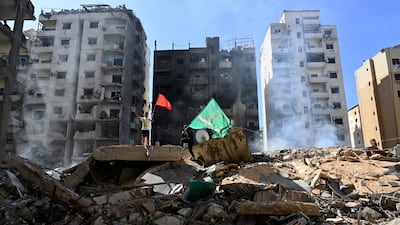
Damage in Beirut after an overnight Israeli strike. EPA -
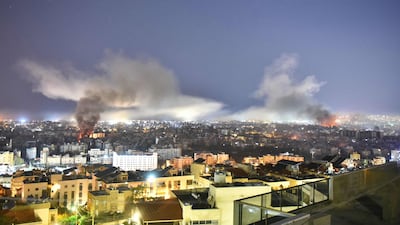
Smoke rises from the site of an Israeli strike in the south of Lebanon's capital. AFP -
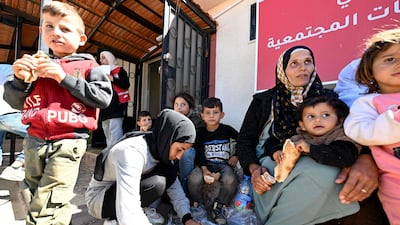
Displaced Syrians and Lebanese enter Syria from Lebanon at the Jusiyah border crossing. AFP -

The site of the Israeli air strike that killed Hezbollah leader Hassan Nasrallah, in Beirut. AP -
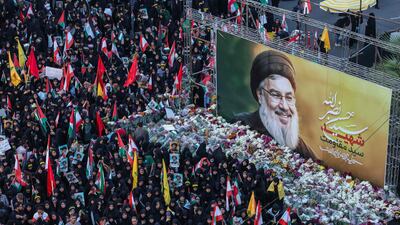
Iranians lay flowers before a portrait of Nasrallah. AFP -

Smoke billows over Tyre, southern Lebanon following an Israeli strike. Reuters -
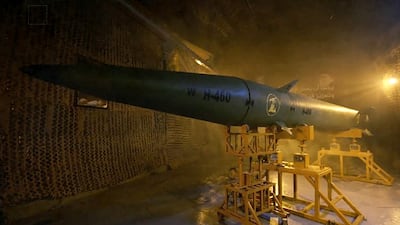
A Qader 1 ballistic missile from Hezbollah's arsenal. AFP -
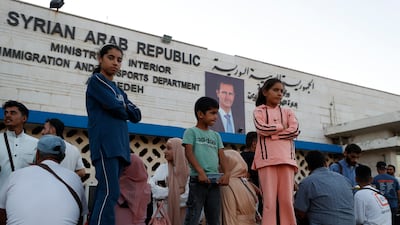
Syrians fleeing the war in Lebanon arrive at the Syrian-Lebanese border crossing in Jdeidet Yabous. AP -
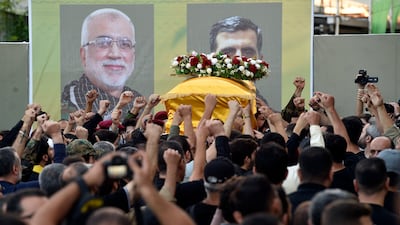
Hezbollah fighters carry the coffin of Hezbollah commander Ibrahim Qubaisi during his funeral in Beirut. EPA -
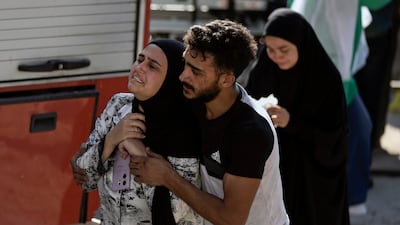
People react at the scene of an Israeli air strike in the town of Maisara, north of Beirut. AP -
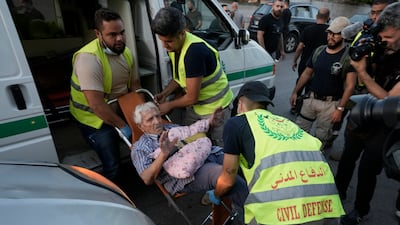
Civil defence workers carry an elderly man who fled from the south of Lebanon, as he arrives at a school turned into a displaced shelter in Beirut. AP -
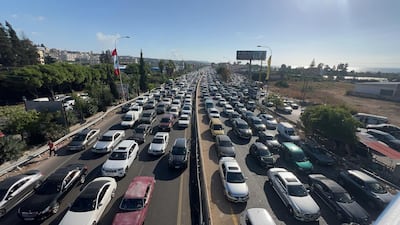
A traffic jam in Ghazieh as people fleeing from the south of Lebanon drive towards Sidon and Beirut. EPA -
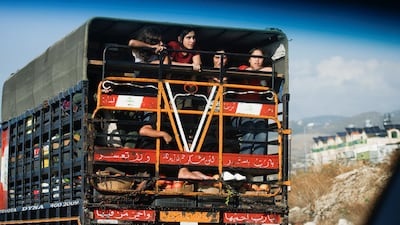
People in heavy traffic drive north from Lebanon's southern coastal city of Sidon, as they flee Israeli bombardment. Reuters -
Smoke billows over southern Lebanon following Israeli strikes, as seen from Tyre. Reuters -
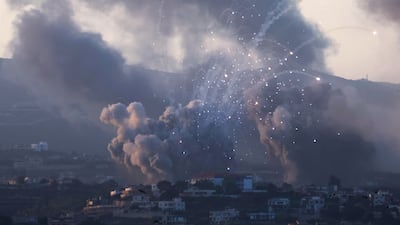
Smoke billows over southern Lebanon following Israeli strikes, as seen from Tyre. Reuters -
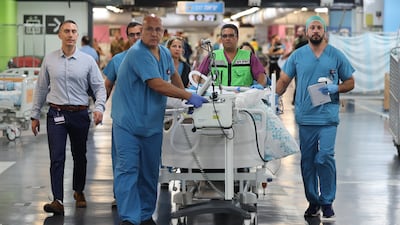
Medics move patients at Rambam Hospital's underground emergency centre, in Haifa, northern Israel. EPA -
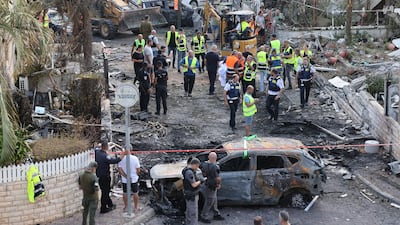
Israeli emergency teams work at the scene of a missile strike on a residential neighbourhood in Kiryat Bialik, northern Israel. EPA -
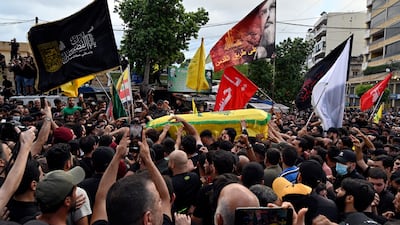
Hezbollah fighters carry the coffin of the group's senior commander Ibrahim Aqil, who was killed in an Israeli strike on September 20, in Beirut. EPA -
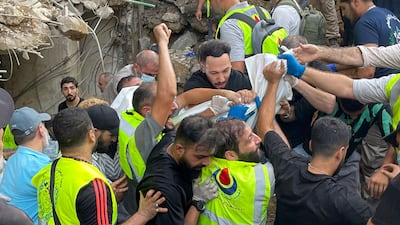
Rescuers carry a body at the scene of a missile strike in the southern suburbs of Beirut. AP


Ms Al Hajj and her family had been parked along the motorway heading north for at least six hours, she told The National. Like thousands of others, they were trying to co-ordinate a place to live with relatives and solidarity groups.
Fleeing families were packed into lorries and vans loaded with mattresses, clothing and belongings, racing to find refuge away from the south. A petrol station owner told The National that so many people had fled that his station had run out of fuel.
His employees distributed water bottles to stuck families. Rest stops and bakeries along the road were crowded with families stocking up on provisions.
Suddenly, the Hajj family set off: they had found a place in Bchamoun, in the mountains.
Ms Al Hajj's daughter Najat said they were lucky: “When you see how congested Saida is with people escaping, it really makes you wonder where they'll go."
By Monday afternoon, Lebanon's government had opened schools and other vocational institutes for displaced people with no other housing to take shelter.
Israel intensified its air campaigns on Lebanon after an unprecedented week of attacks on Hezbollah, including an Israeli air strike in Beirut that was aimed at a senior Hezbollah commander along with top members of the group, killing at least 70 people, including civilians.
Israeli military's spokesman Admiral Daniel Hagari ordered Lebanese civilians on Monday morning to stay away from Hezbollah-controlled areas or leave immediately, as the Israeli army would “engage in extensive, precise strikes against targets embedded widely throughout Lebanon”.
Lebanese telecoms company Ogero reported at least 80,000 suspected Israeli call attempts across the country, telling people to vacate their areas, sparking panic among civilians.
Later on Monday, Health Minister Firass Abiad said that “thousands of families from the targeted areas have been displaced”.
Fadwat, 35, is among them. She hurriedly left the southern town of Burj El Chemali with her toddlers in the early hours of the morning, grabbing what few belongings she could before piling into a car with her relatives. Hours later, she sat on the road trying to figure the situation out.
“We're used to this, it's been like this since the '70s,” she said. “But it's the children I'm worried about. They don't know what's happening around them. My job is to take care of them, and I don’t want them to experience this.”
Her son Ali, eight, pointed at Israeli jets as they released their distinctive trails in the sky. He was looking forward to school on Tuesday, but classes have now been suspended in most regions. Instead of accommodating pupils, classrooms will now house displaced families.

'Worst day'
Mohamed Ghamloush, a resident in the southern city of Sidon, further from the bombing, told The National that the situation in the city is “insane", with people from the south rushing to leave and roads blocked.
“Cars are going in every direction. I'm more afraid of accidents than of air raids,” he said. “It's completely insane.”
“It's a bit chaotic here,” Farah M, 34, a Palestinian Lebanese in Sidon, told The National. “We don't know where the next strike will hit. Some family members are moving to Beirut – others are coming here. And with children involved, it's hectic.
Mr Ghamloush decided to return to his village near the border to pick up his wife, who had stayed behind. “I have to go back. Everyone is telling me not to, but I can't leave her alone. She’s extremely scared.”
On his way, he told The National he saw many residents fleeing in cars, while others were walking on foot because they had no means of transport.
Co-ordination groups in the town of Jiyeh, in southern Lebanon, have begun opening schools and empty houses to host displaced people. WhatsApp groups have been set up in solidarity, where those willing to open their homes share their contact details en masse.
resident of southern Lebanon
Two estate agents based in Beirut said they were receiving constant calls from people fleeing the shelling and trying to find temporary accommodation in Beirut.
“Since yesterday and this morning, people are looking for a place in the safer areas of Beirut for one week to one year,” one of the agents from Beirut Living Real Estate said, adding that he had taken at least 60 calls that day.
But some were not able to leave. Wafa Raghda, 42, from Burj El Moulouk near the border with Israel told The National that she was stuck between two bombed areas and has no option but to stay. There is no safe shelter for her and her children, who usually take refuge in the bathroom during shelling.
“My children are extremely scared,” she told The National over the phone. “This is the worst it’s been since the war started. It's extremely dangerous. I'm right across from the plain that is being bombed and the house is shaking.”

