Tunisian coastguard officials intercept migrants at sea during their dangerous attempt to cross to Italy. Reuters

Tunisia intercepts more than 1,800 migrants aiming to sail to Europe


Ghaya Ben Mbarek
  • English
  • Arabic

Tunisia intercepted more than 1,800 migrants, thwarting 59 attempts to cross the Mediterranean Sea to Europe, on Saturday and Sunday.

There were 18 Tunisian citizens among those who tried to set out on the journey, the National Guard said on Monday.

Two bodies were recovered, while 24 smugglers, including organisers and mediators, were held.

Last week, authorities said security forces prevented more than 30,000 people from crossing to Europe through Tunisia's territorial waters in the first five months of 2024.

According to the Tunisian coastguard, 30,281 irregular migrants were intercepted at sea between January 1 and May 31, compared with 21,652 last year.

The coastguard also said it prevented the entry of 26,619 irregular through Tunisia's land borders in 2024, compared with 7,299 a year ago.

The North African country has signed agreements with the EU and countries such as Italy, which have agreed to help it strengthen Tunisia's capacity to curb the influx of migrants into Europe, in exchange for large sums of money, including much needed budget support packages.

Tunisian authorities have stepped efforts trying to control the large number of migrants moving through the country and attempting to reach Europe through its maritime borders.

  • A migrant woman learns how to sew at a centre run by the Organisation for the Support of Migrants in the southern Tunisian city of Medenine. It is a rare, locally driven opportunity for migrants to better themselves and integrate in a wider North Africa region that is often far from welcoming.
    A migrant woman learns how to sew at a centre run by the Organisation for the Support of Migrants in the southern Tunisian city of Medenine. It is a rare, locally driven opportunity for migrants to better themselves and integrate in a wider North Africa region that is often far from welcoming.
  • Women learn French at a centre run by the Organisation for the Support of Migrants, in the southern Tunisian city of Medenine.
    Women learn French at a centre run by the Organisation for the Support of Migrants, in the southern Tunisian city of Medenine.
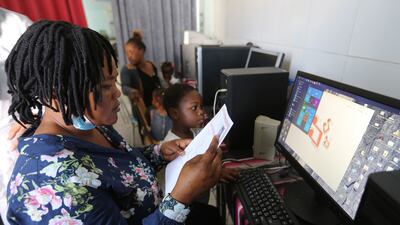
  • Migrant women learn how to use a computer at a centre run by the Organisation for the Support of Migrants, in the southern Tunisian city of Medenine. It is a rare, locally driven opportunity for migrants to better themselves and integrate in a wider North Africa region that is often far from welcoming.
    Migrant women learn how to use a computer at a centre run by the Organisation for the Support of Migrants, in the southern Tunisian city of Medenine. It is a rare, locally driven opportunity for migrants to better themselves and integrate in a wider North Africa region that is often far from welcoming.
  • A migrant woman learns how to use a computer at a centre run by the Organisation for the Support of Migrants, in the southern Tunisian city of Medenine.
    A migrant woman learns how to use a computer at a centre run by the Organisation for the Support of Migrants, in the southern Tunisian city of Medenine.
  • Migrants attend a class at a centre run by the Organisation for the Support of Migrants, in the southern Tunisian city of Medenine.
    Migrants attend a class at a centre run by the Organisation for the Support of Migrants, in the southern Tunisian city of Medenine.
  • Sub-Saharan migrant children learn French at a centre run by the Organisation for the Support of Migrants in southern Tunisia.
    Sub-Saharan migrant children learn French at a centre run by the Organisation for the Support of Migrants in southern Tunisia.
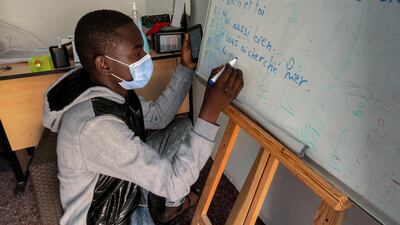
  • A migrant learns French at a centre run by the Organisation for the Support of Migrants, in the southern Tunisian city of Medenine.
    A migrant learns French at a centre run by the Organisation for the Support of Migrants, in the southern Tunisian city of Medenine.
  • A woman learns sewing at a centre run by the Organisation for the Support of Migrants, in the southern Tunisian city of Medenine. The charity is a rare, locally driven opportunity for migrants to better themselves and integrate in a wider North Africa region that is often far from welcoming.
    A woman learns sewing at a centre run by the Organisation for the Support of Migrants, in the southern Tunisian city of Medenine. The charity is a rare, locally driven opportunity for migrants to better themselves and integrate in a wider North Africa region that is often far from welcoming.
  • Migrants gather at a centre run by the Organisation for the Support of Migrants in the southern Tunisian city of Medenine.
    Migrants gather at a centre run by the Organisation for the Support of Migrants in the southern Tunisian city of Medenine.

In recent years, Tunisia has become a major transit point for migrants – most of whom are from sub-Saharan African countries – trying to reach Europe for better economic opportunities through the dangerous Mediterranean route.

Thousands die each year attempting to make the journey with the help of human traffickers who provide unsafe, and often small, boats in exchange for ever increasing amounts of money.

The UN's migration agency has described the Mediterranean crossing as “the deadliest route for migrants on record” estimating that at least 3,129 people died or disappeared trying to cross to Europe through it last year alone.

This is the highest death toll recorded in the Mediterranean since 2017, International Organisation for Migration said.


What are NFTs?

Are non-fungible tokens a currency, asset, or a licensing instrument? Arnab Das, global market strategist EMEA at Invesco, says they are mix of all of three.

You can buy, hold and use NFTs just like US dollars and Bitcoins. “They can appreciate in value and even produce cash flows.”

However, while money is fungible, NFTs are not. “One Bitcoin, dollar, euro or dirham is largely indistinguishable from the next. Nothing ties a dollar bill to a particular owner, for example. Nor does it tie you to to any goods, services or assets you bought with that currency. In contrast, NFTs confer specific ownership,” Mr Das says.

This makes NFTs closer to a piece of intellectual property such as a work of art or licence, as you can claim royalties or profit by exchanging it at a higher value later, Mr Das says. “They could provide a sustainable income stream.”

This income will depend on future demand and use, which makes NFTs difficult to value. “However, there is a credible use case for many forms of intellectual property, notably art, songs, videos,” Mr Das says.

The White Lotus: Season three

Creator: Mike White

Starring: Walton Goggins, Jason Isaacs, Natasha Rothwell

Rating: 4.5/5

Key facilities
  • Olympic-size swimming pool with a split bulkhead for multi-use configurations, including water polo and 50m/25m training lanes
  • Premier League-standard football pitch
  • 400m Olympic running track
  • NBA-spec basketball court with auditorium
  • 600-seat auditorium
  • Spaces for historical and cultural exploration
  • An elevated football field that doubles as a helipad
  • Specialist robotics and science laboratories
  • AR and VR-enabled learning centres
  • Disruption Lab and Research Centre for developing entrepreneurial skills
FIXTURES

Nov 04-05: v Western Australia XI, Perth
Nov 08-11: v Cricket Australia XI, Adelaide
Nov 15-18 v Cricket Australia XI, Townsville (d/n)
Nov 23-27: 1ST TEST v AUSTRALIA, Brisbane
Dec 02-06: 2ND TEST v AUSTRALIA, Adelaide (d/n)
Dec 09-10: v Cricket Australia XI, Perth
Dec 14-18: 3RD TEST v AUSTRALIA, Perth
Dec 26-30 4TH TEST v AUSTRALIA, Melbourne
Jan 04-08: 5TH TEST v AUSTRALIA, Sydney

Note: d/n = day/night

MATCH INFO

Uefa Champions League semi-final, first leg
Bayern Munich v Real Madrid

When: April 25, 10.45pm kick-off (UAE)
Where: Allianz Arena, Munich
Live: BeIN Sports HD
Second leg: May 1, Santiago Bernabeu, Madrid

Stree

Producer: Maddock Films, Jio Movies
Director: Amar Kaushik
Cast: Rajkummar Rao, Shraddha Kapoor, Pankaj Tripathi, Aparshakti Khurana, Abhishek Banerjee
Rating: 3.5

Dubai works towards better air quality by 2021

Dubai is on a mission to record good air quality for 90 per cent of the year – up from 86 per cent annually today – by 2021.

The municipality plans to have seven mobile air-monitoring stations by 2020 to capture more accurate data in hourly and daily trends of pollution.

These will be on the Palm Jumeirah, Al Qusais, Muhaisnah, Rashidiyah, Al Wasl, Al Quoz and Dubai Investment Park.

“It will allow real-time responding for emergency cases,” said Khaldoon Al Daraji, first environment safety officer at the municipality.

“We’re in a good position except for the cases that are out of our hands, such as sandstorms.

“Sandstorms are our main concern because the UAE is just a receiver.

“The hotspots are Iran, Saudi Arabia and southern Iraq, but we’re working hard with the region to reduce the cycle of sandstorm generation.”

Mr Al Daraji said monitoring as it stood covered 47 per cent of Dubai.

There are 12 fixed stations in the emirate, but Dubai also receives information from monitors belonging to other entities.

“There are 25 stations in total,” Mr Al Daraji said.

“We added new technology and equipment used for the first time for the detection of heavy metals.

“A hundred parameters can be detected but we want to expand it to make sure that the data captured can allow a baseline study in some areas to ensure they are well positioned.”

Updated: June 18, 2024, 11:22 AM