


Iranian Armed Forces chief Maj Gen Mohammad Bagheri has assigned a high-ranking delegation to investigate the helicopter crash in which President Ebrahim Raisi and other high-ranking officials were killed.
The delegation has been sent to the crash site and the results of the investigation will be announced when the mission is completed, Irna said later on Monday.
Iran will hold presidential elections on June 28, the state news agency said.
The date was decided in a meeting of senior officials led by interim president Mohammad Mokhber, who was First Vice President.
Foreign Minister Hossein Amirabdollahian, East Azerbaijan provincial governor Malik Rahmati and Mohammed Ali Ale Hashem, supreme leader Ayatollah Ali Khamenei's representative to East Azerbaijan, were also killed in the helicopter crash.
“Ayatollah Raisi, the beloved president of our country, was martyred in a helicopter crash in the Varzaghan region of East Azerbaijan and joined the supreme kingdom,” Irna said.
Mr Khamenei has declared five days of national mourning, confirming their deaths with "great sorrow and regret".
"The Iranian nation lost a sincere and valuable servant," he said in a statement.
Mehdi Mousavi, head of Mr Raisi's protection unit, pilots Taher Mostafavi and Mohsen Darynaosh, and several bodyguards were also killed in the crash, Irna reported.
The group was travelling from Azerbaijan to Iran’s city of Tabriz when their helicopter made a “hard landing” due to heavy fog, state media said on Sunday afternoon.
It said “no sign of life” was detected at the site of the crash in East Azerbaijan province, after more than 70 rescue teams spent the night scouring the mountainous terrain on foot.
Initial reports on the crash varied wildly, including claims that contact had been made with several people onboard the helicopter.
On Monday, Irna reported that Mr Ale Hashem survived for an hour after the crash and contacted Mr Raisi's chief of staff, Gholam Hossein Esmaili.
The bodies were removed from the crash site on Monday morning and taken to the city of Tabriz, the Red Crescent announced, with funeral arrangements set to be revealed by the government.
Experts say the death of Mr Raisi, widely seen as the successor to an ailing Mr Khamenei, 85, will disrupt the choice for the next supreme leader.
The hardliner, 63, took office in 2021 and hastened Iran's nuclear programme, in addition to presiding over the fierce government clampdown on anti-regime protests sparked by the death of Mahsa Amini in morality police custody in September 2022.
The government introduced tighter restrictions on public freedom after the protests.
-
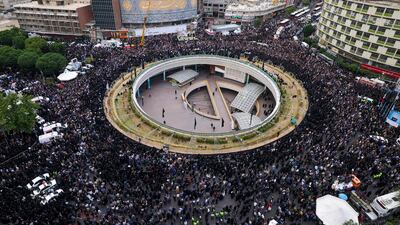
People gather at Valiasr Square in Tehran, following the death of Iranian president Ebrahim Raisi. AFP -
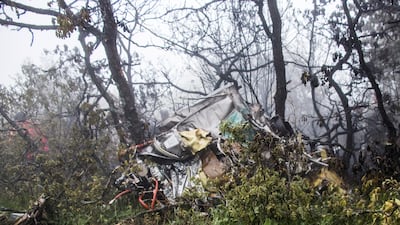
Wreckage from Mr Raisi's helicopter at the crash site on a mountain in Varzaghan area, north-western Iran. Reuters -
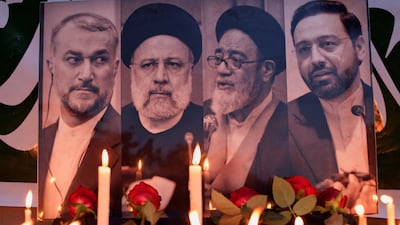
Candles lit to offer condolences over the deaths of Mr Raisi and other leading officials, outside the Iranian embassy, in Baghdad. Reuters -
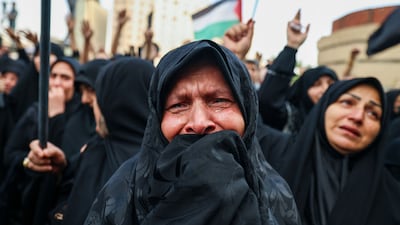
Women mourn the death of Mr Raisi at Valiasr Square in Tehran. AFP -
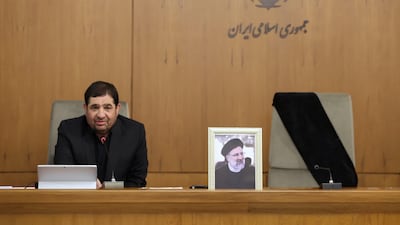
Iran's First Vice President Mohammad Mokhber, next to the empty seat of Mr Raisi, addresses the cabinet in Tehran. AFP -
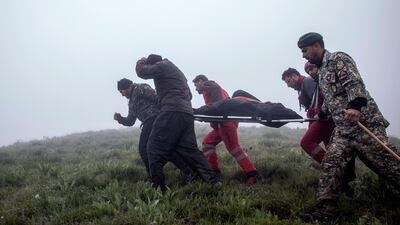
Rrescuers recover bodies at the crash site of in Varzaghan in north-western Iran. AFP -
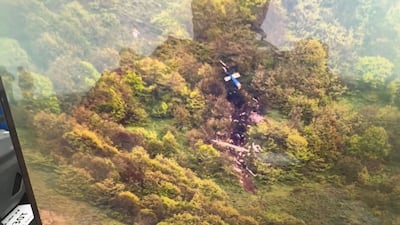
A screengrab shows the crash site of the helicopter that was carrying Iranian President Ebrahim Raisi, in East Azerbaijan province. AFP -
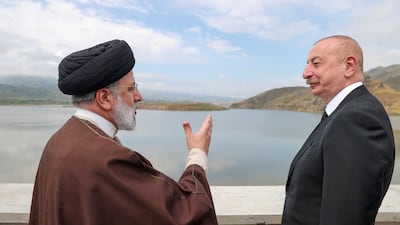
Iranian President Ebrahim Raisi and Azerbaijan's President Ilham Aliyev visit Qiz Qalasi dam on the Azerbaijan-Iran border on Sunday. Reuters -
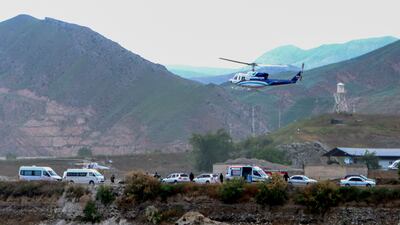
The helicopter thought to be carrying Mr Raisi takes off from the Iran-Azerbaijan border after the inauguration of the dam on the Aras river. AFP -
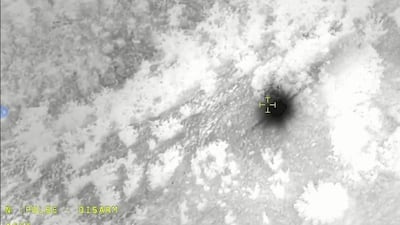
A screen grab shows the moment a drone locates the crash site using thermal imaging. Getty Images -
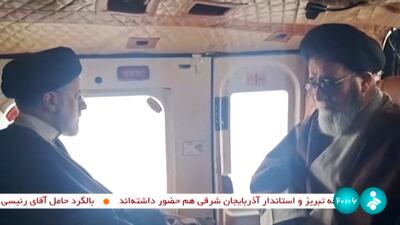
A screengrab provided by Iranian state television shows President Ebrahim Raisi, left, with a member of his delegation on-board a helicopter in Iran's East Azerbaijan province. AFP -
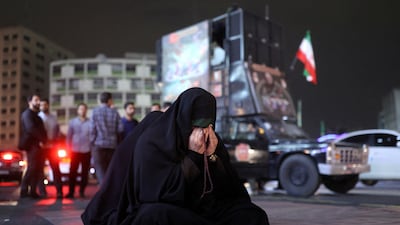
People pray for the well-being of Mr Raisi in Tehran after receiving news that his helicopter had crashed. Reuters -

People follow the news of the helicopter crash in a shop in Tehran. Reuters -

Iranian Shiite pilgrims pray for Mr Raisi at the Imam Ali shrine in Najaf, Iraq. Reuters -
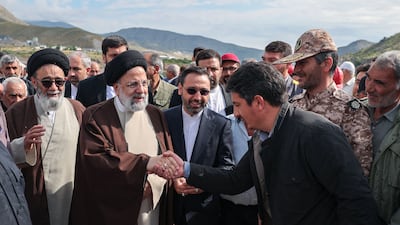
Mr Raisi was visiting Azerbaijan before he flew south as part of a convoy of three helicopters. AFP -
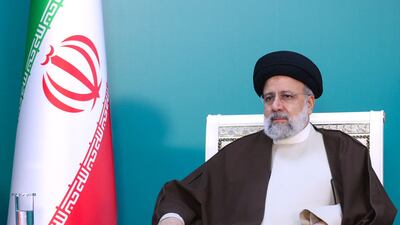
Mr Raisi during a meeting with Mr Aliyev before the inauguration ceremony of the Qiz Qalasi dam. AFP -
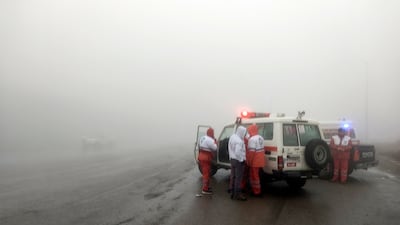
Officials said the helicopter carrying Mr Raisi was forced to make a 'hard landing, in Iran's East Azerbaijan province, sparking a massive rescue operation. AP -

Rescue vehicles in Varzaghan, East Azerbaijan Province. Reuters -
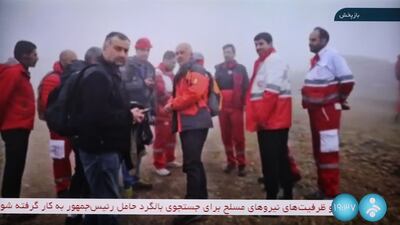
A screengrab from Iranian state television shows rescuers heading towards the site of the crash. AFP -
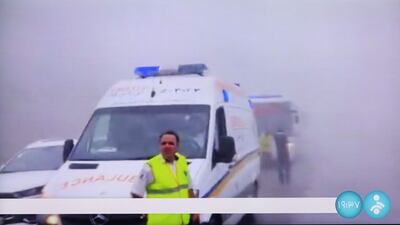
The forested area in East Azerbaijan province was covered in fog on Sunday. AFP -
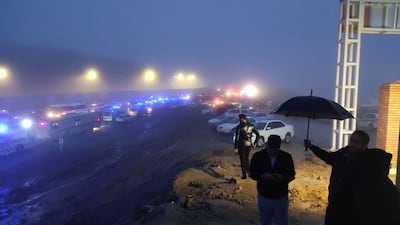
Heavy rain and fog has made rescue efforts more difficult. Reuters


Former foreign minister Mohammad Javad Zarif blamed the US for the crash, saying sanctions prevented Tehran from buying modern aircraft and parts.
Israeli officials denied involvement in the deaths, in statements to Reuters.
Mr Raisi served in Iran's judiciary, including as deputy prosecutor for Tehran, and was well known for his role in the execution of thousands of political prisoners in the 1980s, earning him the nickname “the Butcher of Tehran”.
The government said Mr Raisi “sacrificed his life” for Iran and “did nothing but serve the great people of Iran on the way to the advancement and progress of the country”.
State work will continue “without the slightest disruption”, it said.
Several foreign heads of state expressed their condolences, including Iraqi Prime Minister Mohammed Shia Al Sudani and Indian Prime Minister Narendra Modi.
Pakistan also declared a day of mourning, while Lebanon will observe three.
In 2019, Mr Raisi was placed under sanctions by the US “for his administrative oversight over the executions of individuals who were juveniles at the time of their crime, and the torture and other cruel, inhuman or degrading treatment or punishment of prisoners in Iran, including amputations”.
Executions of regime critics also soared under Mr Raisi's reign, with human rights organisations recently saying one person was being executed every five hours in Iran.
His death comes about three months after Iran's parliamentary elections, in which the 41 per cent turnout was the lowest since 1979.
Voters boycotted the election amid continuing opposition to a regime that has adopted tougher crackdowns on critics and failed to revive an ailing economy weakened by successive rounds of sanctions.
'Faithful servant'
The death of Mr Amirabdollahian, who had close ties with the Islamic Revolutionary Guard Corps and regional proxies, comes at a time when Iran-allied groups continue to fight Israel in response to its campaign in Gaza, and weeks after unprecedented tension between Israel and Iran led to direct attacks.
In an obituary published by Irna on Monday, former diplomat Fatullah Tavasoli said Mr Amirabdollahian “was one of the leading people in obeying the orders of the supreme leader” and working with regional proxies against Israel.
He had a “very intimate and close relationship” with Hezbollah chief Hassan Nasrallah, Mr Tavasoli said.
Iran's Strategic Council of Foreign Relations said the minister was a "faithful servant" and acted to counter "cruel" international sanctions against Tehran, which have increased in recent months over support for Yemen's Houthi rebels and a surge in executions of regime critics.
Deputy Foreign Minister Ali Bagheri Kani has been appointed as Mr Amirabdollahian's replacement.
All sporting domestic events have been cancelled for the next week while cinemas have been closed as public officials issue statements mourning the president and foreign minister.
While authorities across Iran announced the start of grieving ceremonies on Monday morning, many Iranians bereaved and exiled under Mr Raisi's rule and previous leaders welcomed his death.
On Sunday night, social media footage showed fireworks set off in several Iranian cities, including Ms Amini's hometown of Saqqez in the Kurdish west.
On social media, users in Iran and the diaspora made light of the deaths while government authorities warned social media accounts were under surveillance over suspected public incitement.
In a post on X, activist Masih Alinejad said the people of Iran had the right to “rejoice”.
Mr Raisi's death “represents a monumental and irreparable strategic blow to supreme leader Ali Khamenei and the entire regime, notorious for its executions and massacres”, said Maryam Rajavi, president of the National Council of Resistance of Iran, which includes the Mojahedin e-Khalq organisation.
Hamed Esmaeilion, whose wife and daughter were killed when Ukrainian Airlines Flight 752 was shot down by the IRGC, said Mr Raisi deserved to be brought to justice.
“His victims have been robbed of the opportunity to bring this criminal to justice, but his name shall be etched in history in the dark shroud of criminality,” he wrote on X.

