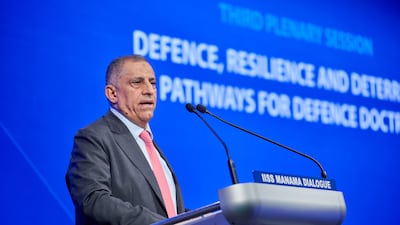

Baghdad is committed to protecting the security of Gulf states and remaining neutral should the war between the US and Iran resume, Iraq's national security adviser has told The National.
Qasim Al Abudi stressed that there was broad national consensus in Iraq that the country must not intervene or become part of the conflict.
Tehran-backed armed factions in Iraq have launched drone and missile attacks against Kuwait, Saudi Arabia, Bahrain and the UAE after the Middle East war started in February with US and Israeli strikes against Iran.
“Iraq is committed to the security of its neighbours, and we will do everything possible to prevent any threat to them originating from Iraqi territory,” Mr Al Abudi told The National on the sidelines of the annual IISS Manama Dialogue security forum in Bahrain.
“The government's position is clear, and there is national consensus that we remain detached and neutral.”
Mr Al Abudi added that while there might be sympathy for one side or another, the government must ensure those sentiments do not translate into action.
“We are always concerned about any war. It is the worst possible way to resolve problems, and it undoubtedly has serious repercussions for everyone," he said.
“We have now seen that the impact of the war has not been limited to the region; it has affected the entire world. Iraq, in particular, has been hit hard. For months, we were unable to export our oil, and the economic situation was extremely difficult.
“As for the possibility of some parties becoming involved, there may naturally be sympathies here and there. But it is the government's responsibility to ensure that such sympathies do not translate into action.”

An interim agreement reached in June failed to secure a lasting ceasefire in the Iran war or restore normal shipping through the Strait of Hormuz. Iran has since proposed that Washington lift its blockade of Iranian ports in exchange for Tehran reopening the waterway within seven days.
Qatari mediators returned to Tehran on Friday in a renewed effort to broker a deal, but the sides are still divided over whether nuclear negotiations or relief from the blockade and oil sanctions should come first.
On efforts to bring weapons held by armed factions under state control, Mr Al Abudi said Iraq was on the right track and had made significant progress in a short period of time.
“The issue had been raised, discussed and eventually shaped into a clear national framework within just a few months,” he said.
Iraqi Foreign Minister Fuad Hussein said this month his country was confident it would meet a June 30, 2027, deadline to bring weapons held by armed groups under state control, despite resistance from some powerful Iran-aligned groups.
The government had initially set September 30 as the deadline, coinciding with the end of the US-led coalition's military mission in Iraq. The deadline was later extended to June 2027.
Relations with Kuwait
Mr Al Abudi said Baghdad was keen to resolve outstanding differences with Kuwait. This includes disputes over the maritime boundary and the Khor Abdullah waterway, as well as the long-running issue of Kuwaitis missing since Iraq’s 1990 invasion and Kuwaiti property taken during that period.
The two countries have made renewed efforts to address the disputes, agreeing in September to establish a joint working group to review issues and propose a way forward.
Mr Al Abudi said he had personally visited Kuwait twice and that several Iraqi delegations had held talks with Kuwaiti officials. He described disagreements between neighbouring nations as normal, but stressed that they should not overshadow the countries’ long-standing ties.
“The relations and ties between the two countries are much greater than that,” he said, pointing to the close family connections between Iraqis and Kuwaitis.
He urged Kuwait to deepen economic co-operation and investment in Iraq, saying this could help strengthen bilateral relations and ease sensitivities.
He said Iraqi Prime Minister Al Al Zaidi intends to visit Kuwait in the near future. “I hope our Kuwaiti brothers will make use of this visit to strengthen their relations with Iraq,” he added.
ISIS threat 'under control'
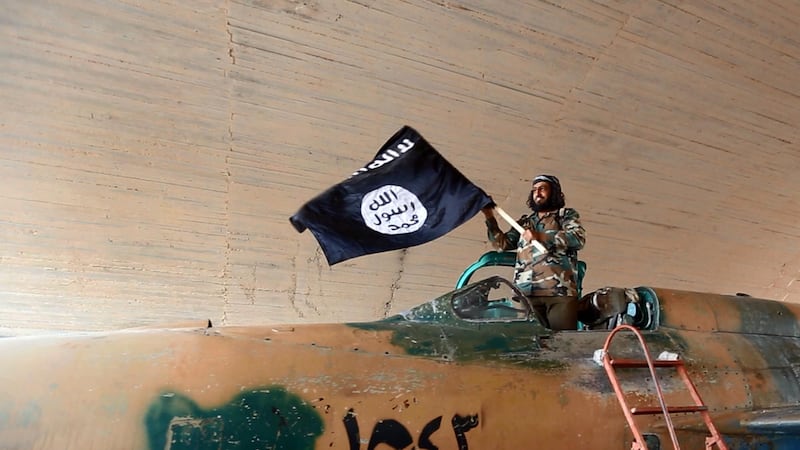
Iraq has largely defeated ISIS, but small groups continue to operate in remote areas, Mr Al Abudi said, describing the remaining threat as limited and the security situation as under control.
ISIS lost its territorial stronghold in Iraq in 2017, but remnants of the group continue to carry out sporadic attacks. Recent monitoring has documented a continued, though reduced, operational presence, rather than a return to the large-scale insurgency the group once waged. At least one federal officer was killed earlier this month when ISIS attacked an Iraqi police site near Kirkuk.
“Frankly, we have confronted ISIS in Iraq and largely defeated it,” said Mr Al Abudi. “That does not rule out the possibility of small groups operating in remote areas, but the situation is entirely under control.”
He said Iraq continued to co-operate with regional and international partners through the Global Coalition to Defeat ISIS, including on the sharing of intelligence. Mr Al Abudi had attended a coalition meeting in Rome, where participating countries renewed their commitment to co-operation against ISIS and other terrorist groups. The meeting was held on October 1 and brought together senior officials from coalition countries.
“An important aspect of tackling ISIS, one that is more important than intelligence and the military and security dimensions, is the ideological dimension,” said Mr Al Abudi. “We need to dry up the ideological sources that feed these groups.”
He identified religious schools, curriculums, academies and institutions as areas that needed attention, saying that addressing these issues would require sustained efforts by countries across the region.

