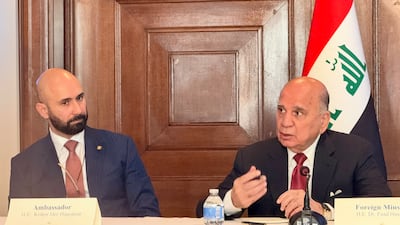

Iraq is confident it will meet a June 30, 2027 deadline to bring weapons held by armed groups under state control, Foreign Minister Fuad Hussein said on Thursday, despite resistance from some powerful Iran-aligned groups.
Mr Hussein told reporters at the Iraqi embassy in Washington, one day after the US withdrew its last troops from Iraq, that his government had a clear plan to disarm and integrate the country's armed factions into the Iraqi security forces.
“We have got the target, we have got the means, we have got the timetable, and we are clear in our plan,” he said.
“The deadline is there,” he said, rejecting a suggestion that disarmament could become an open-ended political process.
In response to a question from The National, Mr Hussein said: “We must reach the target, and that doesn't mean it will stay as an open end. … We hope that we will reach an agreement, and this problem will be solved.”
The Iraqi government had initially linked the deadline for bringing weapons under state control to September 30, the date of the US withdrawal. But the deadline was pushed back to June next year.
Earlier on Thursday, the powerful Iran-backed Kataib Hezbollah group denied that it had reached an understanding with Iraq's Prime Minister, Ali Al Zaidi, on the disarmament of militias.

Speaking alongside Krikor Der-Hagopian, the new Iraqi ambassador to Washington, Mr Hussein said the government had been negotiating with seven armed groups and that several had already expressed support for the disarmament plan. Some factions had also begun handing weapons to the security forces, he added.
The government intends to integrate the factions into the Iraqi armed forces, putting them “under the umbrella of the Iraqi government”, Mr Hussein said.
He acknowledged that external forces had sought to influence the process, but insisted that the decision was ultimately an Iraqi one.
“I don't deny that there has been pressure on the Iraqi government, but also influence from other side on these groups or on the Iraqi government to change the path,” he said. “But the Iraqi government is committed to what we have promised.”
The issue of Iran-aligned militants operating from Iraqi soil took on renewed urgency after last month's attack on a Saudi oil pipeline, which Baghdad said originated from inside Iraq.
Mr Hussein said an investigation was under way. He said the attack had been launched just 13km from the Iranian border.
“It is true the attack happened from the Iraqi territory, but it was very close to the Iranian border,” he said. “That's why we started to investigate, and we asked also the Iranians to give us more information. We are in good contact with the Saudi side.”
He added that Iraqi officials were planning another visit to Riyadh again to discuss the issue.
Baghdad also wants to reassure Gulf states that armed groups operating inside Iraq will no longer be able to strike neighbouring countries.
“Not a single group will be allowed to take the decisions in their hands and attack other countries,” Mr Hussein said. “When they will be integrated in the Iraqi armed forces, that means they will be under the umbrella of the Iraqi government.”
Mr Hussein said Iraq wanted to restore strong relations with Gulf states, acknowledging that ties had been harmed by attacks launched from Iraqi territory.
“We want to have good relationship[s] with Gulf countries. We had an excellent, excellent relationship before the war with the Gulf countries,” he said. “I know it has been damaged because of these attacks, but once again we were able to repair it, and now once again we are in good terms with the Gulf countries.”
US-Iraq ties
Mr Hussein's remarks come as Iraq begins a new phase in its security relationship with the US after the formal end of the 12-year mission to defeat ISIS.
He said Baghdad wants to develop a bilateral security relationship with the US, including discussions on areas such as sharing intelligence, training and military sales.
“The process can start. The process can start with the United States. I'm going to raise these questions today and tomorrow,” he said.
Mr Hussein also said Iraq's own forces are now capable of dealing with any remaining ISIS threat.
“I think, as for the Iraqi forces nowadays … we can face ISIS ourselves,” he said.
But he said ISIS threats coming from outside Iraq could be a different matter. He said Baghdad remained concerned about ISIS fighters operating in Syria and the possibility that they could cross into Iraq. Mr Hussein estimated there could be hundreds or even thousands of ISIS fighters in Syria.
“ISIS at the end is not only a military force. ISIS is an ideological force,” he said, warning that even small movements by the group needed to be taken seriously.

He also stressed that Baghdad remained responsible for protecting Iraq's Kurdish region, saying the federal government would help to equip the Kurdish Peshmerga forces.
Mr Hussein said Iraqi and Kurdish forces were holding intense meetings to prevent security gaps in disputed areas, particularly after a recent ISIS attack there.
He warned that any vacuum could be exploited by the Islamist extremists.

