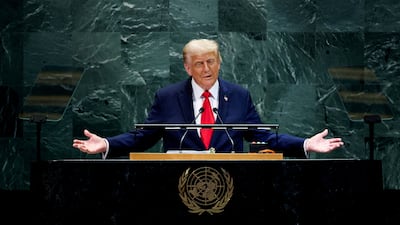
US President Donald Trump’s meeting with Gulf officials in New York this week will include Iraq and Jordan, amid intensifying high-stakes US-Arab diplomacy.
The talks, during the UN General Assembly’s high-level week, are expected to cover several issues, with a particular focus on Iran and its proxies in the region, as well as the future of its conflict with the US.
In addition to officials from Gulf countries, Iraq and Jordan, Egypt is likely to be included.

On Sunday, diplomacy was in full swing ahead of the UNGA high-level debate, with meetings, panel discussions and interviews marking the final hours before the debate officially opens on Tuesday with an address by Brazilian President Luiz Inacio Lula da Silva.
US Secretary of State Marco Rubio attended a reception for State Department staff and international media, including The National, as he held several meetings aimed at advancing US diplomacy during the crucial week.
Dr Anwar Gargash, diplomatic adviser to President Sheikh Mohamed, took part in a panel discussion focused on Iran and regional security, key issues expected to feature in President Trump’s meeting with Arab leaders. The US ambassador to the UN, Mike Waltz, also participated.
Dr Gargash called for a “new mindset” in relations with Iran, saying discussions over the future of the region should also take place between Tehran and Arab states. “The Iranians see themselves as a regional hegemon. They would rather discuss the strategic issues more with the United States,” he added. “We need a new mindset."
He explained that "these sorts of discussions about what sort of region we all want, what sort of stability we all pray for, and what sort of [..] development, which is very much linked to stability … while it can happen at an Iranian-American level, it should also take place at an Iranian-Arab level”.

Dr Gargash also said the UAE and other countries would have to become accustomed to dealing with an "unstable" Iran for some time.
For his part, Mr Waltz said Iran has shifted from supplying Hezbollah with sophisticated weapons to increasingly arming the Houthis.
"What we are seeing is a proliferation of very sophisticated weapons from the Iranian regime," Mr Waltz said. "Whether that is to Hezbollah and the attacks that we've seen from them, and now with the Houthis increasingly deploying very sophisticated drones and even cruise missiles," he added.
"We can really go around the world with Iranian malfeasance. This is a continuation of a 47-year conflict."
The Houthi rebels are another issue expected to feature prominently in the high-level US-Arab talks, after escalating attacks in Yemen and against Saudi Arabia, while seizing Yemen’s western coast and expanding their control around the strategic Bab Al Mandeb strait.
Sources in Tehran, Aden and Cairo who spoke to The National have detailed how Iran helped the rebels plan and execute the campaign, seeking to use the conflict in Yemen as a new pressure point in its war with the US.
In Iraq, the September 30 withdrawal of the US-led international coalition against ISIS is a major milestone, while the fate of a government order to disarm Iran-backed militias also remains a key issue.
Arab diplomatic engagement this week is expected to be at its highest level in years, with a packed schedule of meetings and side events involving Arab officials set to further intensify behind-the-scenes diplomacy.

