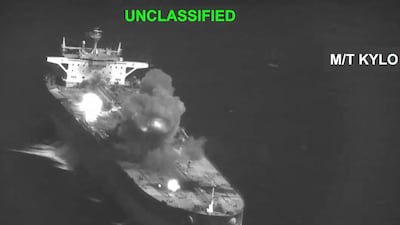

The US and Iran are opening a new front in their six-month-old war: a battle at sea that is increasingly turning commercial shipping into a target and risks repeating the “Tanker War” of the 1980s.
The escalation follows the emergence of a tit-for-tat policy of attacks on tankers approved by US President Donald Trump that risks pulling Gulf states, outside powers and global energy markets deeper into the conflict.
The "tanker-for-tanker" tactic came into full view on Saturday, when Iran's Islamic Revolutionary Guard Corps fired ballistic missiles at two US Navy warships – an aircraft carrier and a guided-missile destroyer – both of which evaded the attack.

In response, the US struck three Iranian oil tankers linked to the IRGC, disabling two and destroying a third. “If you shoot at two of our ships, we will impose an even higher economic cost – taking out three of yours,” US Central Command chief Adm Brad Cooper said.
Centcom said its latest strikes overnight targeted the IRGC-linked crude oil tankers Kaviz, Charminar, Horizon 1 and Riesco in the Gulf of Oman, as well as Derya near Kharg Island – Iran's primary oil export hub.
Iran broadened its own attacks. On Wednesday, the IRGC said it had struck two American warships – the Delbert D Black and John Paul Jones guided-missile destroyers – along with eight oil tankers and 10 other vessels. It accused them of violating a designated “unsafe” zone around the Strait of Hormuz.
The attacks came shortly after the IRGC threatened oil tankers near the ports and harbours of Bahrain and Kuwait, whether “at anchor or berthed”. The IRGC also fired 20 ballistic missiles towards a US military base in Jordan, according to the kingdom’s armed forces, which said 18 were intercepted.
The result is a cycle in which each side is effectively setting the terms of the next escalation: Iran attacks US naval assets and Washington responds by hitting Iranian oil-export capacity. Then Iran expands its response to US ships, bases and commercial shipping, potentially drawing Gulf states into the conflict.
That is broadly how the 1980s Tanker War became so dangerous. Iran and Iraq attacked oil and merchant vessels to damage each other's economies, progressively drawing outside powers into the conflict and turning the security of Gulf oil into an international military concern.
'Escalatory trap'
The significance of the new tanker policy is that it changes the cost of Iran's attacks. The US is no longer simply retaliating against the military asset responsible for an attack. It is targeting an economic asset central to Iran’s ability to finance the war.
US officials have described Iran's tanker fleet as limited and exposed, while saying the vessels form part of a network that helps finance the IRGC and its regional proxies.
Iran has its own economic weapon. It has already sharply reduced shipping through the Strait of Hormuz and threatened to establish new restricted zones. Data shows daily commercial traffic in the energy chokepoint is now in the single digits, far below prewar levels when roughly 125 large commercial vessels crossed the waterway.
The 1980s showed why that matters. Once commercial shipping becomes a target, keeping the waterway open can itself become a military objective and create another means of escalation.
The US can inflict increasing damage on Iran's oil exports while Iran can make the cost and risk of moving Gulf oil increasingly high for the US and its allies. Each strike therefore creates an incentive for a more damaging response, rather than a return to the previous level of violence.

The danger is no longer simply that the US and Iran might miscalculate each other’s intentions. Both sides increasingly appear to understand the other’s retaliation strategy and are responding by making each successive blow more damaging than the last.
It is a pattern that has been described as an “escalatory trap”. This was reflected in comments by Iran's Parliament Speaker, Mohammad Bagher Ghalibaf, who led the government's delegation in failed peace talks with the US but has called for the adoption of a harder line in recent weeks.
“The era of proportionate responses has ended,” Mr Ghalibaf said on Sunday. “Any violation of Iran's interests and security will receive a faster, heavier and more painful response.”
Tanker War 1.0 ended in August 1988 when a UN-brokered ceasefire halted the broader Iran-Iraq war. But with diplomatic efforts to end the 2026 conflict stalled, there are no signs that Tanker War 2.0 will end any time soon.

