


Megaprojects, a tourism boom and a push for hi-tech industries of the future has led to a jobs boom in the Gulf, which is showing no sign of slowing.
A recent UN agency report predicts the region's population will top 68 million in 2048, up from 56 million in 2021 and 26 million in 1995.
Whether it's the world's largest construction project in Neom – with 100,000 workers on the ground – or massive new city projects in Dubai, Abu Dhabi and Doha, a push for economic diversification from fossil fuels means more blue and white-collar labour.
But the trend presents a major challenge: illegal migration. Governments in the Gulf, most recently the UAE, have held amnesties allowing illegal migrants to come forward. The figures are stark, with tens of thousands being found to have been working on the grey market.
Here, The National looks at what governments are doing to tackle the problem.
Pandemic legacy
Before the most recent jobs boom, the coronavirus pandemic led to a surge in irregular migrants, according to Froilan Malit, senior research associate with Gulf Labour Market and Migration.
The pandemic severely impacted the economy of the home countries of many expats. And many already in the Gulf lost their jobs at the height of the pandemic. “As a result, large chunks of migrants who failed to secure jobs ended up overstaying," Mr Malit said.
Gulf states maintain strict control over their airports and seaports, making illegal entry almost impossible.
Foreign workers cannot enter any Gulf country without a local sponsor, or kafeel. Though several have abolished or reformed the 'kafala' system, the majority of migrants are still tied to their sponsors for their employment and residency.
Many migrants enter the Gulf legally, seeking better work opportunities, but then become irregular workers after overstaying their visas.
Mohammed Iqbal, a Pakistani expat who has lived in Abu Dhabi as an illegal resident for five years, fell for a common scam.
“I came here in the hope of a better future and I paid the agent 500,000 rupees [$1,800, Dh6,600],” Mr Iqbal told The National.

He was unaware he had been given a visit visa that did not allow him to work. After it expired two months later, the agent refused to help him renew it. Mr Iqbal then slipped under the radar, becoming one of thousands of illegal migrants in the country.
Fathima Marbella, 37, a Filipino mother who absconded from her employer in Dubai in 2019, has a similar story.
She said she was forced into domestic work by a recruiting agent who had falsely promised her work in a private company. She and her two daughters, aged three and seven months, were living in Dubai without residency permits until she availed of the visa amnesty in September.
These stories, in different versions, were echoed by many migrants from India, Philippines, Kenya, Bangladesh and Sri Lanka, who shared their tales with The National during the continuing visa amnesty campaign in the UAE.
Official statistics on irregular migration are not available but media reports and figures from previous amnesties give an indication of its scale in the Gulf region. Nearly 20,000 people who overstayed their visa in Dubai applied to legalise their status in the first seven days of the two-month visa amnesty. The Indian consulate said it, along with various Indian diaspora organisations, helped more than 10,000 Indian expats with new passports, exit permits and emergency certificates, to seize the opportunity.
In 2018, during a similar initiative, 105,000 people benefitted from the UAE’s five-month visa amnesty programme.
In Kuwait, it was reported about 120,000 migrants sought amnesty after overstaying their visas during the first quarter of this year.
Saudi media reported more than 2.1 million undocumented migrant workers had been deported between 2017 and 2022. There were about five million illegal migrants in the kingdom in 2012, mostly Muslims pilgrims who did not leave after their Hajj or Umrah visas expired.
Ali Shihabi, social and political commentator in Saudi Arabia, said the kingdom was trying to strike a balance between recruitment of foreign workers and the national mandate for localisation.
"Saudi is trying to educate and train its people as fast as possible and control foreign recruitment," Mr Shihabi told The National. "But with the massive expansion under vision 2030, [the country] has to bring in more foreign labour. So it is a dilemma."
What is adding to the number of migrants is the fact that many, after their residency permit runs out, prefer the illegal status in host countries than returning to the unemployment, political instability, or violence and persecution in their homeland.
Unethical recruitment
Illegal recruitment agencies in the labour-sending countries that trick people into non-existent jobs are one of the main reasons why migrants end up as illegal residents in the Gulf.
For instance, a total of 3,042 illegal recruitment agents have been reported across India as of June, according to data on the government's e-Migrate portal that facilitates safe recruitment of Indians to Gulf countries.
States like Andhra Pradesh and Uttar Pradesh that send a large number of workers to the Gulf have reported 498 and 418 illegal agents, respectively.
According to the Indian Emigration Act of 1983, only registered recruiting agents and foreign employers certified by the Protector General of India can recruit for overseas jobs. Currently, nearly 280,000 employers have registered on the e-Migrate system.
Indians make the biggest migrant workforce in the Gulf with a total of 8.8 million. The oil-rich Gulf economies still attract thousands of Indian job seekers every year making them vulnerable to unscrupulous agents.
Despite the safeguards their government has introduced, many people continue to get conned every year by rogue agents, prompting the Ministry of External Affairs to issue a warning last December to prospective migrants. The ministry cited "a huge rise" in the number of overseas job seekers being cheated by unregistered recruitment agents by fake work offers.
"It has also been reported that many illegal agents operate through Facebook, WhatsApp, text messages and other such mediums," the ministry said in its advisory.
Many agents are also overcharging to the tune of Dh10,000 to Dh30,000 ($2,722 to $8,167) whereas the ministry has set a limit of 30,000 Indian rupees as service charges, the ministry noted.
Similar cases of rogue recruitment agencies cheating unsuspecting job seekers with promises of lucrative work in the Gulf have been reported widely in labour-sending countries such as Pakistan, Sri Lanka and Nepal.
One of the most vulnerable sectors is domestic work. There are about 6.6 million domestic workers over the age of 15 employed in the Arab states, representing 8.7 per cent of the global number, the UN's Department of Economic and Social Affairs has found.
A social worker in Kuwait, who does not want to be identified, told The National that several diaspora organisations regularly receive SOS calls from domestic workers stranded in the country.
"Many people abscond from their employers when there is a dispute and fall into the illegal category."

Tackling irregular migration
As demand soars, Gulf states have introduced labour reforms to streamline the migration process. The introduction of unemployment insurance, relaxed rules on work permits and digitisation of services were all put in place to help tackle irregular migration.
Qatar effectively dismantled the controversial kafala system in the country. In 2020, it abolished a 'no objection certificate' ruling that allowed migrant workers to change jobs without their employer's permission and exit the country without a permit. Qatar also passed a minimum wage law in March 2021, setting the monthly minimum at 1,000 Qatari riyals ($275), with additional allowances for food and housing.
In Kuwait, the Public Authority for Manpower has streamlined work permit procedures for employers to bring in foreign workers and reducing the overall cost of labour. "This gives employers the flexibility to directly recruit workers from abroad," Mazen AboulHosn, chief of mission in Kuwait for the International Organisation for Migration, told The National.
"Migrant workers can now also transfer employers after three years with their current sponsor’s approval or by paying a transfer fee of 300 Kuwaiti dinars [$977]. This policy is designed to enhance job satisfaction and career progression for migrant workers in the private sector," Mr AboulHosn said.
Saudi Arabia introduced systems for online recruitment of domestic workers and a skills verification programme for blue-collar workers, while recent reforms in Oman have introduced a new unified social insurance system to cover sickness, maternity and paternity, and employment injury for both citizens and migrant workers.
-
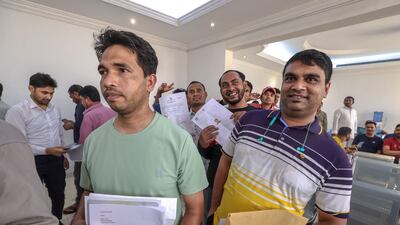
The Bangladeshi embassy in Abu Dhabi offers key support to citizens during the UAE's two-month visa amnesty, which began on September 1. All pictures by Victor Besa / The National -
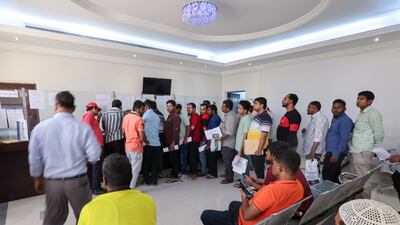
Bangladeshi residents queue to renew their passports at the embassy -
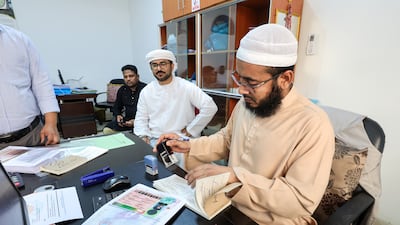
Consular workers at the embassy provide advice and support to Bangladeshis living in the UAE -
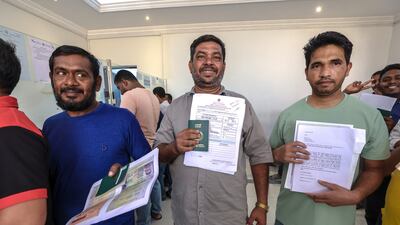
Bangladeshis display their updated passports at the embassy. These documents will enable them to legalise their status as UAE residents -
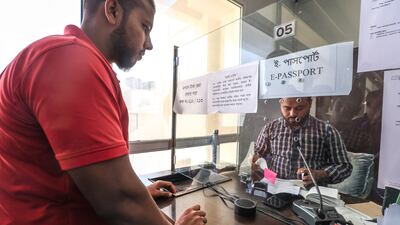
Before the amnesty started, the embassy organised outreach programmes in other emirates to ensure as many Bangladeshis as possible are able to get the services they need


Labour reforms
The Emirates, with more than eight million expat workers, has brought in flexible working arrangements such as part-time jobs, flexible visas and mandatory unemployment insurance for workers.
On the flip side, a recent toughening of rules at airports means passengers entering the Emirates from countries such as India and Pakistan must show they have at least Dh5,000 in a bank account to fund their stay. They must also prove they have a place of stay or residence. This is intended to stop people from going off-grid to seek illegal work.
And, as seen most recently, amnesty schemes to either legalise their status or either leave the country without penalty serve as a pressure release for illegal migration.
Two-sided problem
Experts say the issue of irregular migration must be a joint responsibility for countries of origin and Gulf state governments.
“There is no point in blame game, both parties are responsible,” said Irudaya Rajan, chairman of the International Institute of Migration and Development, who has studied Gulf migration for more than 30 years.
“Low wages is an attraction for employers and that is readily available when there is irregular migration. The "parallel labour" or "shadow labour" is not a Gulf-specific phenomenon, said Mr Rajan. “It is there in India and in the US."
The IOM and the International Labour Organisation have provided several recommendations for GCC countries, including Kuwait, to better manage irregular migration and protect the rights of migrants.
"These include labour policy reforms to reduce exploitation and abuse, establishing more affordable and legal pathways for migration, ensuring fair wages and working conditions, providing access to legal aid and mechanisms to report abuse, awareness campaigns and promoting bilateral and multilateral agreements," an IOM representative told The National.
The most effective policies have stemmed from countries that send millions abroad to work.

Philippines: A case study
The Philippines, which has 1.8 million workers in the Gulf, is seen as a global leader in managing labour.
“We encourage migration, treat our migrants as an asset and hence a lot of effort is put in to ensure their welfare and protection,” Patricia Yvonne Caunan, undersecretary at the Department of Migrant Workers told The National.
Filipinos must go through a licensed recruiter or a government agency or have their contracts approved by a government department to ensure their employment contracts are compliant.
The government has also put in place welfare and protection mechanisms for oversees workers, including lectures on culture and what to expect in domestic work – and even a 24/7 helpline.
But Ms Caunan said even the best welfare protection and mechanisms cannot protect migrant workers without robust co-operation between governments. “Signing bilateral agreements is not enough. We have to talk because we are dealing with people here,” she said.
Several well-publicised cases involving the abuse of workers in Kuwait, and a high-profile murder, led to a dispute between those governments, though it was resolved earlier this year.
Meetings between senior officials, as frequently as every week, have led to far fewer issues, Ms Caunan said.
In Abu Dhabi, Alfonso Halibas, who runs the Bayanihan Council, with more than 60 Filipino community and welfare organisations under its umbrella, said the number of distressed workers seeking help has been drastically reduced in the past five years after authorities overhauled recruitment offices.
“Some five years ago, there were as many as 200 to 300 distressed workers seeking shelter with the embassy on a monthly basis," he said. "Now, we are dealing with five or six cases. There are months when there are none."
Meanwhile, talks with Saudi Arabia in 2022 resulted in new safeguards for workers, including a standard employment contract that provides insurance coverage for non-payment of salaries and change of employers in the case of abuse.
“It was a new concept but we finally reached an agreement,” Ms Caunan said. That led to the Philippines lifting a ban on the deployment of workers including domestic maids and construction workers to the kingdom due to frequent abuse and non-payment of wages.
"It is a give and take. That is the only way to look at migration to become a sustainable model," she said.

