
Spanish Prime Minister Pedro Sanchez is famous for his “remontadas”, or political comebacks, but he and his socialist party face formidable obstacles ahead of Sunday's snap election.
His win, or his demise, could significantly impact European politics for years. Either Mr Sanchez, 54, will be one of the last progressive European leaders standing, or Spain will veer to the right and far-right, as France and Italy are expected to next year.
After Sunday's election, in which 39 million Spaniards will be electing 350 MPs and 209 senators, the political majority in Congress will get to choose a prime minister.

Mr Sanchez hopes to keep his job, and is banking on public anger over Spain's housing crisis. This anger has been fuelled by the death of Maricarmen Abascal, an 87-year old woman, in October. She died 10 days after being evicted from her flat for being unable to pay rent that had a new owner had quintupled.

Tireless campaigner
Mr Sanchez's career has been full of surprises. A decade ago, nobody would have bet on him leading his country after he was forced to step down as head of the socialist party.
He won back its leadership after touring the country for seven months in his Peugeot car – which became a symbol of his ability to bounce back despite the odds. In 2018, Mr Sanchez toppled the government of Mariano Rajoy thanks to a no-confidence vote and in 2023, he survived snap elections despite his party coming second.
That is because there is no need for a clear majority to form a government in Spain. In the past decade, the country has shifted from a two-party system – the People's Party vs the socialists – to a more fragmented and coalition-based political landscape.
Housing crisis
Mr Sanchez has blamed political opponents for blocking housing reforms he had sought to implement. They include a 2023 right-to-housing law that allowed regional governments to cap rent increases, implement control for high-demand areas and raise property tax on unoccupied homes.
The main opposition, the conservative People's Party, vowed not to follow those changes in the regions and cities it controlled, which include Madrid. They said they were an attack on private property and called instead for building new homes.

Yet an overwhelming majority of polls indicate Mr Sanchez's bet may backfire, with the advantage for a right-wing bloc formed by the PP and far-right Vox, which is polling at close to 20 per cent. Such a coalition would be a first since the end of Spain's dictatorship in 1975.
Alberto Nunez Feijoo, the conservative front-runner, was widely viewed as the winner of a TV debate with Mr Sanchez last week.
A right-wing win would likely significantly the foreign policy of Spain and the EU more broadly. Mr Sanchez had taken the lead in Brussels in denouncing Israel's war in Gaza and trying – but failing in the face of German and Italian opposition – to withdraw benefits given to Israeli imports to the EU. In Thursday's final four-way debate between the candidates, Mr Sanchez insisted on describing it as a “genocide” while Mr Feijoo called it a “massacre”.
Migration crisis
Migration policy has also been high on the agenda, following recent large-scale migrant arrivals in Spain's North African enclave of Ceuta and in the Canary Islands this summer.
In July, Spain was stunned by the arrival in one day of more than 72,000 migrants, mostly from Morocco, in Ceuta. The incident weakened the government, exposing internal tension between the defence and interior ministries.
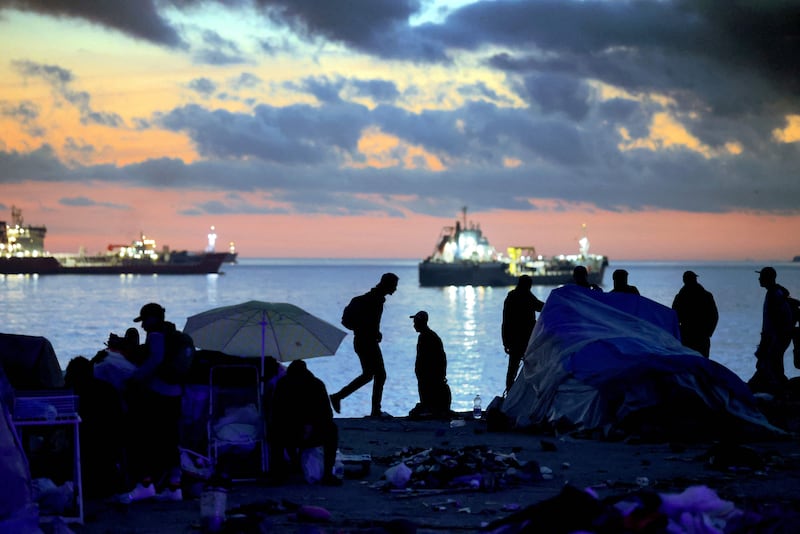
The right and far-right have seized on migration as a campaign topic, with Mr Feijoo visiting El Hierro in the Canary Islands last week to attack Mr Sanchez's migration policies. Describing migration as an “invasion”, he made proposals include toughening returns of unaccompanied migrant children, who, unlike adults, are usually allowed to stay in Spain to request asylum.
A record 2,100-plus migrants arrived Wednesday in the Canary Islands over 24 hours on overcrowded boats. “The Canaries can't take it any more. We're experiencing an unprecedented migration pressure,” Mr Clavijo wrote on X, adding that he had requested an urgent meeting with European Commission President Ursula von der Leyen.
Corruption
Mr Sanchez is also bogged down by accusations of corruption. This was the very issue he weaponised against the PP in 2018 to discredit it after senior party members were involved in a corruption trial.

Now, a number of close allies of Mr Sanchez have been found guilty of corruption or are awaiting trial. His wife, Begona Gomez, is also facing trial, accused of peddling influence and embezzlement at one of Spain's most famous universities. The public prosecutor has asked for her acquittal in the case brought by far-right groups, which Mr Sanchez has said is akin to “persecution” of his family.
After eight years in power, has Mr Sanchez done enough to convince the Spanish people he deserves more time in charge?

