A flat at 5 Rue de Tilsitt in Paris is believed to have been bought in 2010 by the eldest son of former Yemeni president Ali Abdullah Saleh for €6.5 million.

Two sons of former Yemeni president to be tried for laundering €16 million


Sunniva Rose
  • English
  • Arabic

Two sons of former Yemeni president Ali Abdullah Saleh face trial in September 2026 in Paris for allegedly buying luxury property in the French capital with money plundered from the Yemeni state.

Ahmed Ali Saleh, the 53-year old eldest son of the ex-president assassinated in 2017, is described by the National Financial Prosecutor's Office (PNF) as “the heart of this oligarchy operating as a financial business,” French prosecutors confirmed to The National.

With his brother Khaled, 38, Ahmed Ali Saleh is accused by the PNF of “money laundering of embezzled public funds and organised corruption.” The two men deny the charges.

The charges related to more than $30 million of money transfers between 2009 and 2011 that moved through their bank accounts in Paris.

The allegations highlight corruption in one of the poorest countries in the world under the 1990-2012 presidential mandate of Ali Abdullah Saleh, who was toppled after the Arab uprisings.

Ali Abdullah Saleh, centre, pictured in 2006, was president of Yemen from 1990 to 2012. Getty Images

Yemen has for more than a decade been mired in a civil war where the Iran-backed Houthi movement took over the capital, Sanaa. The fighting has hardened sectarian divisions and hardship has increased as foreign aid efforts struggle to meet the population's basic needs.

While he was in power, Ali Abdullah Saleh is believed to have amassed a fortune estimated between $32 billion and $60 billion with a system of bribes on gas, oil and arms deals. He allegedly also siphoned public money, according to figures collected by a UN group of experts on Yemen.

After he stepped down, Ali Abdullah Saleh then allied himself with the Houthi militias he had once fought in the north of the country. But they killed him three years when Sanaa was overrun in 2014.
Luxury real estate

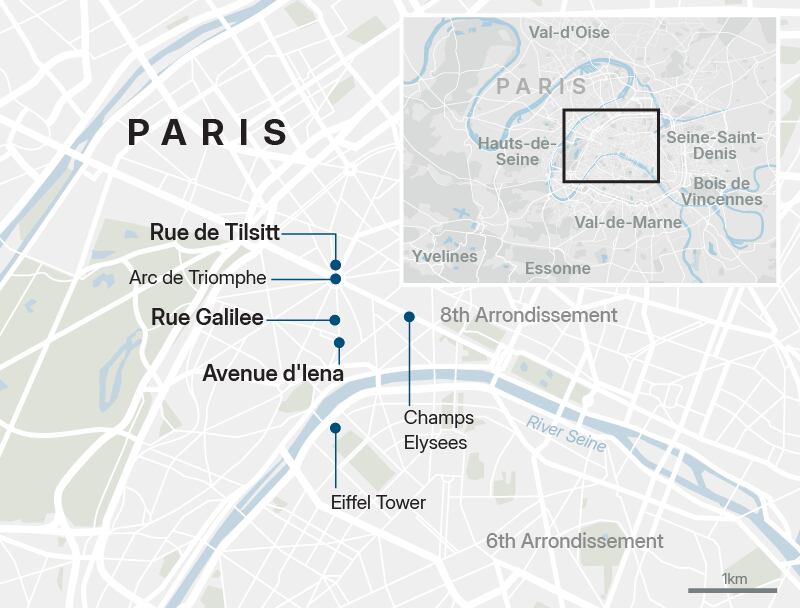
At the heart of the forthcoming proceedings are funds that were allegedly used to buy three properties near the Arc de Triomphe, one of the most upmarket neighbourhoods in Paris, for €16 million.

This includes a building on Rue Galilee, bought for €7 million in 2005; a flat on Rue de Tilsitt bought for €6.5 million in 2010; and a €2.5 million investment in the acquisition of two mansions on Avenue d'Iena.

Khaled Ali Abdullah Saleh, right, pictured in 2007, has argued that the funds that moved through French accounts were gifts from heads of state. Reuters

The French investigation into the alleged ill-acquired wealth of his family members was launched in 2019 following a request for judicial co-operation from Switzerland.

Ahmed Ali Saleh was a brigadier general during his father's presidential rule and led the Republican Guard. He has been under US and UN sanctions since 2015 for supporting the Houthi movement that has been fighting against the UN-recognised government.

Lack of evidence

In a written response to the PNF, Khaled Saleh has rejected the conclusions of UN experts regarding the origin of the family fortune. He argued that the funds that passed through French banks came from gifts from foreign heads of state but the evidence was destroyed in the war, Le Parisien reported.

Lawyers Clara Gerard-Rodriguez and Pierre-Olivier Sur said that their clients had done nothing illegal and argued that there lacked evidence to prove that the real estate purchases were linked to corruption.

Ahmed Saleh, pictured in 2011, is believed to have participated in the purchase of luxury properties in Paris with ill-acquired funds. Reuters

“Simply saying that regime was corrupt in no way proves that it was money from corruption that enabled his sons to purchase property in France,” Ms Gerard-Rodriguez said.

Two other defendants are to be sent to trial, according to Le Parisien: a Yemeni businessman close to the family suspected of having participated in the management of their assets, and the manager of the asset management company he created.


England ODI squad

Eoin Morgan (captain), Moeen Ali, Jonny Bairstow, Jake Ball, Sam Billings, Jos Buttler, Tom Curran, Alex Hales, Liam Plunkett, Adil Rashid, Joe Root, Jason Roy, Ben Stokes, David Willey, Chris Woakes, Mark Wood.

What to watch out for:

Algae, waste coffee grounds and orange peels will be used in the pavilion's walls and gangways

The hulls of three ships will be used for the roof

The hulls will painted to make the largest Italian tricolour in the country’s history

Several pillars more than 20 metres high will support the structure

Roughly 15 tonnes of steel will be used

The%20Beekeeper
%3Cp%3E%3Cstrong%3EDirector%3A%20%3C%2Fstrong%3EDavid%20Ayer%C2%A0%3C%2Fp%3E%0A%3Cp%3E%3Cstrong%3EStarring%3A%20%3C%2Fstrong%3EJason%20Statham%2C%20Josh%20Hutcherson%2C%20Emmy%20Raver-Lampman%2C%20Minnie%20Driver%2C%20Jeremy%20Irons%3C%2Fp%3E%0A%3Cp%3E%3Cstrong%3ERating%3A%20%3C%2Fstrong%3E3%2F5%3C%2Fp%3E%0A
UAE currency: the story behind the money in your pockets

Mercer, the investment consulting arm of US services company Marsh & McLennan, expects its wealth division to at least double its assets under management (AUM) in the Middle East as wealth in the region continues to grow despite economic headwinds, a company official said.

Mercer Wealth, which globally has $160 billion in AUM, plans to boost its AUM in the region to $2-$3bn in the next 2-3 years from the present $1bn, said Yasir AbuShaban, a Dubai-based principal with Mercer Wealth.

Within the next two to three years, we are looking at reaching $2 to $3 billion as a conservative estimate and we do see an opportunity to do so,” said Mr AbuShaban.

Mercer does not directly make investments, but allocates clients’ money they have discretion to, to professional asset managers. They also provide advice to clients.

“We have buying power. We can negotiate on their (client’s) behalf with asset managers to provide them lower fees than they otherwise would have to get on their own,” he added.

Mercer Wealth’s clients include sovereign wealth funds, family offices, and insurance companies among others.

From its office in Dubai, Mercer also looks after Africa, India and Turkey, where they also see opportunity for growth.

Wealth creation in Middle East and Africa (MEA) grew 8.5 per cent to $8.1 trillion last year from $7.5tn in 2015, higher than last year’s global average of 6 per cent and the second-highest growth in a region after Asia-Pacific which grew 9.9 per cent, according to consultancy Boston Consulting Group (BCG). In the region, where wealth grew just 1.9 per cent in 2015 compared with 2014, a pickup in oil prices has helped in wealth generation.

BCG is forecasting MEA wealth will rise to $12tn by 2021, growing at an annual average of 8 per cent.

Drivers of wealth generation in the region will be split evenly between new wealth creation and growth of performance of existing assets, according to BCG.

Another general trend in the region is clients’ looking for a comprehensive approach to investing, according to Mr AbuShaban.

“Institutional investors or some of the families are seeing a slowdown in the available capital they have to invest and in that sense they are looking at optimizing the way they manage their portfolios and making sure they are not investing haphazardly and different parts of their investment are working together,” said Mr AbuShaban.

Some clients also have a higher appetite for risk, given the low interest-rate environment that does not provide enough yield for some institutional investors. These clients are keen to invest in illiquid assets, such as private equity and infrastructure.

“What we have seen is a desire for higher returns in what has been a low-return environment specifically in various fixed income or bonds,” he said.

“In this environment, we have seen a de facto increase in the risk that clients are taking in things like illiquid investments, private equity investments, infrastructure and private debt, those kind of investments were higher illiquidity results in incrementally higher returns.”

The Abu Dhabi Investment Authority, one of the largest sovereign wealth funds, said in its 2016 report that has gradually increased its exposure in direct private equity and private credit transactions, mainly in Asian markets and especially in China and India. The authority’s private equity department focused on structured equities owing to “their defensive characteristics.”

Key facilities
  • Olympic-size swimming pool with a split bulkhead for multi-use configurations, including water polo and 50m/25m training lanes
  • Premier League-standard football pitch
  • 400m Olympic running track
  • NBA-spec basketball court with auditorium
  • 600-seat auditorium
  • Spaces for historical and cultural exploration
  • An elevated football field that doubles as a helipad
  • Specialist robotics and science laboratories
  • AR and VR-enabled learning centres
  • Disruption Lab and Research Centre for developing entrepreneurial skills
Updated: December 16, 2025, 11:49 AM