


Spain sent more troops on Friday to search for survivors among abandoned cars, sodden buildings and layers of mud left by the deadliest natural disaster to hit the country in living memory.
At least 205 people were killed in flash floods that tore through Valencia overnight on Tuesday into Wednesday, leaving cars piled on top of each other, uprooting trees, taking down power lines and destroying homes in dozens of communities.
Rescuers using drones and sniffer dogs waded through water and searched debris on Friday in an increasingly desperate search for the "dozens" of people the authorities believe are still missing.
The government has sent 500 more troops to stricken areas to bolster the 1,200 already helping search, rescue and logistics operations. "There is still a pile of cars in the industrial estate, mountains and mountains of cars," Amparo Fort, Mayor of the town of Chiva, told public radio RNE. "Many must be empty, but we are sure others are occupied."
About 150,000 people in Valencia were without electricity on Wednesday, but power had been restored for about half by Thursday. Some people did not have running water and were relying on bottled water.
Many survivors walked long distances in thick mud to find food and water. Most of their cars were destroyed and the debris left by the storm made some roads impassable. Some pushed shopping trolleys along sodden streets, while others carried their children. Supplies were looted in some areas.
On Thursday, Angel Victor Torres, Spain's Minister for Territorial Policy and Democratic Memory, vowed there would be an uncompromising response to "looting" and the "insults" directed at the security forces. He announced 39 arrests, in a sign civil order was breaking down in some places.
In the town of Aldaia, in the Valencia region, resident Fernando Lozano said thieves stole trousers from an abandoned supermarket as "people are a bit desperate". "Until this is normalised and the supermarket opens, it's going to be very bad here," he added.
As the shock from the floods dissipated, anger grew over how the authorities handled of the crisis. Officials have been accused of issuing warnings too late and failing to deliver adequate relief.
Dozens killed in flash floods in Spain - in pictures
-
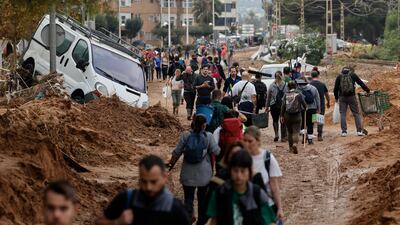
People walk through mud and debris after flash floods in the Paiporta area of Valencia, Spain. EPA -

The deadly floods left cars strewn across streets in Sedavi, Valencia. Reuters -

The flooding was caused by storms that brought heavy rain to high ground in the region. Reuters -
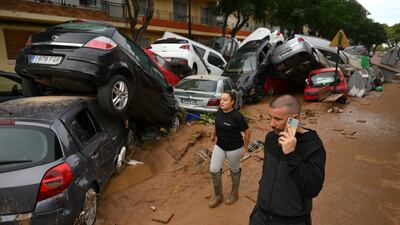
People walk cars swept aside by the flash floods, in the Alfafar municipality. Getty Images -
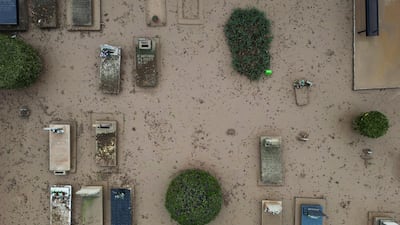
A flooded cemetery in Paiporta. Reuters -
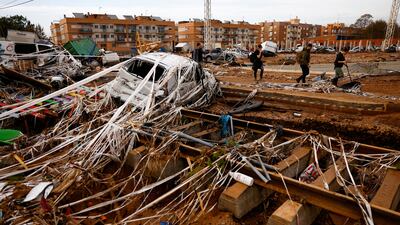
Flood damage in Alfafar. Authorities in Spain have been accused of failing to warn residents in time. Reuters -
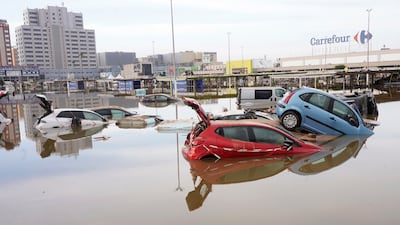
Vehicles submerged by floodwater in Valencia. AP -
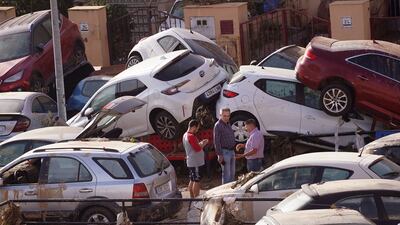
Vehicles piled up after being swept away by floods in Valencia, Spain. AP -
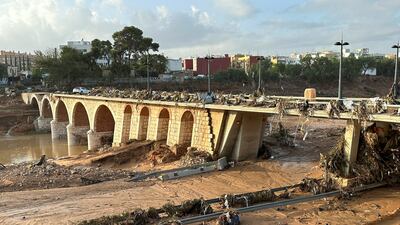
Debris and cars jammed on a bridge after flooding in Torrent, Valencia. Reuters -
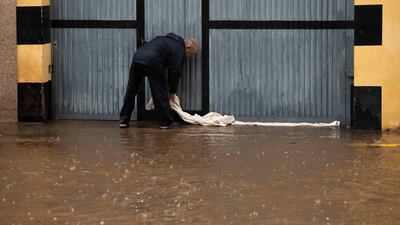
A man places a blanket at the entrance of a garage to keep out flood water, in Castellon de la Plana, Valencia. EPA -
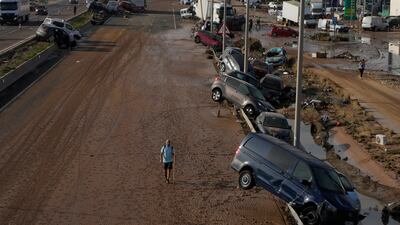
Cars and lorries swept off a motorway in Valencia. AP -
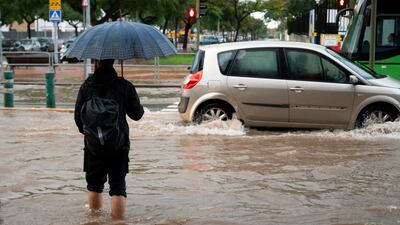
Wading through flood water in Castellon de la Plana. EPA -
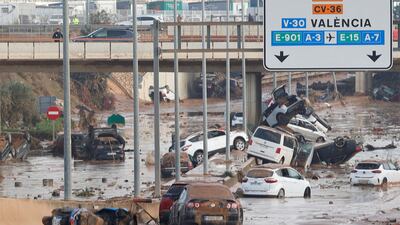
The floods killed dozens and caused damage estimated to be worth hundreds of millions. Reuters -
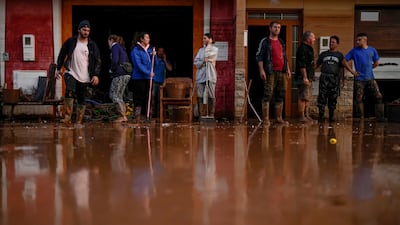
People clean their houses affected by floods in Utiel, Spain. AP -
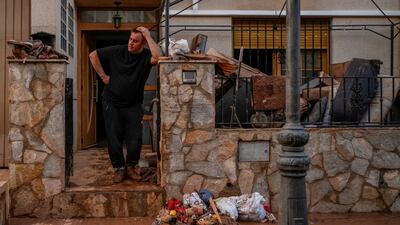
A man outside his house affected by floods in Utiel. AP -
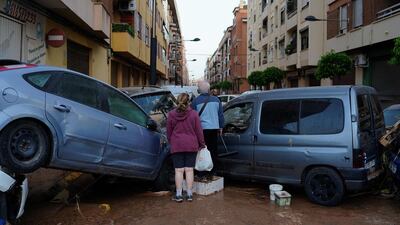
Residents inspect cars swept away by the deadly floods in Alfafar neighbourhood, south of Valencia. AFP -
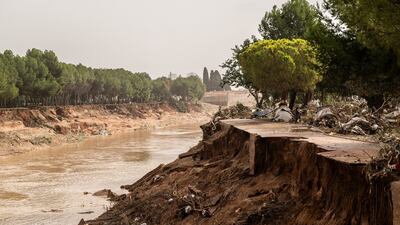
VALENCIA, SPAIN - OCTOBER 30: A man walks by a destroyed road after flash floods hit the region on October 30, 2024 in the Sedaví area of Valencia, Spain. Spanish authorities said on Wednesday that at least 62 people had died in the Valencia region overnight after flash-flooding followed heavy rain. Spain's meteorological agency had issued its highest alert for the region due to extreme rainfall. (Photo by David Ramos / Getty Images) -
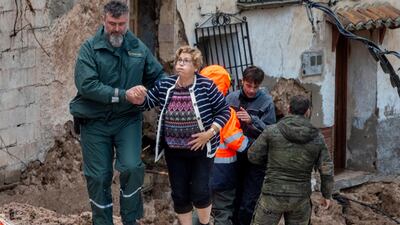
The emergency services rescue people trapped in their homes in Letur, Albacete. AP -
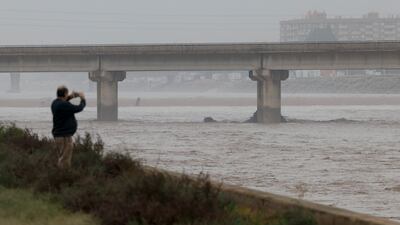
A man takes photos of the Turia River after heavy rainfall hits the Valencia region. EPA -
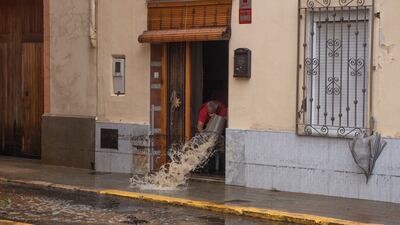
Water has entered houses in the city of Valencia. AP -
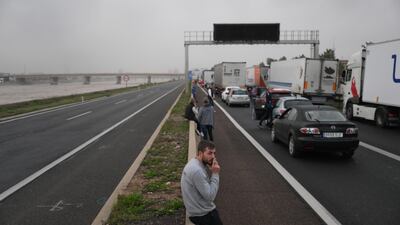
Traffic is halted beside the River Turia in Valencia. Spain's meteorological agency had issued its highest alert for the region. Getty Images -
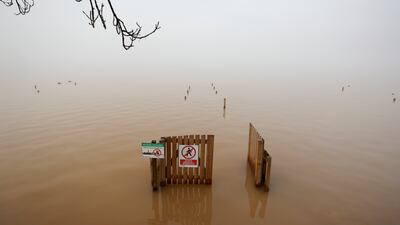
This pier at Gola de Putxol in Albufera, Valencia, has been totally submerged. EPA -
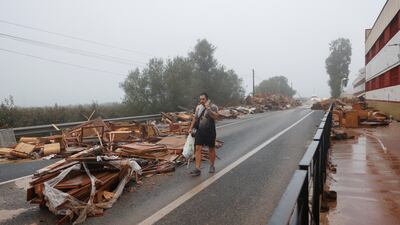
A furniture factory in La Alcudia was badly affected, with many items damaged. Reuters -
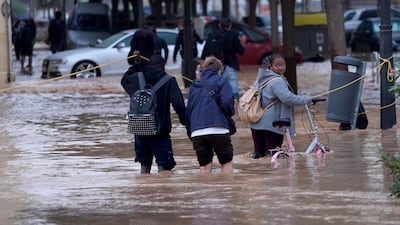
People wade through the streets in Valencia. AP -
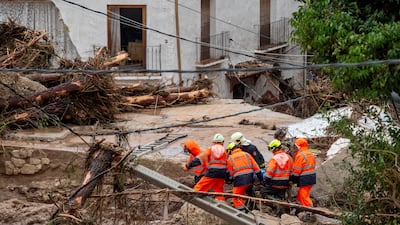
The emergency services free a person trapped after the damage caused in Letur, Albacete. AP -
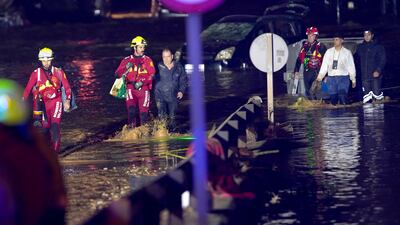
The emergency services rescue residents who were trapped in their homes in Valencia. AP -
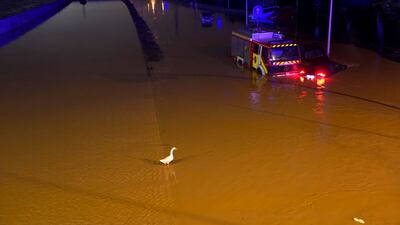
Cars were also trapped by the rising water level. AP


The storm as a particularly intense example of a “dana”, a common phenomenon in the area at this time of year. Danas develop when cold autumn air moving south meets warm, moist air, typically flowing from the Mediterranean, creating high-altitude storm clouds.
These can dump large amounts of rain in a short space of time. More than 48cm of rain fell on high ground in Spain in eight hours, inundating downhill areas and causing flash floods in urban centres.
The flooding was probably due to the hot, dry weather in the region this year, which left soil hard-baked, reducing how much water could soak into the ground. A building boom in recent decades may also have reduced stormwater drainage, experts added.
Questions have been raised about why civil authorities waited so long to tell people to seek shelter, and why infrastructure including roads, bridges and train lines were unable to withstand the downpour. While weather services notified the public on Monday that a major storms was likely to hit Valencia, the main emergency alert was not issued until Tuesday evening, when the storm was already in full force.

“Ultimately, all you can do when you’re getting that amount of rain is alert people in good time, give warnings and make sure that people are aware of how they can keep themselves safe,” said Jess Neumann, associate professor of hydrology at the University of Reading. “It sounds like that was not done adequately.”
Politicians have already begun to cast blame over the disaster. On Thursday, Alberto Nunez Feijoo, leader of the opposition People’s Party, which governs Valencia, said regional authorities acted based on information it received from the national weather agency and the department that oversees rivers. Both rely on the central government.
Climate change has made extreme rain more common by increasing air temperatures, which allows storms to hold more water – a 7 per cent increase for every 1°C that temperatures rise.
Rapid analysis by the World Weather Attribution initiative found the recent extreme rainfall in Spain was about 12 per cent heavier than pre-industrial levels. One-day bursts of rain in the region are increasing as the planet warms, the group said.
Hayley Fowler, professor of climate change impacts at Newcastle University, warned about the limitations of adapting to such storms, which “appear to be becoming more frequent in Europe and are projected to increase further with additional warming".

“The question is not whether we need to adapt for more of these types of storms, but can we?” she said
Adapting to increased rainfall will be essential to lower the risk of future disasters. “Reducing the volume and speed of run-off can be done by replanting upland areas and improving soil health, as well as increasing the capacity of urban areas to absorb, hold or disperse water,” said Kevin Collins, a senior lecturer in environment and systems at the Open University in the UK.
He suggested strengthening dams and bridges, which have proven to be vulnerable, too. But cities can only do so much to mitigate against climate disasters, particularly those cities that are not designed to face the level of rainfall recorded this week in Spain.
“It wouldn’t matter whether it was Spain or anywhere else, if there was that much rainfall falling on impermeable ground, you are going to get flooding,” Mr Neumann said. “In the long term, this isn’t something that’s going to go away."

