


The situation for children in Gaza is similar to that of Japan at the end of the Second World War, said the co-chairman of Nihon Hidankyo, a group of atom bomb survivors from Hiroshima and Nagasaki that won the Nobel Peace Prize on Friday.
“In Gaza, bleeding children are being held [by their parents]. It's like in Japan 80 years ago,” Toshiyuki Mimaki told a news conference in Tokyo on Friday. "[Children in Hiroshima and Nagasaki] lost their fathers in the war and mothers in the atom bomb. They became orphans.”
Nuclear weapons never bring peace, he said. “It has been said that because of nuclear weapons, the world maintains peace. But nuclear weapons can be used by terrorists,” he said.
“For example, if Russia uses them against Ukraine, Israel against Gaza, it won't end there. Politicians should know these things,” added Mr Mimaki, who was playing outside his family's home in Hiroshima, aged three, when the bomb was dropped on August 6, 1945, destroying the city and killing 140,000 people.
A second bomb was dropped three days later on Nagasaki, which killed 70,000 more. Japan surrendered on August 15, 1945, ending the Second World War.

Survivors of the attacks were left with many health problems, including an increase in cases of leukaemia, which was first noticed about two years after the attacks, peaking about four to six years later. Children were the worst affected.
The grass roots movement of survivors from Hiroshima and Nagasaki received the award for its efforts to achieve a world free of nuclear weapons and for demonstrating through witness testimony that nuclear weapons must never be used again. "Never did I dream this could happen," Mr Mimaki said on Friday, with tears in his eyes, after his group won the prize.
It has provided thousands of witness accounts, issued resolutions and public appeals, and sent annual delegations to the UN and peace conferences to remind the world of the pressing need for nuclear disarmament.
Japanese Prime Minister Shigeru Ishiba said the award was “extremely meaningful”. European Commission President Ursula von der Leyen also praised the selection, saying the award sent a “powerful message”.

The award represents “an indirect critique” of the nuclear threats made by Russian President Vladimir Putin and his regime, as well as that of Iran, said Asle Sveen, a researcher who retired from the Norwegian Nobel Institute.
“This year's prize is a prize that focuses on the necessity of upholding this nuclear taboo. And we have all a responsibility, particularly the nuclear powers,” Jorgen Watne Frydnes, chair of the Norwegian Nobel Committee, told a press conference in Oslo where he announced the winner.
Without naming specific countries, Mr Frydnes warned that nuclear nations should not contemplate using the weapons. “Today's nuclear weapons have far greater destructive power. They can kill millions and would impact the climate catastrophically,” he said. “A nuclear war could destroy our civilisation.”
Efforts to eradicate nuclear weapons have been honoured in the past by the Nobel committee. The International Campaign to Abolish Nuclear Weapons won the Peace Prize in 2017 and in 1995 Joseph Rotblat and the Pugwash Conferences on Science and World Affairs won for “their efforts to diminish the part played by nuclear arms in international politics and, in the longer run, to eliminate such arms.”
Who are Nihon Hidankyo?
The fates of those who survived the Hiroshima and Nagasaki bombings were long concealed and neglected, especially in the initial years after the end of the war. Local Hibakusha associations, along with victims of nuclear weapons tests in the Pacific, formed the Japan Confederation of A- and H-Bomb Sufferers Organisations in 1956.
The organisation, whose name was shortened in Japanese to Nihon Hidankyo, would become the largest and most influential Hibakusha organisation in Japan. It has helped drive global opposition to nuclear weapons through the force of the survivors' testimonies while also creating educational campaigns and issuing stark warnings about the spread and use of nuclear arms.
With each passing year, the number of survivors from the two nuclear blasts in Japan nearly 80 years ago grows smaller. But the grassroots movement has played a part creating a culture of remembrance, allowing for new generations of Japanese to carry on the work.
Nobel Peace Prize winners – in pictures
-
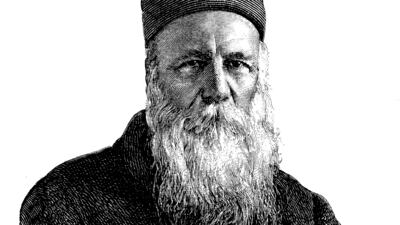
1901. Jean-Henri Dunant. The founder of the Red Cross was awarded the prize 'for his humanitarian efforts to help wounded soldiers and create international understanding'. He shared the first award with Frederic Passy. Getty Images -

1901. Frederic Passy. The French economist and writer was awarded 'for his lifelong work for international peace conferences, diplomacy and arbitration'. Getty Images -
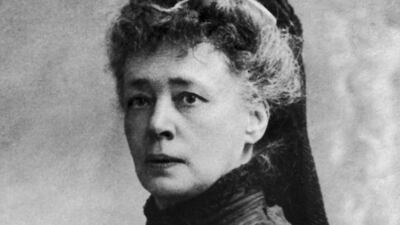
1905. Baroness Bertha von Suttner. The first woman to win the Peace Prize, she was awarded for her work as President of the Permanent International Peace Bureau. She was also the author of the anti-war novel 'Lay Down Your Arms'. Getty Images -
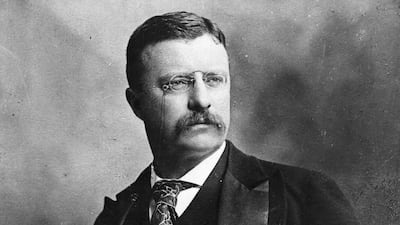
1906. Theodore Roosevelt. The 26th US president was awarded for 'for his role in bringing to an end the bloody war recently waged between two of the world’s great powers, Japan and Russia'. Getty Images -
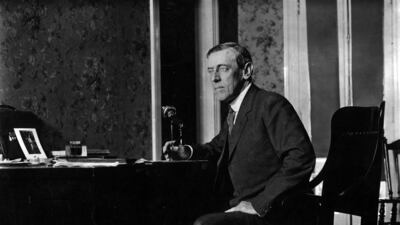
1919. Woodrow Wilson, the 28th US president was awarded 'for his role as founder of the League of Nations'. Getty Images -
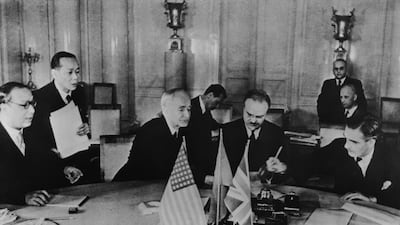
1945. Cordell Hull, centre left, won 'for his indefatigable work for international understanding and his pivotal role in establishing the United Nations'. He is pictured here signing the four-power pact in Moscow in 1943 alongside (L-R) Chinese ambassador to Moscow Foo Ping Shen, Vyacheslav Mikhailovich Molotov of Russia and Anthony Eden of Britain. Getty Images -
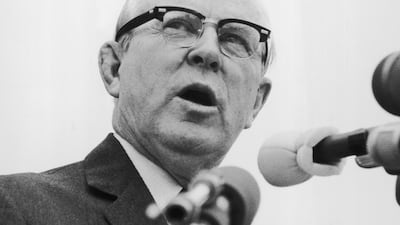
1957. Canadian politician Lester Bowles Pearson was awarded 'for his crucial contribution to the deployment of a United Nations Emergency Force in the wake of the Suez Crisis'. Getty Images -
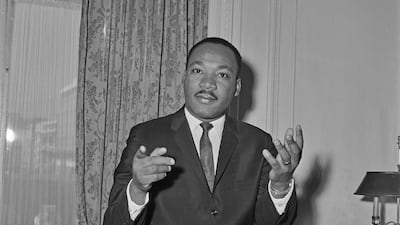
1964. American civil rights campaigner Martin Luther King Jnr was awarded 'for his non-violent struggle for civil rights for the Afro-American population'. Getty Images -
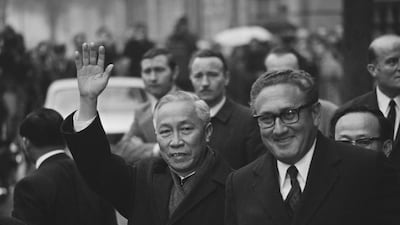
1973. Another shared award, North Vietnamese leader Le Duc Tho and US National Security Adviser Henry Kissinger are pictured here at the Paris Peace Accords during the Vietnam War, January 1973. They were jointly awarded the Nobel Peace Prize later that year 'for jointly having negotiated a cease fire in Vietnam in 1973'. Getty Images -
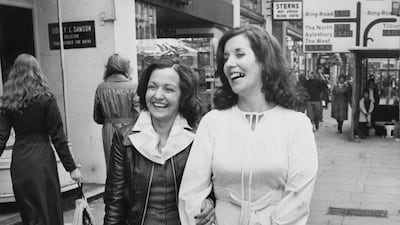
1976. Mairead Corrigan (left) and Betty Williams, co-founders of Community of Peace People, were both awarded 'for the courageous efforts in founding a movement to put an end to the violent conflict in Northern Ireland'. Getty Images -

1978. US president Jimmy Carter, who would go on to be awarded the Peace Prize himself in 2002, is pictured here with Israeli Prime Minister Menachem Begin and Egyptian President Mohamed Anwar Sadat during peace talks at Camp David, Maryland in 1978. That year Mr Begin and Mr Sadat won 'for jointly having negotiated peace between Egypt and Israel in 1978'. Getty Images -
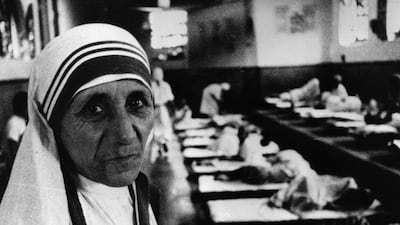
1979. Mother Teresa receiving the Nobel Peace Prize in Oslo, Norway, 'for her work for bringing help to suffering humanity'. Getty Images -
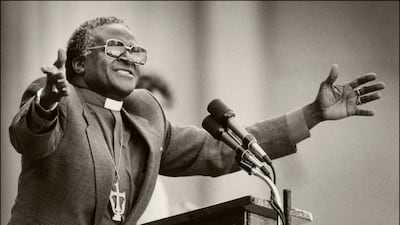
1984. South African religious leader and activist Bishop Desmond Tutu was awarded the prize 'for his role as a unifying leader figure in the non-violent campaign to resolve the problem of apartheid in South Africa'. Pictured here giving an impassioned speech at the University of California Berkeley in 1985. Getty Images -
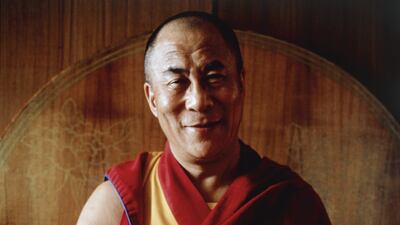
1989. His Holiness the 14th Dalai Lama (Tenzin Gyatso) at his home in Dharamsala, India, circa 1991. He won 'for advocating peaceful solutions based upon tolerance and mutual respect in order to preserve the historical and cultural heritage of his people'. Getty Images -
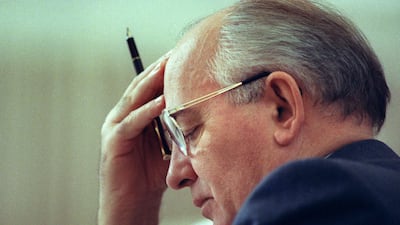
1990. The last Soviet president Mikhail Gorbatchev was awarded 'for the leading role he played in the radical changes in East-West relations'. AFP -
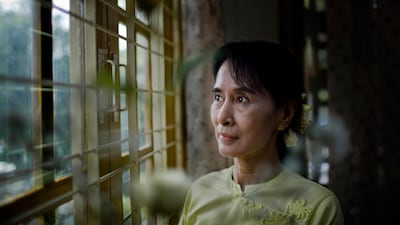
1991. Myanmar democracy figurehead Aung San Suu Kyi became a Peace Prize laureate 'for her non-violent struggle for democracy and human rights'. Getty Images -

1993. South African president Nelson Mandela and second deputy president F.W. de Klerk were jointly awarded 'for their work for the peaceful termination of the apartheid regime, and for laying the foundations for a new democratic South Africa'. Reuters -
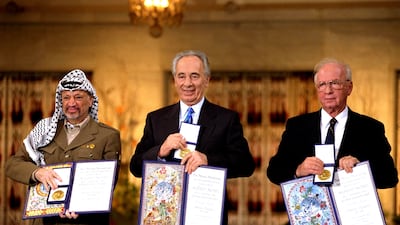
1994. (R-L) Israeli PM Yitzak Rabin, Israeli foreign minister Shimon Peres and Palestinian leader Yaser Arafat, were each Nobel Peace Prize winners, 'for their efforts to create peace in the Middle East'. Getty Images -
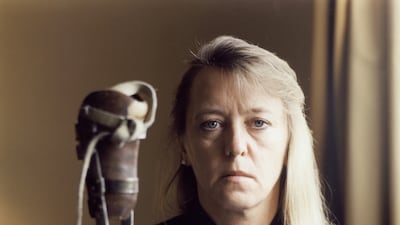
1997. Jody Williams was awarded alongside the International Campaign to Ban Landmines 'for their work for the banning and clearing of anti-personnel mines'. Getty Images -
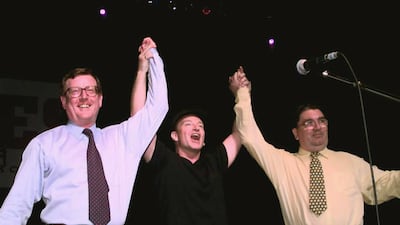
1998. Ulster Unionist leader David Trimble, left, and SDLP leader John Hume, standing with Irish rock band U2's lead singer Bono, were awarded 'for their efforts to find a peaceful solution to the conflict in Northern Ireland'. EPA -

2001. UN secretary general Kofi Annan was a Nobel Peace Prize laureate along with the UN 'for their work for a better organized and more peaceful world'. Getty Images -
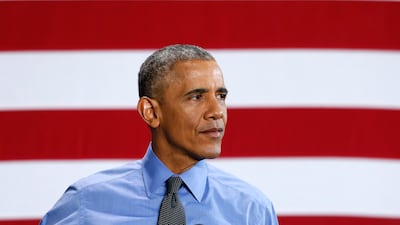
2009. 44th US president Barack Obama was named Nobel Peace Prize winner 'for his extraordinary efforts to strengthen international diplomacy and cooperation between peoples'. EPA -
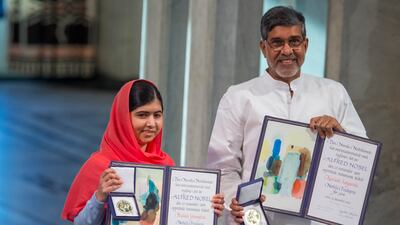
2014. Malala Yousafzai and Kailash Satyarthi accept their Nobel Peace Prize Awards 'for their struggle against the suppression of children and young people and for the right of all children to education'. Getty Images -

2021. Nobel Peace Prize winners Maria Ressa (L) and Dmitry Muratov receive their awards during the ceremony at the City Hall in Oslo. Ms Ressa, from the Philippines, and Mr Muratov, from Russia, were awarded the Nobel Peace Prize for their efforts for freedom of expression. EPA



