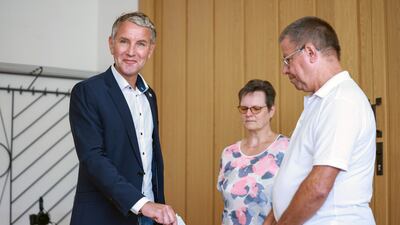
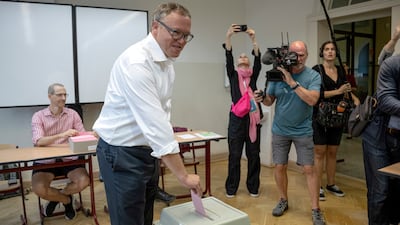
Björn Hocke, party and parliamentary group leader of the Alternative for Germany leaves an election party in Erfurt. AP

German far-right election win 'final wake-up call' for Scholz


Tim Stickings
  • English
  • Arabic

Pressure was mounting on German Chancellor Olaf Scholz on Monday to calm the voter anger that fuelled a far-right party's most significant election win since the Nazi era.

Members of Mr Scholz's party called the state election results in Germany's former East a “final wake-up call” and a moment for “humility and reflection” in his government.

Some MPs within Mr Scholz's three-party coalition hinted he should resign after the Alternative for Germany (AfD) topped the poll in the state of Thuringia.

Although opposing parties will probably work together to keep the AfD out of power, its victory broke a taboo in post-1945 Germany and led to finger-pointing across the political spectrum.

The election result came 85 years to the day since Germany invaded Poland, ushering in the Second World War and Thuringia is particularly symbolic as an early electoral stronghold of the Nazis.

The AfD in Thuringia is regarded as particularly radical. Domestic intelligence treats it as extremist and its leader, Bjorn Hocke, has convictions for using Nazi slogans.

The party campaigned vigorously on immigration and crime at the regional polls in Thuringia and in Saxony, where the AfD came second. The votes were for regional governments but were overshadowed by national concerns.

Mr Hocke, one of the AfD's most prominent figures, seized on an Islamist knife attack in Solingen nine days before the election to drive home his message that a “multicultural experiment must be stopped”.

Germany votes in state elections – in pictures

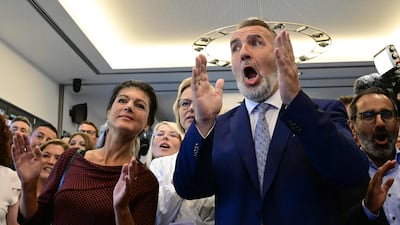
  • Leader of left-wing Sahra Wagenknecht Alliance, Sahra Wagenknecht, left, and Thuringia's BSW top candidate Katja Wolf, third right, at the party's election night at the Dompalais in Erfurt, eastern Germany, on September 1. AFP
    Leader of left-wing Sahra Wagenknecht Alliance, Sahra Wagenknecht, left, and Thuringia's BSW top candidate Katja Wolf, third right, at the party's election night at the Dompalais in Erfurt, eastern Germany, on September 1. AFP
  • Top candidates of the new German left-wing party Buendnis Sahra Wagenknecht in Saxony, Sabine Zimmermann and Joerg Scheibe, on stage after the first exit polls for Saxony's state elections during the party's election night at Hotel Penck in Dresden, Germany. AFP
    Top candidates of the new German left-wing party Buendnis Sahra Wagenknecht in Saxony, Sabine Zimmermann and Joerg Scheibe, on stage after the first exit polls for Saxony's state elections during the party's election night at Hotel Penck in Dresden, Germany. AFP
  • Joerg Urban, lead candidate of the far-right party Alternative for Germany, speaks to AfD supporters. EPA
    Joerg Urban, lead candidate of the far-right party Alternative for Germany, speaks to AfD supporters. EPA
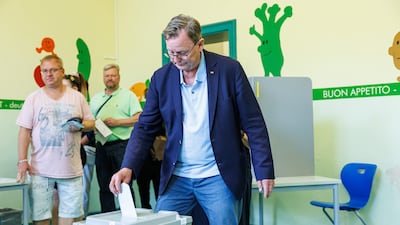
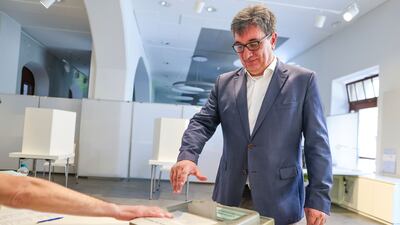
  • Bodo Ramelow, Thuringia Premier and member of the leftist Die Linke political party, casts his ballot in the Thuringia state elections in Erfurt, Germany. EPA
    Bodo Ramelow, Thuringia Premier and member of the leftist Die Linke political party, casts his ballot in the Thuringia state elections in Erfurt, Germany. EPA
  • Thomas Kemmerich votes in the state election in Saxony, at a polling station in Weimar, Germany. AP
    Thomas Kemmerich votes in the state election in Saxony, at a polling station in Weimar, Germany. AP
  • Alternative for Germany party faction chairman in the regional parliament of Thuringia and top candidate for the 2024 Thuringia state election, Bjoern Hoecke, left, casts his ballot in Bornhagen, Germany. EPA
    Alternative for Germany party faction chairman in the regional parliament of Thuringia and top candidate for the 2024 Thuringia state election, Bjoern Hoecke, left, casts his ballot in Bornhagen, Germany. EPA
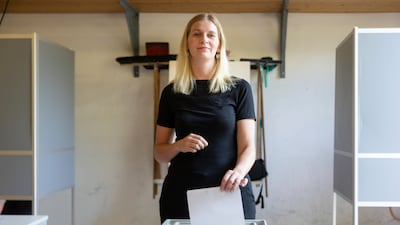
  • Katja Wolf, BSW, casts her vote for the state election in Thuringia, at a polling station in Eisenach, Germany. AP
    Katja Wolf, BSW, casts her vote for the state election in Thuringia, at a polling station in Eisenach, Germany. AP
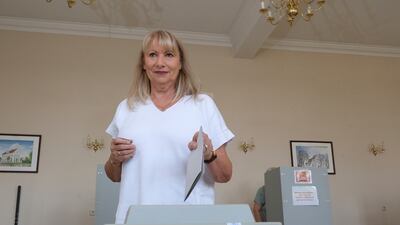
  • Madeleine Henfling, The Greens, casts her vote for the state election in Thuringia, at a polling station in Ilmenau, Germany. AP
    Madeleine Henfling, The Greens, casts her vote for the state election in Thuringia, at a polling station in Ilmenau, Germany. AP
  • Stefan Hartmann (Die Linke) casts his vote for the state election in Saxony, at a polling station in Leipzig, Germany. AP
    Stefan Hartmann (Die Linke) casts his vote for the state election in Saxony, at a polling station in Leipzig, Germany. AP
  • Sabine Zimmermann (BSW) casts her vote for the state election in Saxony, at a polling station in Werdau, Germany. AP
    Sabine Zimmermann (BSW) casts her vote for the state election in Saxony, at a polling station in Werdau, Germany. AP
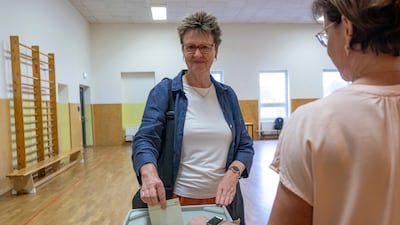
  • Petra Kopping, SPD, casts her vote for the state election in Saxony, at a polling station in Grimma, Germany. AP
    Petra Kopping, SPD, casts her vote for the state election in Saxony, at a polling station in Grimma, Germany. AP
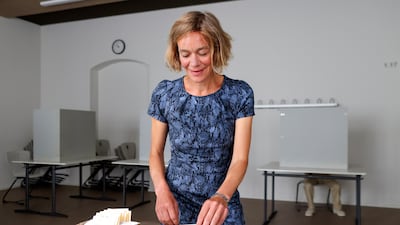
  • Juliane Nagel (Die Linke) casts her vote for the state election in Saxony, at a polling station in Leipzig, Germany. AP
    Juliane Nagel (Die Linke) casts her vote for the state election in Saxony, at a polling station in Leipzig, Germany. AP
  • Christian Democratic Union (CDU) State Premier and Saxony top candidate Michael Kretschmer stands next to his wife Annett Hofmann, as he casts his ballot during the Saxony state election in Dresden, Germany. Reuters
    Christian Democratic Union (CDU) State Premier and Saxony top candidate Michael Kretschmer stands next to his wife Annett Hofmann, as he casts his ballot during the Saxony state election in Dresden, Germany. Reuters
  • Mario Voigt (CDU) casts his ballot paper for the Thuringia state election at the polling station in Jena, Germany. AP
    Mario Voigt (CDU) casts his ballot paper for the Thuringia state election at the polling station in Jena, Germany. AP
  • People visit a polling station to vote in the Saxony state election, in Dresden, Germany. Reuters
    People visit a polling station to vote in the Saxony state election, in Dresden, Germany. Reuters

Discontent with Mr Scholz's government, which has been plagued by infighting and economic malaise, was also seen as a crucial factor.

Ministers announced a package of policies on migration, extremism and knife crime last week in what was seen as a desperate last-ditch bid to calm populist anger.

“After such a devastating defeat for the coalition parties, it should be time for a bit of humility, reflection and sorting things out,” Michael Roth, a senior MP from Mr Scholz's Social Democrats, said on Monday.

Some within the coalition appear to be “cheerfully carrying on as before”, he said. “That is like committing suicide for fear of death.”

Wake-up call

A second Social Democrat, Sebastian Roloff, said the “terrible results” in Thuringia and Saxony should be a “final wake-up call”.

“Politics, and that certainly includes the government, needs to take the concerns of the population more seriously,” he said.

Exit polls showed the AfD was especially popular among those in economic hardship. The party is strongest in the former East, where resentment at the wealthier West still lingers and racial tension has been high.

The AfD's leader in Thuringia, Bjorn Hocke, is one of the party's most prominent and divisive figures. Getty Images

Support for coalition parties was near rock bottom. The Social Democrats came fourth and fifth in the two contests. The Greens won no seats in Thuringia, and the liberal Free Democrats no seats in either state.

Wolfgang Kubicki, deputy leader of the Free Democrats, said the results showed the coalition had “lost its legitimacy”.

“When a substantial part of the population refuses to support it in this manner, that must have consequences,” he said. “People have the impression that this coalition is damaging the country.”

Christoph Hoffmann, another liberal MP, said Mr Scholz should “clear the way” for his more popular Defence Minister, Boris Pistorius.

Mr Scholz responded, calling the results worrying, speaking in his parliamentary capacity as a Social Democrat.

“Our country cannot and must not get used to this. The AfD is damaging Germany. It is weakening the economy, dividing society and ruining our country's reputation,” he said.

A knife attack in Solingen pushed crime and immigration to the top of the election agenda. Getty Images

The coalition could suffer another defeat when a third eastern state, Brandenburg, goes to the polls on September 22.

Germany's next general election is in September 2025 and there are growing doubts whether the coalition will survive until then, although it still has a comfortable majority in parliament.

Majorities in Thuringia and Saxony will be harder to attain. The centre-right Christian Democrats are in pole position to lead new coalitions, but working with the AfD is against customs and the next-strongest party, the left-populist Sahra Wagenknecht Alliance, is hardly a natural partner.

Tino Chrupalla, one of the AfD's two national leaders, said it was “ready and willing to talk to all parties”. He said there would be “no politics without the AfD”.


Avatar: Fire and Ash

Director: James Cameron

Starring: Sam Worthington, Sigourney Weaver, Zoe Saldana

Rating: 4.5/5

While you're here
Ten tax points to be aware of in 2026

1. Domestic VAT refund amendments: request your refund within five years

If a business does not apply for the refund on time, they lose their credit.

2. E-invoicing in the UAE

Businesses should continue preparing for the implementation of e-invoicing in the UAE, with 2026 a preparation and transition period ahead of phased mandatory adoption. 

3. More tax audits

Tax authorities are increasingly using data already available across multiple filings to identify audit risks. 

4. More beneficial VAT and excise tax penalty regime

Tax disputes are expected to become more frequent and more structured, with clearer administrative objection and appeal processes. The UAE has adopted a new penalty regime for VAT and excise disputes, which now mirrors the penalty regime for corporate tax.

5. Greater emphasis on statutory audit

There is a greater need for the accuracy of financial statements. The International Financial Reporting Standards standards need to be strictly adhered to and, as a result, the quality of the audits will need to increase.

6. Further transfer pricing enforcement

Transfer pricing enforcement, which refers to the practice of establishing prices for internal transactions between related entities, is expected to broaden in scope. The UAE will shortly open the possibility to negotiate advance pricing agreements, or essentially rulings for transfer pricing purposes. 

7. Limited time periods for audits

Recent amendments also introduce a default five-year limitation period for tax audits and assessments, subject to specific statutory exceptions. While the standard audit and assessment period is five years, this may be extended to up to 15 years in cases involving fraud or tax evasion. 

8. Pillar 2 implementation 

Many multinational groups will begin to feel the practical effect of the Domestic Minimum Top-Up Tax (DMTT), the UAE's implementation of the OECD’s global minimum tax under Pillar 2. While the rules apply for financial years starting on or after January 1, 2025, it is 2026 that marks the transition to an operational phase.

9. Reduced compliance obligations for imported goods and services

Businesses that apply the reverse-charge mechanism for VAT purposes in the UAE may benefit from reduced compliance obligations. 

10. Substance and CbC reporting focus

Tax authorities are expected to continue strengthening the enforcement of economic substance and Country-by-Country (CbC) reporting frameworks. In the UAE, these regimes are increasingly being used as risk-assessment tools, providing tax authorities with a comprehensive view of multinational groups’ global footprints and enabling them to assess whether profits are aligned with real economic activity. 

Contributed by Thomas Vanhee and Hend Rashwan, Aurifer

War 2

Director: Ayan Mukerji

Stars: Hrithik Roshan, NTR, Kiara Advani, Ashutosh Rana

Rating: 2/5


Classification of skills

A worker is categorised as skilled by the MOHRE based on nine levels given in the International Standard Classification of Occupations (ISCO) issued by the International Labour Organisation. 

A skilled worker would be someone at a professional level (levels 1 – 5) which includes managers, professionals, technicians and associate professionals, clerical support workers, and service and sales workers.

The worker must also have an attested educational certificate higher than secondary or an equivalent certification, and earn a monthly salary of at least Dh4,000. 

Updated: September 02, 2024, 10:36 AM