• Leader of left-wing Sahra Wagenknecht Alliance, Sahra Wagenknecht, left, and Thuringia's BSW top candidate Katja Wolf, third right, at the party's election night at the Dompalais in Erfurt, eastern Germany, on September 1. AFP
    Leader of left-wing Sahra Wagenknecht Alliance, Sahra Wagenknecht, left, and Thuringia's BSW top candidate Katja Wolf, third right, at the party's election night at the Dompalais in Erfurt, eastern Germany, on September 1. AFP
  • Top candidates of the new German left-wing party Buendnis Sahra Wagenknecht in Saxony, Sabine Zimmermann and Joerg Scheibe, on stage after the first exit polls for Saxony's state elections during the party's election night at Hotel Penck in Dresden, Germany. AFP
    Top candidates of the new German left-wing party Buendnis Sahra Wagenknecht in Saxony, Sabine Zimmermann and Joerg Scheibe, on stage after the first exit polls for Saxony's state elections during the party's election night at Hotel Penck in Dresden, Germany. AFP
  • Joerg Urban, lead candidate of the far-right party Alternative for Germany, speaks to AfD supporters. EPA
    Joerg Urban, lead candidate of the far-right party Alternative for Germany, speaks to AfD supporters. EPA
  • Bodo Ramelow, Thuringia Premier and member of the leftist Die Linke political party, casts his ballot in the Thuringia state elections in Erfurt, Germany. EPA
    Bodo Ramelow, Thuringia Premier and member of the leftist Die Linke political party, casts his ballot in the Thuringia state elections in Erfurt, Germany. EPA
  • Thomas Kemmerich votes in the state election in Saxony, at a polling station in Weimar, Germany. AP
    Thomas Kemmerich votes in the state election in Saxony, at a polling station in Weimar, Germany. AP
  • Alternative for Germany party faction chairman in the regional parliament of Thuringia and top candidate for the 2024 Thuringia state election, Bjoern Hoecke, left, casts his ballot in Bornhagen, Germany. EPA
    Alternative for Germany party faction chairman in the regional parliament of Thuringia and top candidate for the 2024 Thuringia state election, Bjoern Hoecke, left, casts his ballot in Bornhagen, Germany. EPA
  • Katja Wolf, BSW, casts her vote for the state election in Thuringia, at a polling station in Eisenach, Germany. AP
    Katja Wolf, BSW, casts her vote for the state election in Thuringia, at a polling station in Eisenach, Germany. AP
  • Madeleine Henfling, The Greens, casts her vote for the state election in Thuringia, at a polling station in Ilmenau, Germany. AP
    Madeleine Henfling, The Greens, casts her vote for the state election in Thuringia, at a polling station in Ilmenau, Germany. AP
  • Stefan Hartmann (Die Linke) casts his vote for the state election in Saxony, at a polling station in Leipzig, Germany. AP
    Stefan Hartmann (Die Linke) casts his vote for the state election in Saxony, at a polling station in Leipzig, Germany. AP
  • Sabine Zimmermann (BSW) casts her vote for the state election in Saxony, at a polling station in Werdau, Germany. AP
    Sabine Zimmermann (BSW) casts her vote for the state election in Saxony, at a polling station in Werdau, Germany. AP
  • Petra Kopping, SPD, casts her vote for the state election in Saxony, at a polling station in Grimma, Germany. AP
    Petra Kopping, SPD, casts her vote for the state election in Saxony, at a polling station in Grimma, Germany. AP
  • Juliane Nagel (Die Linke) casts her vote for the state election in Saxony, at a polling station in Leipzig, Germany. AP
    Juliane Nagel (Die Linke) casts her vote for the state election in Saxony, at a polling station in Leipzig, Germany. AP
  • Christian Democratic Union (CDU) State Premier and Saxony top candidate Michael Kretschmer stands next to his wife Annett Hofmann, as he casts his ballot during the Saxony state election in Dresden, Germany. Reuters
    Christian Democratic Union (CDU) State Premier and Saxony top candidate Michael Kretschmer stands next to his wife Annett Hofmann, as he casts his ballot during the Saxony state election in Dresden, Germany. Reuters
  • Mario Voigt (CDU) casts his ballot paper for the Thuringia state election at the polling station in Jena, Germany. AP
    Mario Voigt (CDU) casts his ballot paper for the Thuringia state election at the polling station in Jena, Germany. AP
  • People visit a polling station to vote in the Saxony state election, in Dresden, Germany. Reuters
    People visit a polling station to vote in the Saxony state election, in Dresden, Germany. Reuters

German far-right party AfD wins first regional election


Lemma Shehadi
  • English
  • Arabic

Germany's far-right Alternative for Germany party (AfD) has won its first regional election in the former East German state of Thuringia, taking between 32 and 33 per cent of the vote, exit polls showed on Sunday.

In neighbouring Saxony, projections put support for the Christian Democratic Union of Germany party (CDU), which has led the state since German reunification in 1990, at 31.5-31.8 per cent and AfD on 30.8-31.4 per cent.

The new Sahra Wagenknecht Alliance, or BSW, took up to 16 per cent of the vote in Thuringia and 12 per cent in Saxony.

Protests against the far right in Germany – in pictures

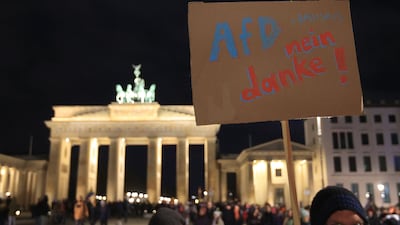
  • Demonstrators at the Brandenburg Gate in Berlin protest against the Alternative fur Deutschland (AfD) party. Bloomberg
    Demonstrators at the Brandenburg Gate in Berlin protest against the Alternative fur Deutschland (AfD) party. Bloomberg
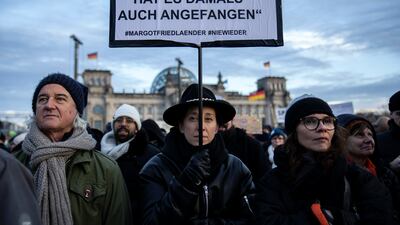
  • A woman in front of the Reichstag building in Berlin with a sign reading 'That's exactly how it started back then' during a protest against the AfD and right-wing extremism. AP
    A woman in front of the Reichstag building in Berlin with a sign reading 'That's exactly how it started back then' during a protest against the AfD and right-wing extremism. AP
  • People in Munich gather to protest. Getty Images
    People in Munich gather to protest. Getty Images
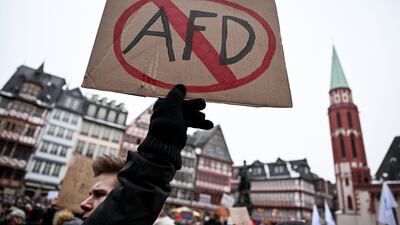
  • A demonstration in Frankfurt am Main. AFP
    A demonstration in Frankfurt am Main. AFP
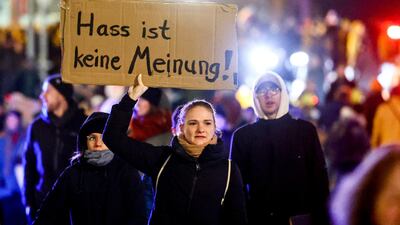
  • A protester with a sign reading 'hate is no opinion' during a demonstration in Berlin. EPA
    A protester with a sign reading 'hate is no opinion' during a demonstration in Berlin. EPA
  • Protesters in Munich. AFP
    Protesters in Munich. AFP
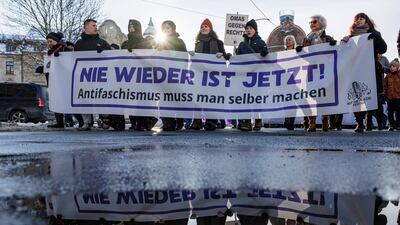
  • Participants hold a banner reading 'Never again is now!' during a demonstration in Erfurt. AFP
    Participants hold a banner reading 'Never again is now!' during a demonstration in Erfurt. AFP
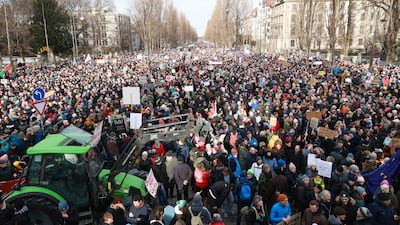
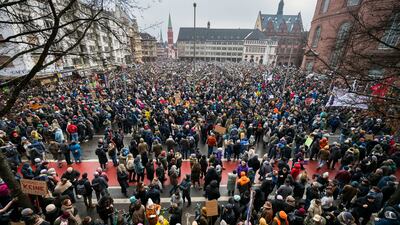
  • People gather in Berlin to protest against the AfD party and right-wing extremism. AP
    People gather in Berlin to protest against the AfD party and right-wing extremism. AP
  • A large protest in Frankfurt. Getty Images
    A large protest in Frankfurt. Getty Images

“This is a historic success for us,” Alice Weidel, a national co-leader of AfD, told German broadcaster ARD. She described the result as a “requiem” for Chancellor Olaf Scholz's coalition.

The CDU's national general secretary, Carsten Linnemann, said that “voters in both states knew that we wouldn't form a coalition with AfD, and it will stay that way – we are very, very clear on this”.

Ms Weidel denounced that as “pure ignorance” and said that “voters want AfD to participate in a government”.

“An openly right-wing extremist party has become the strongest force in a state parliament for the first time since 1949, and that causes many people very deep concern and fear,” said Omid Nouripour, a leader of the Greens, one of the national governing parties.

Despite the results, a custom in German politics that prevents parties from collaborating with the far-right, known as a firewall, will be tested.

The party would be unable to form a state government as it lacks the required majority, and other parties would be unwilling to go into coalition with it.

Both the AfD and BSW are anti-migration, Eurosceptic, pro-Russia and are particularly strong in the former Communist-run East, where concerns about a cost of living crisis, the Ukraine war and immigration run deep.

The results come after Germany unveiled stricter measures on asylum seekers, in the wake of an ISIS-inspired attack by a Syrian citizen in Solingen.

The package unveiled by Mr Scholz included stripping the asylum status for refugees who return home on holiday.

The elections are two of the three regional elections planned in East Germany, and the results will serve as an indicator for the general elections in September 2025.

'Stop calling voters Neo Nazis'

The growth of the AfD’s popularity was a sign that mainstream politicians were not taking voters seriously enough, according to a German diplomat.

“We should stop calling the voters Neo Nazis. These are people who protest with their vote. So we have to take this seriously, and we have to try to address that,’ said German ambassador to the UK Miguel Berger on Sunday.

“We should not forget that more than half of people don’t vote for the extremes,” he told Sky News.

Another risk is that mainstream parties could start to mirror policies proposed by the far-right.

Germany deported 28 Afghan asylum seekers back to Afghanistan on Friday, with Syrians set to be next.

“We had a terrible terrorist attack by a Syrian refugee, which has highlighted the necessity that we need to be able to deport criminals who came among the asylum seekers,” Mr Berger said.

“What we need is really a possibility to deport those who have been criminals and to integrate the others, so we want to make both.”


How to report a beggar

Abu Dhabi – Call 999 or 8002626 (Aman Service)

Dubai – Call 800243

Sharjah – Call 065632222

Ras Al Khaimah - Call 072053372

Ajman – Call 067401616

Umm Al Quwain – Call 999

Fujairah - Call 092051100 or 092224411

COMPANY%20PROFILE
%3Cp%3E%3Cstrong%3EName%3A%3C%2Fstrong%3E%20Carzaty%2C%20now%20Kavak%3Cbr%3E%3Cstrong%3EBased%3A%3C%2Fstrong%3E%20Dubai%3Cbr%3E%3Cstrong%3ELaunch%20year%3A%20%3C%2Fstrong%3ECarzaty%20launched%20in%202018%2C%20Kavak%20in%20the%20GCC%20launched%20in%202022%3Cbr%3E%3Cstrong%3ENumber%20of%20employees%3A%3C%2Fstrong%3E%20140%3Cbr%3E%3Cstrong%3ESector%3A%3C%2Fstrong%3E%20Automotive%3Cbr%3E%3Cstrong%3EFunding%3A%20%3C%2Fstrong%3ECarzaty%20raised%20%246m%20in%20equity%20and%20%244m%20in%20debt%3B%20Kavak%20plans%20%24130m%20investment%20in%20the%20GCC%3C%2Fp%3E%0A
The specs

Price, base / as tested Dh1,100,000 (est)

Engine 5.2-litre V10

Gearbox seven-speed dual clutch

Power 630bhp @ 8,000rpm

Torque 600Nm @ 6,500rpm

Fuel economy, combined 15.7L / 100km (est) 

KINGDOM%20OF%20THE%20PLANET%20OF%20THE%20APES
%3Cp%3E%3Cstrong%3EDirector%3A%3C%2Fstrong%3E%20Wes%20Ball%3C%2Fp%3E%0A%3Cp%3E%3Cstrong%3EStarring%3A%3C%2Fstrong%3E%20Owen%20Teague%2C%20Freya%20Allen%2C%20Kevin%20Durand%3C%2Fp%3E%0A%3Cp%3E%3Cstrong%3ERating%3A%20%3C%2Fstrong%3E3.5%2F5%3C%2Fp%3E%0A
Soldier F

“I was in complete disgust at the fact that only one person was to be charged for Bloody Sunday.

“Somebody later said to me, 'you just watch - they'll drop the charge against him'. And sure enough, the charges against Soldier F would go on to be dropped.

“It's pretty hard to think that 50 years on, the State is still covering up for what happened on Bloody Sunday.”

Jimmy Duddy, nephew of John Johnson

The Great Derangement: Climate Change and the Unthinkable
Amitav Ghosh, University of Chicago Press

Milestones on the road to union

1970

October 26: Bahrain withdraws from a proposal to create a federation of nine with the seven Trucial States and Qatar. 

December: Ahmed Al Suwaidi visits New York to discuss potential UN membership.

1971

March 1:  Alex Douglas Hume, Conservative foreign secretary confirms that Britain will leave the Gulf and “strongly supports” the creation of a Union of Arab Emirates.

July 12: Historic meeting at which Sheikh Zayed and Sheikh Rashid make a binding agreement to create what will become the UAE.

July 18: It is announced that the UAE will be formed from six emirates, with a proposed constitution signed. RAK is not yet part of the agreement.

August 6:  The fifth anniversary of Sheikh Zayed becoming Ruler of Abu Dhabi, with official celebrations deferred until later in the year.

August 15: Bahrain becomes independent.

September 3: Qatar becomes independent.

November 23-25: Meeting with Sheikh Zayed and Sheikh Rashid and senior British officials to fix December 2 as date of creation of the UAE.

November 29:  At 5.30pm Iranian forces seize the Greater and Lesser Tunbs by force.

November 30: Despite  a power sharing agreement, Tehran takes full control of Abu Musa. 

November 31: UK officials visit all six participating Emirates to formally end the Trucial States treaties

December 2: 11am, Dubai. New Supreme Council formally elects Sheikh Zayed as President. Treaty of Friendship signed with the UK. 11.30am. Flag raising ceremony at Union House and Al Manhal Palace in Abu Dhabi witnessed by Sheikh Khalifa, then Crown Prince of Abu Dhabi.

December 6: Arab League formally admits the UAE. The first British Ambassador presents his credentials to Sheikh Zayed.

December 9: UAE joins the United Nations.

Updated: September 02, 2024, 3:56 AM