

In a swimming pool in an eastern suburb of Paris, Marie-Louise Mangho-Kuete, 49, practises floating on her stomach without touching her trainer. There is hope that in a few months, she will manage to float alone.
Ms Mangho-Kuete, who contracted polio as a child in her native Cameroon, has worked for months on conquering her fears after several bad experiences in sport.
Like many involved in supporting people with disabilities, she has high hopes that the Paris Paralympic Games, which start on Wednesday, will make it easier for others.
“As a child at school, it was written in my report that I was unfit for sports,” she told The National. “When society considers us unfit, we integrate that idea and think that sport isn't meant for us.”
Many hope that sports will become more accessible for people with physical disabilities in France thanks to the Paris Paralympic Games, scheduled to start just over two weeks after the end of the Olympic Games, and running from August 28 to September 8.
-
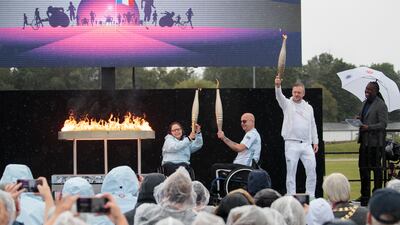
Para athletes Helene Raynsford, left, Gregor Ewan, centre, and IPC president Andrew Parsons during the Paralympic flame lighting ceremony at Stoke Mandeville Stadium. Getty Images -
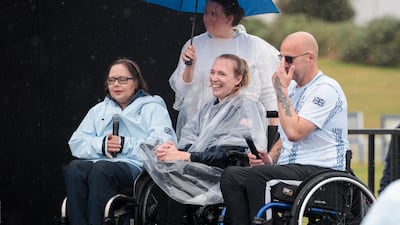
Para athletes Helene Raynsford, Sophie Christiansen, and Gregor Ewan at the Stoke Mandeville Stadium. Getty Images -
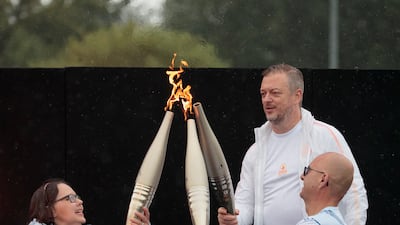
Helene Raynsford, left, Gregor Ewan, right, and IPC chief Andrew Parsons light the Paralympic flame on Saturday. Getty Images -
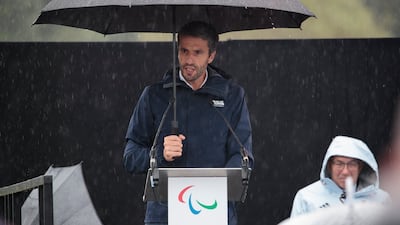
Tony Estanguet, Paris 2024 organising committee president, at the Stoke Mandeville Stadium. Getty Images -
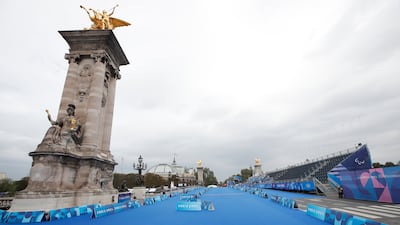
The Alexandre III bridge which will be used for triathlon during the Paralympic Games in Paris. AP


What legacy?
The legacy of the Games, both Olympic and Paralympic, has become a key argument to boost their popularity amid high costs for taxpayers.
This is the first time that Paralympic Games have been organised in France, further increasing pressure on the state to open up access to sports for its disabled population, of which only one third regularly takes part in any sport. At 65 per cent, that figure is more than double among the rest of the population older than 15.
Efforts have been made, with the training of more than 3,000 sports clubs across France, to host people with disabilities.
In Paris, their number has quadrupled from 10 to 40 in the past six years. Investments have been made in public swimming pools, such as the 1934 art deco Pontoise pool in the heart of Paris, to make them more accessible.
There has also been renewed focus on making transport more user-friendly.
An interministerial committee commissioned 15 people with disabilities to conduct accessibility tests, particularly at Charles de Gaulle international airport and in train stations.

A project to revamp the Metro at a cost of up to €20 million ($22.3 million) was unveiled on Monday by the president of the Ile-de-France region, Valerie Pecresse.
Currently, only 20 per cent of the city's trains are accessible to people with disabilities, a “black point” for the city during the global competition, said Ms Pecresse.
The same amount was put on the table by the state in 2020 to develop high-level sports, including for people with disabilities.
“It's something really important for me,” said Ms Mangho-Kuete, a special-education teacher in a children's psychiatric hospital, who also works for an NGO that defends the rights of people with disabilities.
“It's important to show that sport is important for everyone. I hope [the momentum] won't stop with the Games and that we'll benefit from infrastructure to help us continue practising sports.”
Growing up in a supportive family helped Ms Mangho-Kuete with her self-confidence. As a young adult, she wanted to exercise but developed a fear of water after a bad experience in a swimming class. Later she joined a gym but the classes were not adapted for her and she stopped.
Ten years ago, she discovered Lapla'jh, an association that gives sports lessons to people with disabilities. Its name is also a play on the word for “beach” (plage) in French.
With weekly swimming lessons, she has gained strength. She can now walk up stairs and is less tense when moving in public spaces.
“I've been able to lower my hypervigilance and hold my head higher,” Ms Mangho-Kuete said. “Being constantly aware of your surroundings, because others don't look where they're walking and sometimes inadvertently kick my crutches away from me, can be very tiring.”
Lapla'jh's founder, Nathalie Dagnet, was among the 11,000 people chosen to carry the Olympic Torch. She also has high expectations for the Paralympic Games. “I hope … they change perception and change priorities, because now people with disabilities are not priorities,” she said.
'Inspirational model' not enough
Yet past examples are not encouraging, researchers say. The 2012 London Games, viewed at the time as the most successful Paralympics in history, did not cause a significant increase in disabled people's participation in sports, according to a study published five years later by Athanasios Pappous, a researcher at the University of Bologna, Italy. Participation peaked one year after the London Games but slumped in 2016.
Mega-sporting events should not be used as policy intervention to increase participation in sports, wrote Mr Pappous. Rather, “bottom-up solutions designed and managed in conjunction with people with disabilities may be more effective”, he said in the article he co-wrote with Christopher Brown of the University of Hertfordshire.
Many expect similar results after the Paris Paralympics. Media reports have shown that the Games have already encouraged people to take part in more sports, especially those in which French athletes excelled during the Games such as swimming, with four gold medals won by Leon Marchand, 22.
At Pontoise swimming pool, which reopened in December after several years of work at a cost of €17 million, more people have been coming since the Games, said its director, Louis-Jonathan Victor.
“We're confident swimming will become more popular in France in the years to come,” he told The National.
The pool now features a lift, adapted changing rooms and a special chair to lower swimmers into the water if they wish.
But enthusiasm for sports will not last without significant public investment, said Sylvain Ferez, director of the health, education, disability situations research unit at the University of Montpellier in France.
Long-term support is necessary to make sure the 3,000 sports clubs trained to host people with disabilities remain relevant, yet no funds have been allocated to monitor their development, he warned.
“One of the lessons of London is that we used to think that the inspirational model was enough, meaning it was enough for people to see people like them doing sport on TV to want to do it,” Mr Ferez told The National.
“But once the Games are over and people pick up the phone and look for a practical offer, we know very well that the offer is very limited.”
Goodwill and kindness are not enough, said Mr Ferez. “A mega-sporting event can at best shine the spotlight on an issue. At worst, it's just a communication exercise.”
Even the most ardent supporters of the Olympics have had their disappointments. Like many local councillors, Ms Mangho-Kuete received free tickets to sporting events. But they turned out to be a tedious exercise.
“I've loved watching the Games. The only issue has been getting there and back,” she said. “You have to be highly motivated.”

There were problems with the car that picked her up, along with two other people in wheelchairs. The promised carts to move around the premises never materialised.
Despite being thrilled by the opening ceremony on the Seine, she returned home at 3am to her Paris suburb of Noisy-Le-Grand, exhausted, after waiting for a return car that never appeared. She had to walk to find a taxi.
The organisers had not answered a request for comment by the time this article was published.
Ms Mangho-Kuete is now worried that she will have a similarly difficult time attending para taekwondo on Friday and para athletics the following week. People she met there were kind, she said, but the whole system needs fixing.
“I don't expect a miracle, because I'm used to daily frustrations linked to accessibility issues. But I do hope for something more fluid.”

