

Live updates: Follow the latest news on Israel-Gaza
The EU's foreign ministers have agreed to call a bilateral council meeting with Israel to discuss the country's compliance with its human rights obligations under the EU-Israel Association Agreement.
The request comes amid fears that Israel is violating an International Court of Justice ruling ordering it to stop its military offensive against Rafah and just days after more than 40 Palestinians died in an airstrike.
It was first lodged by Spain and Ireland in February but had not received sufficient backing until Monday's meeting of the bloc's 27 foreign affairs ministers.
The fact that ministers agreed on holding such a meeting represents a first step towards the EU possibly adopting retaliatory measures against Israeli Prime Minister Benjamin Netanyahu's government for the conduct of its war in Gaza.
It would represent an opportunity for the bloc to question Israeli officials about their country's compliance with the ICJ ruling that was issued on Friday and possible breaches of human rights and international law.
A review of the agreement may lead to its suspension, but this would require unanimous backing from all EU member states.
Such a move remains unlikely since a number of countries such as Germany, Hungary and the Czech Republic have been hesitant to adopt language that may appear critical of Israel.
"Member states have a consensus for calling for the association council, so the necessary procedures will be made to extend invitations and have preparatory discussions," foreign affairs and security spokesperson Peter Stano told reporters on Tuesday.
There is "hope the Israeli side will accept the invitation sooner rather than later because issues the member states want to discuss with Israel are quite urgent," said Mr Stano.
A suspension of the agreement would represent a significant blow to Israel because the EU is its first trading partner. Israeli goods have preferential access to the EU under the EU-Israel Association Agreement, signed in 2000.
Under Article 2 of the agreement passed in 2000, it stipulates the deal is “based on respect for human rights and democratic principles”.
The last association council meeting was held in 2022 for the first time in ten years under the previous Israeli government led by Yair Lapid. The delays in between meetings were caused by disagreements among EU countries, with some, viewed as more pro-Palestinian, saying that they should only take place in parallel with meetings with Palestinian officials.
Josep Borrell, the EU foreign affairs high representative, told reporters after Monday's meeting that the "necessary unanimity" had been found to call for a council meeting with Israel. He said the aim would be "to discuss the respect to human rights under the obligations that Israel has assumed under the association council and how they plan to implement the ruling of the [ICJ] court."
Civilians ordered to flee eastern Rafah as Israel begins invasion – in pictures
-
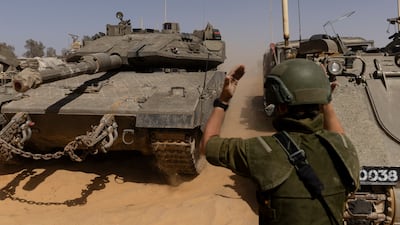
An Israeli soldier directs a tank near Israel's border with southern Gaza. Getty Images -
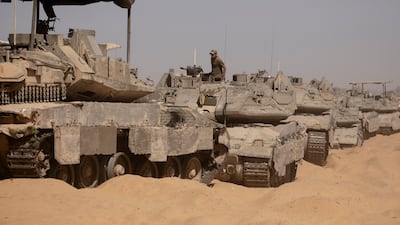
An Israeli soldier stands on a tank in southern Israel. Getty Images -
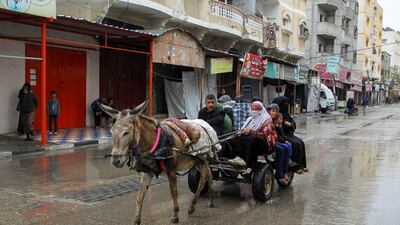
People flee the eastern parts of Rafah ahead of a threatened Israeli incursion. Reuters -
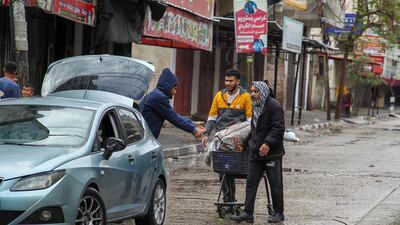
Palestinians leave ahead of a threatened assault on Rafah. Reuters -

Palestinians search for casualties in the rubble of a house destroyed in an Israeli strike in Rafah. AFP -

Palestinians carry an injured man who was pulled from the rubble of a house destroyed in an Israeli strike in Rafah. AFP -
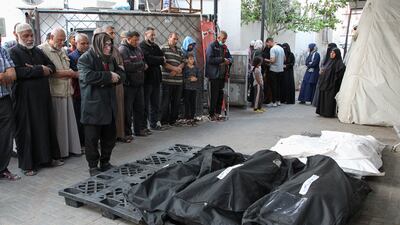
Mourners next to the bodies of Palestinians killed in an Israeli strike in southern Gaza. Reuters -
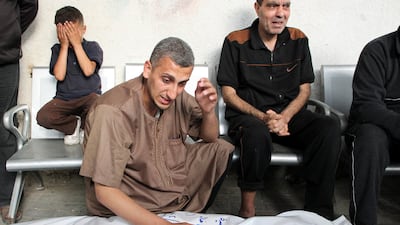
Mourners at Abu Yousef El-Najjar Hospital in Rafah. Reuters


Belgian Foreign Minister Hadja Lahbib said the move to convene an Association Council sends a “strong signal.”
“We must ensure that our rules and values are respected by all, and above all by our partners like Israel. Our credibility depends on it,” Ms Lahbib said.
Slovenia's Tanja Fajon, whose government is looking at recognising the state of Palestine, and other foreign ministers called for the bloc to go further by imposing sanctions on Israel for its continued violations of international law in the Gaza Strip.
“I strongly condemn Israel's attack last night on the displaced Palestinians, in which many children were also burned to death,” Ms Fajon said in a post on X.
“In Brussels today, I will stand up for respect for international humanitarian law and decision [of the] ICJ.
“In case of continuing violations, [the] EU must react uniformly and decisively, including sanctions.”
In light of rising tension with Israel after Ireland, Norway and Spain decided to recognise the state of Palestine, Mr Borrell declined to comment on whether he believed the Israelis would agree to attend the Association Council.
On Sunday, Spain's Foreign Affairs Minister Jose Manuel Albares condemned as “scandalous and execrable” a video posted by Israeli Foreign Minister Israel Katz suggesting Hamas would be grateful to Spain, in a growing dispute between the two countries over the Gaza war.
A short video posted by Mr Katz on X on Sunday says “Hamas: Gracias Espana” (“Hamas: Thanks Spain”).
The video shows the Spanish flag and then a couple dancing to flamenco music.
Film of Hamas fighters is interspersed, including people fleeing during the October 7 attacks on southern Israel that led to Israel's military campaign in Gaza.
“We are not going to fall into provocations. The video is scandalous and execrable,” Mr Albares told a news conference in Brussels.
“Its scandalous because all the world knows, including my colleague in Israel, that Spain condemned the actions of Hamas from the first moment.
“And execrable for the use of one of those symbols of Spanish culture.”
The EU, like the US and Israel, considers Hamas to be a terrorist organisation.
The top EU diplomat said there is no appetite for imposing sanctions on Israel for its actions in Gaza at the moment, but that this could change if Netanyahu's government “continues to ignore” the ICJ's ruling.
Mr Borrell said on Sunday that if Israel disregards the ICJ ruling and continues its attack on Rafah: “It would be against the rules-based world order we support and promote everywhere.”
We “emphasise the crucial importance of fully respecting this decision of the ICJ”, Mr Borrell said.
“If one of the parties is not satisfied by the decision of the court it can of course address a specific request for interpretation, but not disregard it.”
He said the ICJ decisions do not intend to target the “brave people of Israel”, saying they also deserve to live in peace and security, side by side with the Palestinian people.

