• Human rights activists protest outside the European Parliament ahead of a vote on the Pact on Asylum and Migration in Brussels, Belgium. Reuters
    Human rights activists protest outside the European Parliament ahead of a vote on the Pact on Asylum and Migration in Brussels, Belgium. Reuters
  • Demonstrators protest out the European Parliament. Reuters
    Demonstrators protest out the European Parliament. Reuters
  • A woman waves a flag in support of refugees in Brussels. Reuters
    A woman waves a flag in support of refugees in Brussels. Reuters
  • Despite opposition from far-right and far-left parties, the parliament passed the new migration and asylum pact, enshrining a difficult overhaul nearly a decade in the making. Reuters
    Despite opposition from far-right and far-left parties, the parliament passed the new migration and asylum pact, enshrining a difficult overhaul nearly a decade in the making. Reuters
  • Migrant charities slammed the pact, which includes building border centres to hold asylum seekers and sending some to outside 'safe' countries. Reuters
    Migrant charities slammed the pact, which includes building border centres to hold asylum seekers and sending some to outside 'safe' countries. Reuters
  • The vote was initially disrupted by protesters. Reuters
    The vote was initially disrupted by protesters. Reuters
  • The pact's measures are due to come into force in 2026, after the European Commission sets out in the coming months how it would be enacted. EPA
    The pact's measures are due to come into force in 2026, after the European Commission sets out in the coming months how it would be enacted. EPA

EU adopts large-scale reform of asylum and migration policies


Soraya Ebrahimi
  • English
  • Arabic

The European Parliament on Wednesday voted in favour of introducing a sweeping reform of Europe's asylum policies that will both harden border procedures and force all the bloc's 27 nations to share responsibility for migration.

Despite opposition from far-right and far-left parties, the parliament passed the new migration and asylum pact, enshrining a difficult overhaul nearly a decade in the making.

The measure will “secure European borders … while ensuring the protection of the fundamental rights” of migrants, European Commission President Ursula von der Leyen said.

“We must be the ones to decide who comes to the European Union and under what circumstances, and not the smugglers and traffickers.”

EU governments – a majority of which previously approved the pact – also welcomed its adoption.

German Chancellor Olaf Scholz and Greece's Migration Minister Dimitris Kairidis both called it “historic”.

Migrant charities, though, immediately slammed the pact, which includes building border centres to hold asylum seekers and sending some to outside “safe” countries.

Amnesty International said the EU has “shamefully” backed a deal “they know will lead to greater human suffering” while the Red Cross federation urged member states “to guarantee humane conditions for asylum seekers and migrants affected”.

The vote itself was initially disrupted by protesters yelling, “The pact kills – vote no!", while dozens of demonstrators outside the parliament building in Brussels held up placards with slogans decrying the reform.

The parliament's far-left group, which maintains that the reforms are incompatible with Europe's commitment to upholding human rights, said it was a “dark day”.

It was “a pact with the devil”, said Damien Careme, a politician from the Greens group.

Far-right politicians had also opposed the passage of the 10 laws making up the pact, saying it was insufficient to stop irregular migrants they accuse of spreading insecurity and threatening to “submerge” European identity.

Marine Le Pen, the figurehead of France's far-right National Rally, posted on the social media platform X that the changes would give “legal impunity to NGOs complicit with smugglers”.

She and her party's leader who sits in the European Parliament, Jordan Bardella, said they would seek to overturn the reform after EU elections in June, which are tipped to boost far-right numbers in the legislature.

The pact's measures are due to come into force in 2026, after the European Commission sets out in the coming months how it would be enacted.

New border centres would hold migrants while their asylum requests are vetted and deportations of those deemed inadmissible would be sped up.

The pact also requires EU countries to take in thousands of asylum seekers from “frontline” states such as Italy and Greece, or – if they refuse – to provide money or other resources to the under-pressure nations.

Migrants arriving in Europe – in pictures

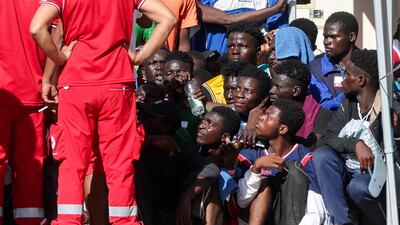
  • Migrants at a reception centre on the Sicilian island of Lampedusa, Italy. Reuters
    Migrants at a reception centre on the Sicilian island of Lampedusa, Italy. Reuters
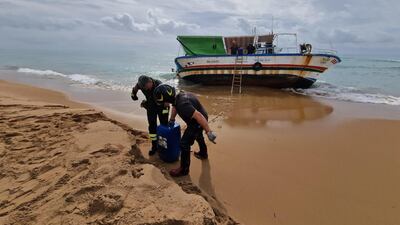
  • Italian firefighters in Marinella di Selinunte, Sicily, remove fuel cans from a boat used by migrants to cross the Mediterranean. EPA
    Italian firefighters in Marinella di Selinunte, Sicily, remove fuel cans from a boat used by migrants to cross the Mediterranean. EPA
  • Migrants on the Sicilian island of Lampedusa, Italy. Reuters
    Migrants on the Sicilian island of Lampedusa, Italy. Reuters
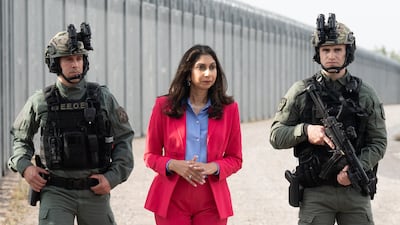
  • UK Home Secretary Suella Braverman in Alexandroupolis during a visit to the north-eastern Greek border with Turkey to see surveillance facilities and learn how Greek security forces monitor the land border. PA
    UK Home Secretary Suella Braverman in Alexandroupolis during a visit to the north-eastern Greek border with Turkey to see surveillance facilities and learn how Greek security forces monitor the land border. PA
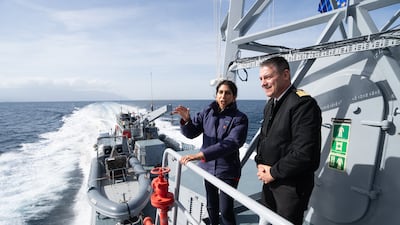
  • Ms Braverman on board an Hellenic Coastguard patrol vessel with Coastal Commander Dimitri Tsinias off the island of Samos. PA
    Ms Braverman on board an Hellenic Coastguard patrol vessel with Coastal Commander Dimitri Tsinias off the island of Samos. PA
  • A group of people thought to be migrants in Grande-Synthe, northern France after French police dismantled their camp clearing their tents and shelters. PA
    A group of people thought to be migrants in Grande-Synthe, northern France after French police dismantled their camp clearing their tents and shelters. PA
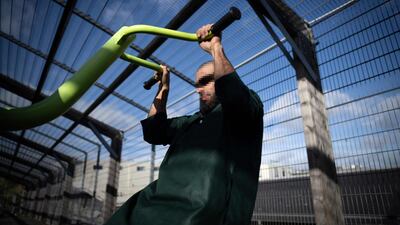
  • A migrant works out in the recreation area of the Centre de Retention Administrative, a migrant detention centre in Vincennes, France. AFP
    A migrant works out in the recreation area of the Centre de Retention Administrative, a migrant detention centre in Vincennes, France. AFP
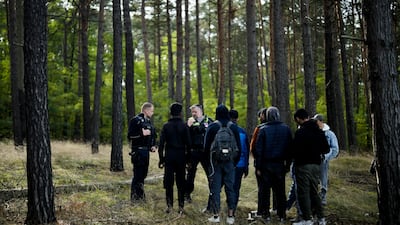
  • A Federal Police officer and a colleague in a forest near Forst, south-east of Berlin, with a group of migrants who illegally crossed the border from Poland into Germany. AP
    A Federal Police officer and a colleague in a forest near Forst, south-east of Berlin, with a group of migrants who illegally crossed the border from Poland into Germany. AP
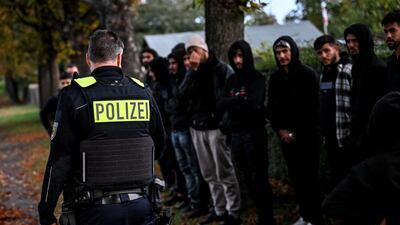
  • Migrants after being detained by German police in Forst, Germany. EPA
    Migrants after being detained by German police in Forst, Germany. EPA

Hungary, run by an anti-immigration government that fiercely rejected the pact, reaffirmed that it would not be taking in any asylum seekers.

“This new migration pact practically gives the green light to illegal migration to Europe,” Hungary's Foreign Minister Peter Szijjarto said before the vote.

“No matter what kind of migration pact the MEPs vote for, we will not give up on the physical border barrier … we will not allow illegal migrants to set foot here in Hungary.”

The German Chancellor, though, also commenting on X, said the accord stands for “solidarity among European states” and would “finally relieve the burden on those countries that are particularly hard hit”.

One measure particularly criticised by migrant charities is the sending of asylum seekers to countries outside the EU deemed “safe”, if the migrant has sufficient ties to that country.

The pact resulted from years of arduous negotiations spurred by a massive inflow of migrants in 2015, many from war-torn Syria and Afghanistan.

Under current EU rules, the arrival country bears responsibility for hosting and vetting asylum seekers as well as returning those deemed inadmissible. That has put southern states under pressure and fuelled far-right opposition.

A political breakthrough came in December when a weighted majority of EU countries backed the reforms, overcoming opposition from Hungary and Poland.

In parallel with the reform, the EU has been multiplying the same sort of deal it struck with Turkey in 2016 to stem migratory flows.

It has reached accords with Tunisia and, most recently, Egypt that are portrayed as broader co-operation arrangements. Many politicians have, however, criticised the deals.


10 tips for entry-level job seekers
  • Have an up-to-date, professional LinkedIn profile. If you don’t have a LinkedIn account, set one up today. Avoid poor-quality profile pictures with distracting backgrounds. Include a professional summary and begin to grow your network.
  • Keep track of the job trends in your sector through the news. Apply for job alerts at your dream organisations and the types of jobs you want – LinkedIn uses AI to share similar relevant jobs based on your selections.
  • Double check that you’ve highlighted relevant skills on your resume and LinkedIn profile.
  • For most entry-level jobs, your resume will first be filtered by an applicant tracking system for keywords. Look closely at the description of the job you are applying for and mirror the language as much as possible (while being honest and accurate about your skills and experience).
  • Keep your CV professional and in a simple format – make sure you tailor your cover letter and application to the company and role.
  • Go online and look for details on job specifications for your target position. Make a list of skills required and set yourself some learning goals to tick off all the necessary skills one by one.
  • Don’t be afraid to reach outside your immediate friends and family to other acquaintances and let them know you are looking for new opportunities.
  • Make sure you’ve set your LinkedIn profile to signal that you are “open to opportunities”. Also be sure to use LinkedIn to search for people who are still actively hiring by searching for those that have the headline “I’m hiring” or “We’re hiring” in their profile.
  • Prepare for online interviews using mock interview tools. Even before landing interviews, it can be useful to start practising.
  • Be professional and patient. Always be professional with whoever you are interacting with throughout your search process, this will be remembered. You need to be patient, dedicated and not give up on your search. Candidates need to make sure they are following up appropriately for roles they have applied.

Arda Atalay, head of Mena private sector at LinkedIn Talent Solutions, Rudy Bier, managing partner of Kinetic Business Solutions and Ben Kinerman Daltrey, co-founder of KinFitz

In-demand jobs and monthly salaries
  • Technology expert in robotics and automation: Dh20,000 to Dh40,000 
  • Energy engineer: Dh25,000 to Dh30,000 
  • Production engineer: Dh30,000 to Dh40,000 
  • Data-driven supply chain management professional: Dh30,000 to Dh50,000 
  • HR leader: Dh40,000 to Dh60,000 
  • Engineering leader: Dh30,000 to Dh55,000 
  • Project manager: Dh55,000 to Dh65,000 
  • Senior reservoir engineer: Dh40,000 to Dh55,000 
  • Senior drilling engineer: Dh38,000 to Dh46,000 
  • Senior process engineer: Dh28,000 to Dh38,000 
  • Senior maintenance engineer: Dh22,000 to Dh34,000 
  • Field engineer: Dh6,500 to Dh7,500
  • Field supervisor: Dh9,000 to Dh12,000
  • Field operator: Dh5,000 to Dh7,000
When is VAR used?

Goals

Penalty decisions

Direct red-card incidents

Mistaken identity

MATCH INFO

Day 2 at the Gabba

Australia 312-1 

Warner 151 not out, Burns 97,  Labuschagne 55 not out

Pakistan 240 

Shafiq 76, Starc 4-52

Match info

Uefa Nations League A Group 4

England 2 (Lingard 78', Kane 85')
Croatia 1 (Kramaric 57')

Man of the match: Harry Kane (England)

Updated: April 10, 2024, 7:18 PM