
US President Donald Trump on Friday said Iran is in "big trouble" and reiterated his threat to attack the country if authorities there kill large numbers of protesters.
He spoke after Iran's supreme leader Ayatollah Ali Khamenei struck a defiant note against the spiralling nationwide protests, saying "we will not back down".
Mr Trump said he is watching the unfolding situation "very closely" and expressed surprise at the extent of the protests across Iran.
"Iran's in big trouble," he said at a meeting of oil executives at the White House. "It looks to me that the people are taking over certain cities that nobody thought were really possible just a few weeks ago."
He repeated an earlier warning to the Iranian government, saying the US would "get involved" if authorities kill protesters "like they have in the past".
"I just hope the protesters in Iran are going to be safe, because ... it's a very dangerous place right now," he said. "Again, I tell the Iranian leaders, you better not start shooting because we'll start shooting, too."
Facing down the largest public disturbances in almost four years, Mr Khamenei had earlier condemned alleged foreign influences behind the demonstrators, among them Mr Trump, whom he told to "manage your own country".
Death penalty
Iranian officials threatened those participating in the anti-government protests with the death penalty on Friday, as Tehran braced for another night of unrest.
Mr Khamenei said the government would not tolerate “vandalism” or “people acting as mercenaries for foreign powers”, with officials claiming that foreign-backed gunmen had taken part in violent acts against the security forces in some provinces.
A Tehran prosecutor warned that rioters who damaged public property would face the death sentence. The Islamic Revolutionary Guard Corps, charged with defending the pillars of the 1979 revolution, also issued a statement, saying “the continuation of this situation is unacceptable” and that it had the right to avenge “terrorist incidents”.
The protests, the largest in Iran since nationwide unrest over the 2022 death of Mahsa Amini in police custody, erupted two weeks ago when the Iranian rial fell to a record low against the US dollar. The unrest has since spread to all 31 provinces and comes amid deteriorating living conditions, where high inflation, rising costs and a weak currency have fuelled growing public frustration. Western sanctions on Tehran have worsened the country's economic woes.
-
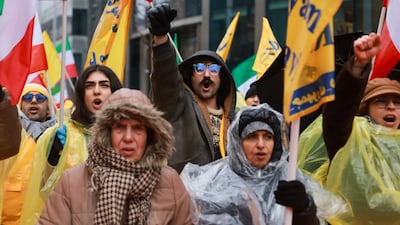
Supporters of the National Council of Resistance of Iran attend a rally backing anti-government protests across Iranian cities, at Schuman Square in Brussels, Belgium. EPA -

A demonstrator wearing a Make Iran Great Again cap joins anti-regime protesters outside the Iranian Embassy in central London. AFP -

Protesters wave pre-revolutionary Iranian flags featuring the lion and sun emblem at a rally outside the embassy in London. AFP -
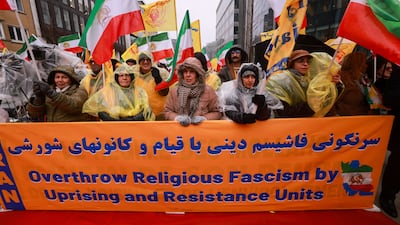
Demonstrators in Schuman Square, Brussels. EPA -
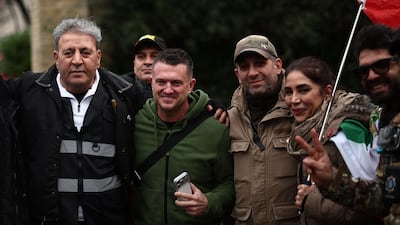
British far-right activist Tommy Robinson, second left, poses with anti-Iranian regime protesters in London. AFP -
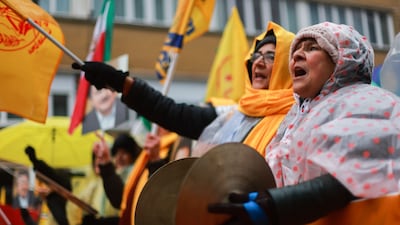
Protesters in Brussels. EPA -
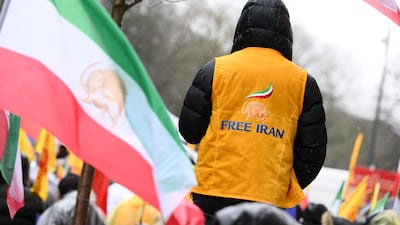
A supporter of the National Council of Resistance of Iran at the Brussels rally. AFP


Toll from deadly protests rises
Iranian rights group HRANA said on Friday it had documented the deaths of at least 62 people including 14 security personnel and 48 protesters since demonstrations began.
Mr Khamenei accused protesters of acting on behalf of Mr Trump, saying rioters were attacking public property.
"Last night in Tehran, a bunch of vandals and rioters came and destroyed a building that belonged to the state, to the people themselves, just to please the heart of the President of the United States," he said.
The supreme leader said that Tehran will not tolerate people acting as "mercenaries for foreigners".
The unrest has also led to the suspension of dozens of international flights, including at least 17 between Dubai and Iranian cities.
Turkish Airlines cancelled 17 flights, reports in Turkey said, while Ajet grounded six and budget carrier Pegasus Airlines cancelled flights to Iran on Friday. At least two flights between Qatar's capital Doha and Tehran scheduled for Friday were also cancelled, Hamad International Airport's website showed.
Internet connectivity has also been cut or extremely limited across Iran since Thursday. NetBlocks, which tracks internet access and digital rights around the world, confirmed that it was detecting problems through various internet providers in Iran.
The National attempted to access Iranian state news agencies on Friday, which appeared to be down at the time of publication. The suppression of internet access in Iran is not unprecedented.
Authorities have attempted a dual approach to the protests – acknowledging the economic crisis and offering dialogue with demonstrators, while meeting more forceful displays of dissent with violence and accusing foreign powers of fuelling the protests.
Plan B for Khamenei
Mr Trump has repeatedly weighed in on the situation in Iran. Asked in an interview on Thursday whether rumours were true that Mr Khamenei had a “Plan B” to flee to Russia. The US President replied: “Or someplace, yeah. He’s looking to go someplace".
Washington has threatened to intervene if Tehran suppresses demonstrations. US special envoy Massad Boulos reiterated that the Iranian regime would be crossing a “red line” if it continues to fire on and kill civilian protesters.
“The President gave a clear warning. It's a red line. The killing of civilians that are exercising the right of free speech and demonstrating in the street is a red line to President Trump, and he gave a clear, clear warning to that effect,” Mr Boulos told On The Record, broadcast by Sky News Arabia and The National.

Torbjorn Soltvedt, principal Middle East Analyst at risk intelligence company Verisk Maplecroft, said the protests pose a real and credible threat to the Iranian government.
"The most immediate dilemma facing Iran’s leadership is Mr Trump’s warning to intervene if protests are quashed through lethal force, which has been Mr Khamenei’s answer to previous bouts of unrest," said Mr Maplecroft.
"For the first time during almost four decades in power, Mr Khamenei’s default response to unrest comes with a risk of external intervention. Recent events in Venezuela have brought the possibility US action into sharp focus."
Last week, US forces conducted a large-scale strike on Venezuela, capturing president Nicolas Maduro and his wife. They were removed from the country and have been indicted on drug charges in New York.
"You can see how they’ve besieged a country in Latin America and taken some actions there. They aren’t even ashamed and explicitly state that this was for oil. For oil! They say they’ve done this for oil!," Mr Khamenei wrote.
A French diplomatic source said Paris is calling on Iranian authorities to show maximum restraint towards those protesting against the government in the country, Reuters reported.
The EU's high representative for foreign affairs, Kaja Kallas, said violence against peaceful demonstrators is unacceptable.
"The Iranian people are fighting for their future. By ignoring their rightful demands, the regime shows its true colours. Images from Tehran reveal a disproportionate and heavy-handed response by the security forces," she wrote on X.
In a joint statement, France, Britain and Germany said they were "deeply concerned" about reports of violence by Iranian security forces.
"The Iranian authorities have the responsibility to protect their own population and must allow for the freedom of expression and peaceful assembly without fear of reprisal," the statement read.
Tehran has warned against foreign intervention. Iranian security and judicial authorities announced the arrest of “several armed terror cells and foreign-linked operatives amid a wave of foreign-backed riots”, Press TV, a state-run channel, reported.
Officials said they had detained ringleaders orchestrating riots and attacking religious sites and public property, a terror cell preparing a false-flag killing operation and individuals plotting sophisticated attacks on military and government installations.
They said four police officers were killed in separate incidents on Wednesday and Thursday.
“Acts of riots and armed attacks have been openly encouraged by American and Israeli figures,” reported Press TV.
Iran's Foreign Ministry has accused Washington of attempting to incite violence and unrest, after former US secretary of state Mike Pompeo last week claimed that Israel’s spy agency is operating inside Iran.

