
Iranian police clashed with protesters on the 10th day of unrest in Tehran, as the death toll rose to at least 36, according to the US-based Human Rights Activists News Agency.
Strikes continued in Tehran’s main market, the Grand Bazaar, on Tuesday, where videos showed chaotic scenes. Security forces fired tear gas into groups of demonstrators as shopkeepers shut their stores and stage a sit-in.
The anger also spilt on to the streets in hundreds of cities across Iran on Tuesday, where protests were met live rounds and tear gas, according to activists.
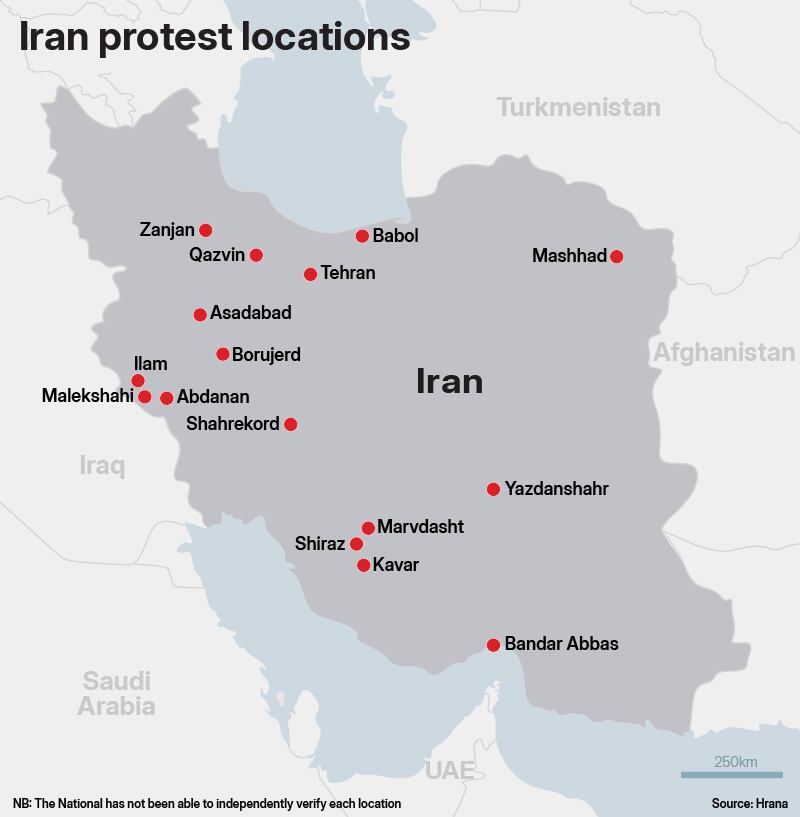
Other videos posted on social media appeared to show security forces entering Sina Hospital in Hasanabad on Tuesday and firing tear gas inside the medical compound, where injured protesters had been receiving treatment. This was the second such recorded incident after security forces stormed Imam Khomeini Hospital in the western city of Ilam on Sunday, fuelling public anger and prompting President Masoud Pezeshkian to order an investigation.
Iran's Ministry of Health issued a statement saying the attack on Sina Hospital was under review and would be pursued “within the framework of the law”.
At least 36 people have been confirmed killed during the past 10 days of protests, according to HRANA. Among them were four under the age of 18, as well as two members of security and law enforcement forces, it said.
The rights group, which relies on an activist network in Iran, has also recorded dozens of cases of injuries among protesters, mostly caused by pellet and plastic bullets, and at least 2,076 arrests.
The unrest began last week when the Iranian rial fell to a record low against the US dollar. Authorities have attempted a dual approach to the protests – acknowledging the economic crisis and offering dialogue with demonstrators, while meeting more forceful displays of dissent with violence and accusing networks linked to foreign powers of fuelling the protests.
Iran’s army chief warned on Wednesday that his country would respond in "full force" to any external acts of aggression, after US President Donald Trump said Iran would be “hit very hard” if more protesters die.
“I can say with confidence that today the readiness of the armed forces of the Islamic Republic of Iran is far greater than it was before the 12-day war,” said Maj Gen Amir Hatami.
The chief commander of the Iranian army said Iran “will cut off the hand” of any aggressor. “The Islamic Republic of Iran considers the escalation of hostile rhetoric against the Iranian nation a threat and will not tolerate its continuation without responding,” he added, according to the Fars news agency.
Both the US and Israel have expressed support for the protests in Iran in recent days. The countries have been exchanging threats since a 12-day war between Iran and Israel broke out in June last year, with the US also attacking Tehran.
The war erupted with a surprise Israeli attack on Tehran after several rounds of nuclear negotiations between Iran and the US that consequently fell through. Iran's Foreign Minister Abbas Araghchi said on Wednesday that Iran has never abandoned the negotiating table, but accused the US administration of obstructing talks based on mutual interests and respect.
He said internal issues were "solely the concern of the Iranian people" and that "no foreign government has any jurisdiction over Iran’s internal affairs".
The protests are the biggest to rock Iran since nationwide unrest over the death of Mahsa Zhina Amini in police custody began in 2022.
The unrest comes amid deteriorating living conditions in Iran, where high inflation, rising costs and a weak currency have fuelled growing public frustration. US sanctions and UN “snapback” sanctions against Iran last year have only worsened the country's economic woes.

