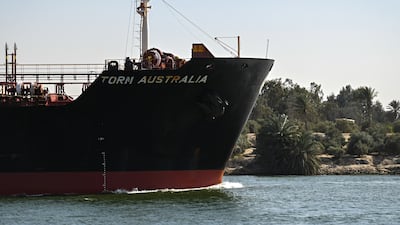
The MV True Confidence, a Barbados-flagged, Liberian-owned bulk carrier, was attacked by the Houthis in March while crossing the Gulf of Aden.

UN Security Council demands Houthis end attacks in Red Sea


Adla Massoud
  • English
  • Arabic

The UN Security Council on Thursday demanded again that Yemen's Houthi rebels stop all attacks on ships in the Red Sea, extending the requirement that UN Secretary General Antonio Guterres report monthly on incidents.

The resolution received 12 votes in favour and three abstentions, from Russia, China and Algeria.

A follow-up to the resolution adopted in January, the measure comes as the Iran-backed Houthis continue to threaten maritime traffic in the Red Sea, the Gulf of Aden and the broader Indian Ocean, despite sustained US-led retaliatory strikes in Yemen.

The council repeated its demand that the group immediately cease all attacks against merchant and commercial ships, and release the Galaxy Leader and its crew.

The Galaxy Leader is a Japanese-operated vessel affiliated with an Israeli businessman. The Iran-backed Houthis seized the ship in November.

The rebels have launched missiles and drones at more than 60 ships. The attacks have killed four sailors and sunk two vessels so far.

The Houthis maintain that their attacks are focused on ships linked to Israel, the US and the UK, and are being carried out in solidarity with Palestinians amid the war in Gaza.

But many of the ships attacked have little or no connection to the conflict, with some of them even bound for Iran.

Many vessels have since opted to avoid the Red Sea route to the Suez Canal, taking the longer journey around the southern tip of Africa instead.

The Security Council text emphasises the need to address the root causes, including “the conflicts contributing to regional tensions and the disruption of maritime security in order to ensure a prompt, efficient and effective response”.

Robert Wood, US deputy ambassador to the UN, condemned the continuous attacks on ships in the Red Sea, and those countries supplying weapons for the assaults.

“The threat to navigational rights and freedoms in the Red Sea is a global challenge and necessitates a global response,” Mr Wood said.

He said that extending Mr Guterres's reporting period to January 2025 will help to ensure that the Security Council has “accurate and timely information to inform its deliberations over how to best address Houthi actions”.

Russia expressed support for Red Sea shipping access but pointed out “flaws” in the US-Japanese resolution in its application of international law.

Houthi attacks must end but retributive strikes must also stop, Russia’s deputy UN ambassador Anna Evstigneeva stressed.

“We urge all participants in the coalition to immediately halt illegal attacks and to transition to political and diplomatic means to reduce tensions in the waters adjacent to Yemen,” she said.

Ms Evstigneeva reminded council members that achieving normalisation in the Red Sea region cannot occur without first securing a ceasefire in the conflict between Israel and Hamas.

Without including this, she said, the resolution remains “divorced from reality, to put it mildly”.

China also shared its concern over actions taken unilaterally by some states and rejected “misuses of international law” by any country.

“Our main concern was that that resolution's ambiguity on some key elements could have negative consequences and lead to further escalation of regional tensions,” said Beijing's deputy ambassador Geng Shuang.

Mr Geng called on all parties concerned to avoid “misinterpretation and misuse” of international law and council resolutions.

Houthi rebels disrupt ships in the Red Sea – in pictures

  • A ship in the Suez Canal heading towards the Red Sea in Ismailia, Egypt. Houthi rebels in Yemen have pledged to disrupt all shipping destined for Israel through the Red Sea and the Suez Canal. Getty Images
    A ship in the Suez Canal heading towards the Red Sea in Ismailia, Egypt. Houthi rebels in Yemen have pledged to disrupt all shipping destined for Israel through the Red Sea and the Suez Canal. Getty Images
  • Sailors on the USS Mason during Operation Prosperity Guardian. Photo: US Navy
    Sailors on the USS Mason during Operation Prosperity Guardian. Photo: US Navy
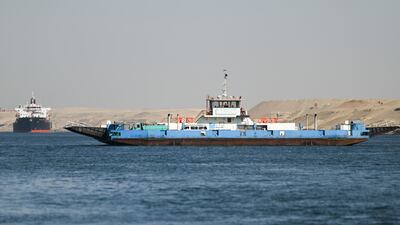
  • A ship travelling south through the Suez Canal. Getty Images
    A ship travelling south through the Suez Canal. Getty Images
  • The officer of the watch on the bridge of HMS Diamond in the Red Sea. Reuters
    The officer of the watch on the bridge of HMS Diamond in the Red Sea. Reuters
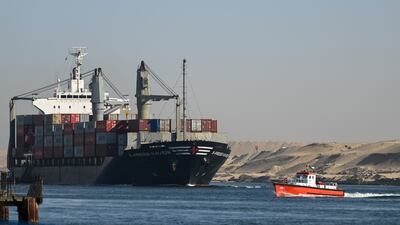
  • A container ship in the Suez Canal near Ismailia, Egypt. Getty Images
    A container ship in the Suez Canal near Ismailia, Egypt. Getty Images
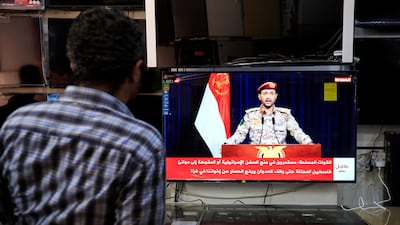
  • A televised statement by the Houthis' military spokesman Yahya Sarea in Sanaa, Yemen, after a large-scale missile and drone attack by the group against shipping lanes in the Red Sea. EPA
    A televised statement by the Houthis' military spokesman Yahya Sarea in Sanaa, Yemen, after a large-scale missile and drone attack by the group against shipping lanes in the Red Sea. EPA
  • A ship in the Suez Canal heading towards the Red Sea. Getty Images
    A ship in the Suez Canal heading towards the Red Sea. Getty Images
  • On the bridge of HMS Diamond as Sea Viper missiles are fired in the Red Sea to combat a barrage of Houthi drones and missiles. Photo: Ministry of Defence via AP
    On the bridge of HMS Diamond as Sea Viper missiles are fired in the Red Sea to combat a barrage of Houthi drones and missiles. Photo: Ministry of Defence via AP

Mercer, the investment consulting arm of US services company Marsh & McLennan, expects its wealth division to at least double its assets under management (AUM) in the Middle East as wealth in the region continues to grow despite economic headwinds, a company official said.

Mercer Wealth, which globally has $160 billion in AUM, plans to boost its AUM in the region to $2-$3bn in the next 2-3 years from the present $1bn, said Yasir AbuShaban, a Dubai-based principal with Mercer Wealth.

Within the next two to three years, we are looking at reaching $2 to $3 billion as a conservative estimate and we do see an opportunity to do so,” said Mr AbuShaban.

Mercer does not directly make investments, but allocates clients’ money they have discretion to, to professional asset managers. They also provide advice to clients.

“We have buying power. We can negotiate on their (client’s) behalf with asset managers to provide them lower fees than they otherwise would have to get on their own,” he added.

Mercer Wealth’s clients include sovereign wealth funds, family offices, and insurance companies among others.

From its office in Dubai, Mercer also looks after Africa, India and Turkey, where they also see opportunity for growth.

Wealth creation in Middle East and Africa (MEA) grew 8.5 per cent to $8.1 trillion last year from $7.5tn in 2015, higher than last year’s global average of 6 per cent and the second-highest growth in a region after Asia-Pacific which grew 9.9 per cent, according to consultancy Boston Consulting Group (BCG). In the region, where wealth grew just 1.9 per cent in 2015 compared with 2014, a pickup in oil prices has helped in wealth generation.

BCG is forecasting MEA wealth will rise to $12tn by 2021, growing at an annual average of 8 per cent.

Drivers of wealth generation in the region will be split evenly between new wealth creation and growth of performance of existing assets, according to BCG.

Another general trend in the region is clients’ looking for a comprehensive approach to investing, according to Mr AbuShaban.

“Institutional investors or some of the families are seeing a slowdown in the available capital they have to invest and in that sense they are looking at optimizing the way they manage their portfolios and making sure they are not investing haphazardly and different parts of their investment are working together,” said Mr AbuShaban.

Some clients also have a higher appetite for risk, given the low interest-rate environment that does not provide enough yield for some institutional investors. These clients are keen to invest in illiquid assets, such as private equity and infrastructure.

“What we have seen is a desire for higher returns in what has been a low-return environment specifically in various fixed income or bonds,” he said.

“In this environment, we have seen a de facto increase in the risk that clients are taking in things like illiquid investments, private equity investments, infrastructure and private debt, those kind of investments were higher illiquidity results in incrementally higher returns.”

The Abu Dhabi Investment Authority, one of the largest sovereign wealth funds, said in its 2016 report that has gradually increased its exposure in direct private equity and private credit transactions, mainly in Asian markets and especially in China and India. The authority’s private equity department focused on structured equities owing to “their defensive characteristics.”

Dubai Bling season three

Cast: Loujain Adada, Zeina Khoury, Farhana Bodi, Ebraheem Al Samadi, Mona Kattan, and couples Safa & Fahad Siddiqui and DJ Bliss & Danya Mohammed 

Rating: 1/5

So what is Spicy Chickenjoy?

Just as McDonald’s has the Big Mac, Jollibee has Spicy Chickenjoy – a piece of fried chicken that’s crispy and spicy on the outside and comes with a side of spaghetti, all covered in tomato sauce and topped with sausage slices and ground beef. It sounds like a recipe that a child would come up with, but perhaps that’s the point – a flavourbomb combination of cheap comfort foods. Chickenjoy is Jollibee’s best-selling product in every country in which it has a presence.
 

Company%C2%A0profile
%3Cp%3ECompany%3A%20Zywa%3Cbr%3EStarted%3A%202021%3Cbr%3EFounders%3A%20Nuha%20Hashem%20and%20Alok%20Kumar%3Cbr%3EBased%3A%20UAE%3Cbr%3EIndustry%3A%20FinTech%3Cbr%3EFunding%20size%3A%20%243m%3Cbr%3ECompany%20valuation%3A%20%2430m%3C%2Fp%3E%0A
COMPANY%20PROFILE
%3Cp%3E%3Cstrong%3EName%3A%20%3C%2Fstrong%3ESmartCrowd%0D%3Cbr%3E%3Cstrong%3EStarted%3A%20%3C%2Fstrong%3E2018%0D%3Cbr%3E%3Cstrong%3EFounder%3A%20%3C%2Fstrong%3ESiddiq%20Farid%20and%20Musfique%20Ahmed%0D%3Cbr%3E%3Cstrong%3EBased%3A%20%3C%2Fstrong%3EDubai%0D%3Cbr%3E%3Cstrong%3ESector%3A%20%3C%2Fstrong%3EFinTech%20%2F%20PropTech%0D%3Cbr%3E%3Cstrong%3EInitial%20investment%3A%20%3C%2Fstrong%3E%24650%2C000%0D%3Cbr%3E%3Cstrong%3ECurrent%20number%20of%20staff%3A%3C%2Fstrong%3E%2035%0D%3Cbr%3E%3Cstrong%3EInvestment%20stage%3A%20%3C%2Fstrong%3ESeries%20A%0D%3Cbr%3E%3Cstrong%3EInvestors%3A%20%3C%2Fstrong%3EVarious%20institutional%20investors%20and%20notable%20angel%20investors%20(500%20MENA%2C%20Shurooq%2C%20Mada%2C%20Seedstar%2C%20Tricap)%3C%2Fp%3E%0A
Ziina users can donate to relief efforts in Beirut

Ziina users will be able to use the app to help relief efforts in Beirut, which has been left reeling after an August blast caused an estimated $15 billion in damage and left thousands homeless. Ziina has partnered with the United Nations High Commissioner for Refugees to raise money for the Lebanese capital, co-founder Faisal Toukan says. “As of October 1, the UNHCR has the first certified badge on Ziina and is automatically part of user's top friends' list during this campaign. Users can now donate any amount to the Beirut relief with two clicks. The money raised will go towards rebuilding houses for the families that were impacted by the explosion.”

Updated: June 27, 2024, 7:47 PM