


The US on Tuesday urged outside entities to stop fuelling and prolonging the Sudanese conflict by supplying weapons to the region.
Linda Thomas-Greenfield, the US ambassador to the UN, also asked the Security Council to give priority to Sudan and called for the resumption of ceasefire negotiations that include a return to civilian governance.
“There is no military solution to this senseless war … none whatsoever,” Ms Thomas-Greenfield told the 15-member Security Council.
The Sudanese Armed Forces and the Rapid Support Forces militia have been fighting since April 2023 in a conflict the UN says has already claimed about 150,000 lives.
The war has also pushed much of the country into food insecurity and acute hunger.
Fighting has been particularly severe in El Fasher, the capital city of North Darfur and the only capital in the Darfur region that is not under the RSF’s control.
UN rights chief Volker Turk told the UN Human Rights Council in Geneva on Tuesday that Sudan “is being destroyed in front of our eyes by two warring parties and affiliated groups … [who have] flagrantly cast aside the rights of their own people”.
Mr Turk called for both sides to be held accountable for committing war crimes.
On June 14, the Security Council adopted a UK-drafted resolution demanding an end to the siege of El Fasher.
The measure, which won 14 votes in favour and an abstention from Russia, expresses “grave concern” over the spreading violence and reports that the RSF is carrying out “ethnically motivated violence”.
During Tuesday's Security Council meeting, the Sudanese ambassador to the UN, Ammar Al Harith Idriss, repeated allegations that the UAE is supporting the RSF.
The UAE's ambassador to the UN, Mohamed Abushahab, said the “ludicrous allegations” came from the representative of Sudan “who represents the Sudanese armed forces, one of the warring parties in Sudan”.
“We believe that the Sudanese people deserve justice and peace. They need a ceasefire, a credible political process and unhindered flow of humanitarian aid,” Mr Abushahab said.
The ambassador expressed the UAE’s deep concern over the consequences of the intensifying conflict on the “brotherly Sudanese people.”
“Excuses and finger pointing only prolongs the suffering of civilians,” Mr Abushahab said in response to the accusations made by Sudan’s representative.
Since the onset of the conflict, about 9.2 million people have been displaced and 1.9 million people have sought refuge in Sudan’s neighbouring countries – the Central African Republic, Chad, Egypt, Ethiopia and South Sudan.
The hostilities have persisted across several front lines, including in and around Khartoum, Al Jazirah, Kordofan, and White Nile.
According to the UN, more than two million people in 41 hotspots are at high risk of slipping into catastrophic hunger in the coming weeks and 7,000 new mothers could die in the next few months if they do not receive access to food and health care.
Growing needs are becoming increasingly difficult to meet due to shrinking funding.
“As of the end of May 2024, the gap between humanitarian funding requirements and available resources stands at $40.8 billion,” Mr Turk said.
“Appeals are funded at an average of 16.1 per cent only.”
The UAE on Monday increased its contributions to humanitarian efforts in Sudan by directing $70 million in aid for UN agencies. This is in addition to the $130 million in aid sent over the past 10 months.
“With millions of Sudanese people facing a looming famine, it is unconscionable that the Sudanese Armed Forces continue to obstruct and deny basic humanitarian assistance, in violation of international humanitarian law,” Mr Abushahab said.
The ambassador also stressed the need for a ceasefire and for a credible political process, while allowing an uninterrupted flow of humanitarian aid to the country.
Mr Abushab also called on the Sudanese representative to take part in the Jeddah talks – aimed at bringing an end to the conflict.
The US last week provided another $315 million for the humanitarian response in Sudan and neighbouring countries.
“We are in the race against time to avert massive loss of life. And in this unprecedented protection and food security crisis in Sudan,” warned Edem Wosornu, director at the UN's Office for the Co-ordination of Humanitarian Affairs.
“Every day that we wait for funding to come, more lives are at risk.”
War in Sudan one year on – in pictures
-

Rapid Support Forces commander Gen Mohamed Dagalo, then deputy head of Sudan's sovereign council, gives a media briefing in Khartoum in February last year. Reuters -
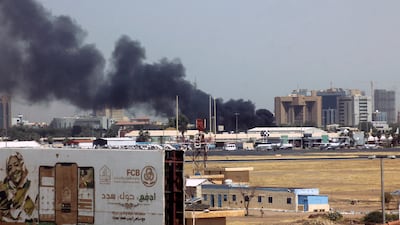
Smoke rises after blasts in Khartoum amid clashes between the Sudanese Army and the Rapid Support Forces paramilitary on April 15 last year. AFP -
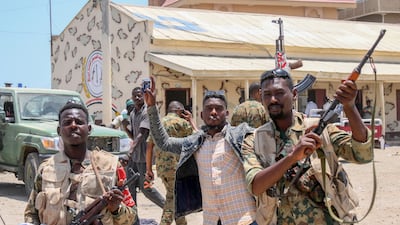
Sudanese Army soldiers at the Rapid Support Forces base in Port Sudan on April 16 last year. AFP -

Black smoke covers the sky over Khartoum as clashes continued on April 19. AFP -
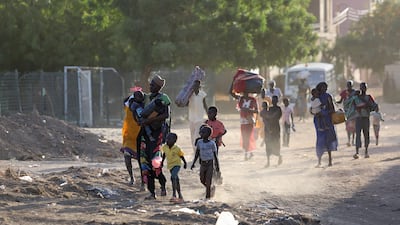
Displaced Khartoum residents flee the city after a 24-hour truce collapsed on April 19. AFP -
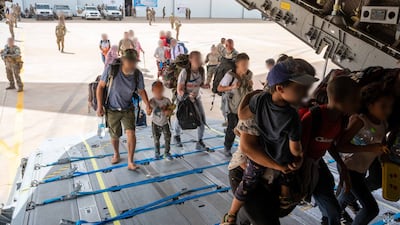
Foreign citizens board a plane at a French military air base in Khartoum to leave Sudan on April 23. AFP -
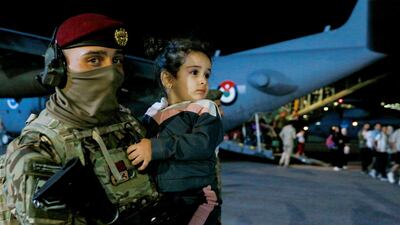
A soldier carries a child as people evacuated from Sudan disembark from a plain at a military airport in Amman on April 24. AFP -

Evacuees from Sudan sit in a military plane as they wait to be processed by Kenyan troops in Nairobi on April 24. Reuters -

Sudanese refugees gather to receive humanitarian aid in Koufroun, Chad, on April 30. AFP -
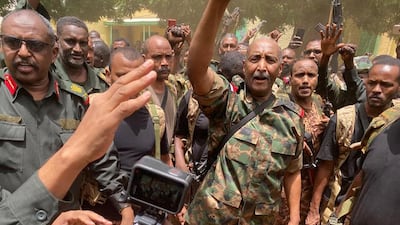
Sudanese Army chief Gen Abdel Fattah Al Burhan visits troop positions in Khartoum on May 30. AFP -
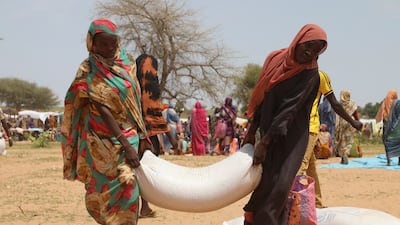
Sudanese refugees at the Zabout camp in Goz Beida, Chad, on July 1. AP -

Smoke rises from a fire at a lumber warehouse in southern Khartoum on June 7. AFP -
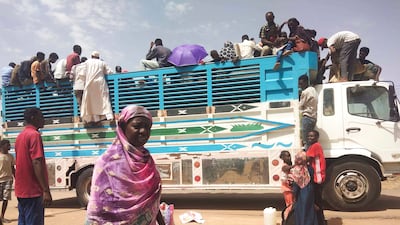
People prepare to leave Khartoum during a ceasefire on June 19. AP -

People sit on top of a lorry carrying furniture on the road between Khartoum and Wad Madani, Al Gezirah state, on July 18. AFP -
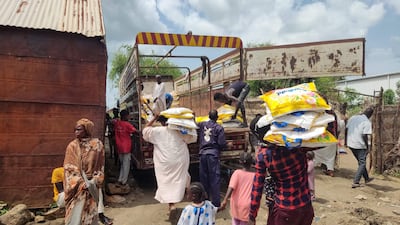
Men load goods from Ethiopia on to a lorry in the border town of Gallabat on August 2. AFP -
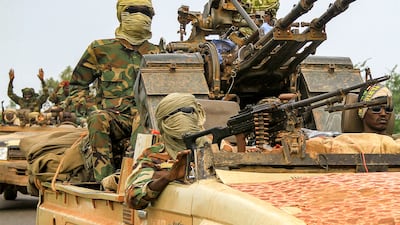
Sudanese Army troops ride in a military convoy accompanying the governor of Darfur State in the eastern city of Gedaref on August 30. AFP -
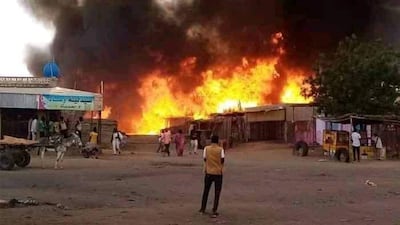
A fire rages at a livestock market after RSF bombardment in Al Fasher, the capital of North Darfur state, on September 1. AFP -

People cook on a campfire at a school that has been turned into a shelter for displaced Sudanese in the northern border town of Wadi Halfa, near Egypt, on September 11. AFP -
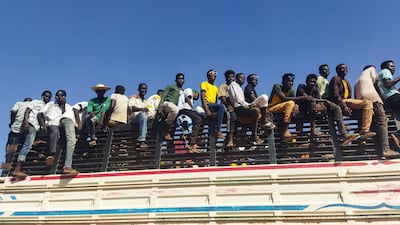
Displaced Sudanese ride on top of a lorry in Wad Madani on December 16. AFP -
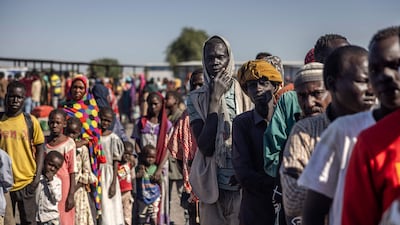
Sudanese refugees queue to board a lorry to go to a transit centre after crossing the border into South Sudan on February 14. AFP -
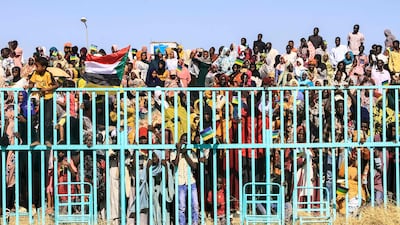
People watch as fighters from the army-aligned Sudan Liberation Movement attend a graduation ceremony in the south-eastern Gedaref state on March 28. AFP -

Fighters from the SLM attend a graduation ceremony in Gedaref state on March 28. AFP



