As talks between Iran and the United States continue in the Austrian capital Vienna over Iran's nuclear programme, concerns are rising over how quickly the Tehran can create its first nuclear weapon.
US Secretary of State Antony Blinken said on Monday the "breakout time" could be cut to weeks if action isn't taken.
"It remains unclear whether Iran is willing and prepared to do what it needs to do come back into compliance," Mr Blinken told the US House of Representatives.
"Meanwhile, its programme is galloping forward. ... The longer this goes on, the more the breakout time gets down ... it's now down, by public reports, to a few months at best. And if this continues, it will get down to a matter of weeks," he added.
The 2015 Joint Comprehensive Plan of Action, known as the Iran nuclear deal, prevented Iran from obtaining a nuclear weapon. Former US President Donald Trump withdrew from the deal in 2018, which involves Russia, France, Germany and the UK, because Iran's ballistic missiles programme was not addressed within the agreement.
Running out of 'breakout time'
The Institute of Science and International Security predicts a "worst case scenario" of 2.3 months for Iran to produce enough weapons grade uranium (WGU) for one nuclear weapon.
"Iran could produce a second significant quantity of WGU early in the fifth month after breakout commences, and a third quantity could be produced early in the seventh month," the institute said in a report on Monday.
This breakout time could have been even shorter had an incident involving a fire at Iran's Natanz Fuel Enrichment Plant (FEP) on April 11 not occurred. Some Iranian officials cited sabotage as the reason behind the fire, although no official reason has been given.
Limited access to Iran's nuclear facilities has also resulted in the UN International Atomic Energy Agency (IAEA) nuclear watchdog not being able to give an accurate understanding of how far along Iran is towards creating its first nuclear weapon.
On Monday, the IAEA said inspections of Iran's nuclear facilities were becoming "increasingly difficult", after some IAEA inspections were suspended.
The agency then agreed to a three-month deal allowing it to continue inspections despite the reduced access.
Compliance and transparency
"I can see this space narrowing down," IAEA Director General Rafael Grossi told journalists in Vienna at the beginning of the quarterly meeting of the agency's board of governors.
But Mr Grossi was hopeful that the Vienna talks, if fruitful, could lead to better inspections.
-

Iranian President Hassan Rouhani, right, and the head of Atomic Energy Organization of Iran Ali Akbar Salehi inspect the nuclear technology on the occasion of Iran National Nuclear Technology Day in Tehran in 2019. EPA -
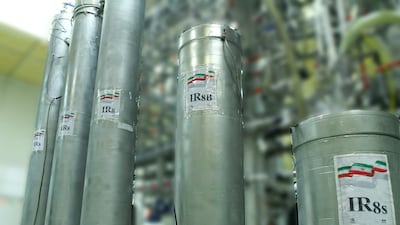
IR-8 centrifuges at Natanz nuclear power plant, some 300 kilometres south of capital Tehran. AFP -
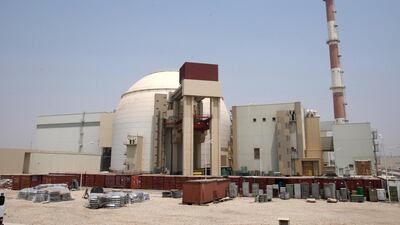
The Iranian nuclear power plant in Bushehr in 2010. EPA -

Salehi speaks with media while visiting Natanz enrichment facility, in central Iran in 2019. Atomic Energy Organization of Iran via AP -
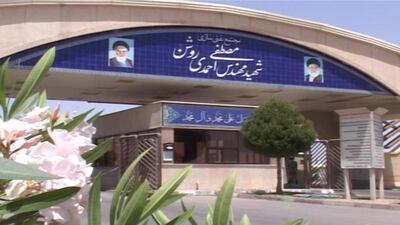
The gate of Natanz nuclear power plant in Natanz , Isfahan province, in 2019. EPA -
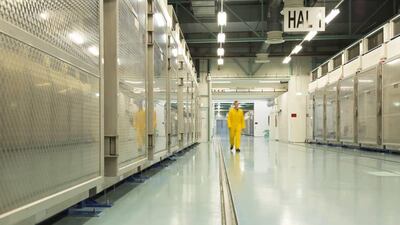
Inside of the Iran's Fordow nuclear facility, in Fordow, Qom province in 2019. EPA -
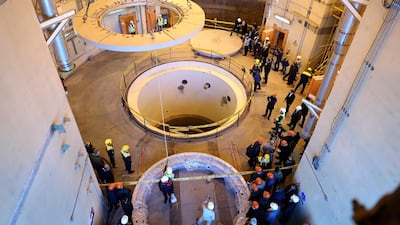
Technicians work at the Arak heavy water reactor's secondary circuit, as officials and media visit the site, near Arak, Iran in 2019. Atomic Energy Organization of Iran via AP -
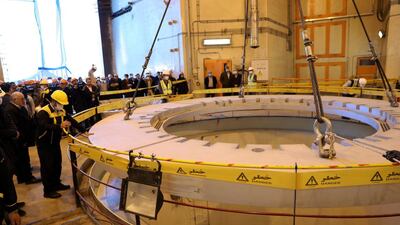
Members of the media and officials tour the water nuclear reactor at Arak in 2019. WANA via Reuters -
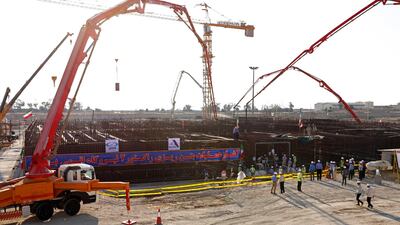
Concrete is poured for the base of the second nuclear power reactor at Bushehr plant in 2019. Atomic Energy Organization of Iran via AP


He hoped that by a "wider general agreement that's being worked on downtown or by some other means, we are not going to see our... inspection capacities curtailed any more".
"We cannot limit and continue to curtail the ability of the inspectors to inspect and at the same time pretend that there is trust," he added.
The IAEA said that several of its questions on undeclared nuclear sites have gone unanswered by Iran.
Mr Grossi said his "expectations were not met" and that there had been no "concrete progress" on the issue, despite the Iranian authorities' stated willingness to co-operate.
"Talk must lead to conclusions," he said.
"For me the road to trust goes through information, clarification, inspections and full transparency," he added.
Iran said its diminishing cooperation with authorities was in retaliation to Mr Trump's withdrawal in 2018 and sanctions which have had a devastating impact on Iran's economy.
"We have a country that has a very developed and ambitious nuclear programme which is enriching at very high levels... very close to weapons grade," Mr Grossi said.
Iran's government spokesman Ali Rabiei said he hoped the discussions in Vienna would be concluded before the presidential election on June 18.

