


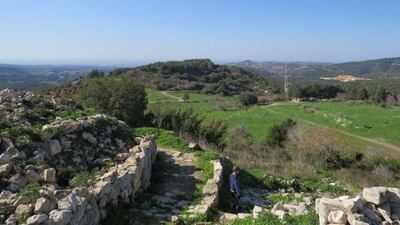
In a quiet valley in Jerusalem lies a village frozen in time.
Its stone buildings have stood for centuries and have long since been overtaken by plants and weeds.
This is Lifta and it is one of the hundreds of Palestinian villages that were violently depopulated by Jewish militias, who would become part of Israel's army and police forces following the establishment of the state in 1948 in what is known by Palestinians as the Nakba, or catastrophe.
Situated less than 5km west of Sheikh Jarrah – the district in East Jerusalem that became the site of protests and violence from 2021 as 12 Palestinian families battled eviction – Lifta since moved into the media spotlight as advocacy groups sought to prevent planned Israeli developments that threaten to erase history.
What happened to Lifta?
The fight for Lifta began months before Israel was established in May 1948. The village's strategic location on the road to Tel Aviv from Jerusalem made it desirable for paramilitary Jewish forces, including the Lehi and Haganah.
When an irregular Arab militia moved in to defend the hamlet in December 1947, firefights broke out against Jewish patrols.
According to Israeli historian Benny Morris, a machine-gun and grenade attack in a cafe killed seven Palestinians and prompted some villagers to flee to safety.
In January 1948, Lehi forces blew up three houses and, the following month, Arab militias abandoned Lifta, leaving the remaining Palestinian families without any defence.
The Haganah moved into the village, shooting locals and forcing others on to lorries headed for East Jerusalem.
Before its capture, about 2,900 Palestinians lived in Lifta, in homes made by hand, said architect Antoine Raffoul, founder of 1948.org.uk, who works with the Committee to Save Lifta.
“Lifta is one of the most beautiful architectural urban developments I've seen anywhere,” he told The National.
“East Jerusalem was very depressing for a lot of [the expelled villagers]. So, the young left but never forgot.”
The 57 remaining houses were left to deteriorate until Israeli forces destroyed them in the 1950s to make them uninhabitable for Liftawis seeking to return.
Unlike the hundreds of other Palestinian villages that were emptied, bulldozed and built over after the war, Lifta has remained virtually untouched.
Over the years, several plans were developed to “renovate” the village.
In 2006, a plan was presented to build a Jewish museum, luxury hotel, shopping mall and Israeli housing. It was approved in 2009 by the Israel Antiquities Authority.
“In 2010, official tenders were issued for Lifta to be divided and [destroyed],” Mr Raffoul said.
The Coalition to Save Lifta filed an objection to the plans at the Municipal Court of Jerusalem a year later. The court threw out the plan and ordered a more detailed survey of the site.
Coalition to Save Lifta
Meanwhile, the coalition contacted the New York-based World Monument Fund and Lifta was placed on the World Monument Watch list in 2018.
“The new survey [by the Israeli Land Authority] confirmed that Lifta merits preservation rather than redevelopment,” Mr Raffoul said.
However, in June 2021, the Israeli Land Authority announced it would welcome bids on tenders to develop Lifta on July 4.
The coalition found itself racing against time to stop a revised renovation plan from coming into effect and a petition was filed to the Israeli District Court in Jerusalem to halt the development plans.
If the plans, known as Project 6036, go ahead, the last remaining village in West Jerusalem and a symbol of hope for Palestinians seeking a right to return will be destroyed.
“As an architect promoting cultural sites, I would defend and protect Lifta even if it had been a Jewish village,” said Mr Raffoul.
In August 2022, according to The Times of Israel, the Jerusalem Municipality and Israel Lands Authority agreed to “rethink” plans to turn Lifta into a boutique hotel, providing relief to activists seeking to preserve the site – for now.

Yacoub Odeh, 81, and his family were among those who were expelled from their homes in Lifta. Today, he leads tours in what has been described as modern-day Pompeii.
“Lifta in my memory is like a picture with two faces. There is the beautiful life that I lived in Lifta before the Nakba,” he told The National.
“The other picture is one of a miserable life, under British colonial occupation and Zionist armed gangs, terrorists.”
Mr Odeh remembers being at home with his younger brother and mother when the attack began. He was placed in a lorry to East Jerusalem with four other families while his father stayed behind to fight.
“That’s when we became refugees,” he said.
Like many, he escaped with nothing but the clothes on his back, thinking he would soon return home.
“The next day we were knocking on doors, asking for food. We had nothing.”
Historians argue that the Nakba began with the signing of the Balfour Declaration in 1917, in which the British promised Jews a homeland in Palestine.
Others say it began in earnest in November 1947, six months before Israel’s declaration of independence and the subsequent Arab-Israeli War.
By the end of the war, in 1949, more than 700,000 Palestinians – or about two thirds of the population at the time – had either fled or been forcibly removed from their homes.
An estimated 500 villages were depopulated and partially, if not completely, demolished.
As the battle for the preservation of Lifta rages on in courtrooms, The National profiles four other Palestinian towns, villages and neighbourhoods that were captured before and after Israel's creation and what they look like now.
Deir Yassin, Jerusalem. Renamed Giv'at Sha'ul B and Har Nof
-
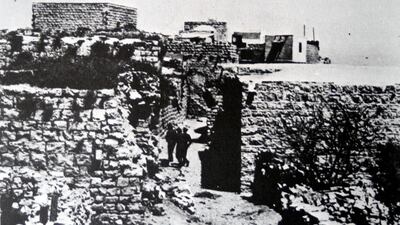
Deir Yassin, located west of Jerusalem, pictured before the attacks by Jewish militias on April 9, 1948. Alamy -
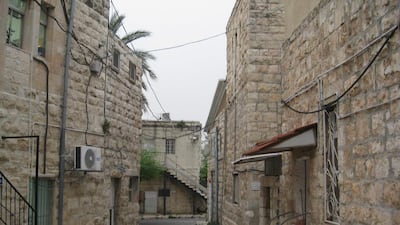
Only a few of the village's original buildings remain. Courtesy: Zochrot -
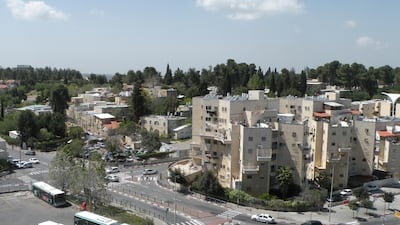
The Israeli neighbourhood of Har Nof can be seen on the right in 2010, while the remains of Deir Yassin, including the Kfar Shaul Mental Health Centre, are on the left. Courtesy: Effib -
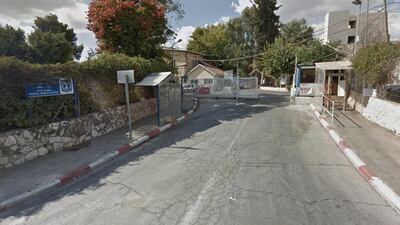
The health centre was built atop ruins. Courtesy: Google Street View


The assault on Deir Yassin, a village that was home to hundreds of Palestinians and was situated about 5km west of Jerusalem, began on the morning of April 9, 1948.
Jewish militias, including the Haganah, Lehi and Irgun, which was headed by Menachem Begin, who would go on to become the sixth prime minister of Israel, entered the village and killed between 107 and 250 Palestinians, including women, children and elderly people – although the exact figure remains disputed.
The Palestinians fought back but Zionist militias used grenades and heavy arms to defeat them.
Yehoshua Zettler, the Jerusalem commander of Lehi, told Neta Shoshani, director of the documentary Born in Deir Yassin in 2009, that they went house to house “putting in explosives … within a few hours, half the village isn't there any more”.
The bodies were rounded up and burnt or buried as part of efforts to cover up the total deaths, according to former Israeli government minister Yair Tsaban.
“Women and children were stripped, lined up, photographed and then slaughtered by automatic firing, and survivors have told of even more incredible bestialities,” a report from the UK's delegation to the UN in April 1948 read.
The assault on Deir Yassin was condemned by The Jewish Agency for Israel, the Chief Rabbinate and the first Israeli prime minister, David Ben Gurion, who sent an apology to King Abdullah I of Jordan.
Within a year, the village was repopulated with orthodox Jewish immigrants from Poland, Romania and Slovakia. The Islamic cemetery was bulldozed and the name Deir Yassin was wiped off the map.
Today, few parts of the village remain visible, with Kfar Shaul Mental Health Centre built on top of ruins.
Manshiya, Jaffa. Now an extension of Tel Aviv
-

Hassan Bek Mosque in the Manshiya area of Jaffa pictured in the summer of 1936. Courtesy: Library of Congress -
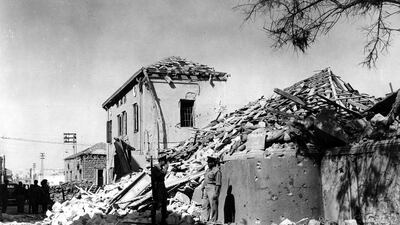
The police station in Jaffa's Manshiya quarter in 1948. AP -

Manshiya is destroyed by Igrun forces after it was captured in May 1948. AP -
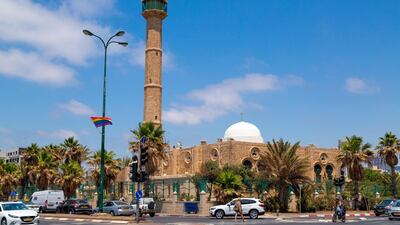
Hassan Bek Mosque, pictured in 2018, is one of the few structures that survived the assault. Alamy -
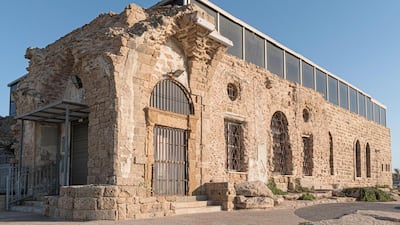
Beit Etzel Museum, honouring the Irgun fighters, is built on the ruins of an ancient Ottoman period sandstone building. Alamy -
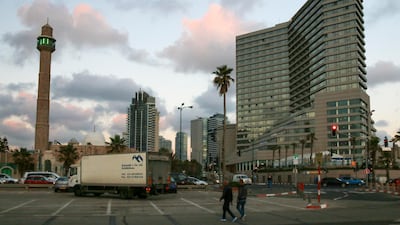
The Hassan Bek Mosque, left, is one of the most famous mosques in Tel Aviv. It was built in 1916. AP


Manshiya was once a bustling, commercial seaside city in Palestine, filled with shops, cafes, factories, and houses.
Historically, it was one of Jaffa's largest Arab districts. In the late 1800s, Jewish neighbourhoods began to be established nearby, including Tel Aviv, which bordered Manshiya.
By 1944, Jaffa's population included more than 12,000 Palestinians and about 1,000 Jews.
According to Zochrot, a non-government organisation that documents the Nakba, the Jewish population began to see Manshiya as a threat to Tel Aviv after the 1936 Arab revolt against the British mandate.
In 1948, the town was attacked by the Irgun – a Jewish paramilitary organisation (also known as Etzel) that operated in Palestine before the creation of Israel – to cut it off from surrounding Palestinian villages.
About 600 Irgun fighters began their attack on Manshiya on April 25. The British, who were still in the process of withdrawing from Palestine, sent military reinforcements to warn against further attacks, but the assault resumed two days later and reached the coast.
With what few weapons they had, the people of Manshiya resisted the attack, fighting from the Ottoman-era Hassan Bek mosque, but the city fell the following day.
The British demanded Irgun forces surrender the city's police station and open the main street between Jaffa and Tel Aviv to allow their troops to pass through.
But the Irgun demolished the roadside buildings to block the passage and destroyed the police station, planting an Israeli flag on its ruins.
Some of Manshiya’s inhabitants were expelled to Jordan and others were sent by sea to Gaza and Egypt. Others were imprisoned.
The city was demolished in stages and, in May, Jewish immigrants were moved into emptied homes and Manshiya was transformed into an extension of Tel Aviv.
Only three original buildings remain: The Hassan Bek Mosque, a derelict house on HaMered street, and a partially preserved house that was renovated in the 1980s and turned into the Etzel Museum, in honour of Etzel’s operations officer and the 41 Israeli fighters who died.
In the 1960s, a committee was formed to protect the mosque from demolition, after its minaret was destroyed.
“For state officials, the mosque was a landmark which symbolised an urban past they preferred to eliminate and a potential hazard for the urban future as they perceived it,” Israeli professor Nimrod Luz of the Kinneret Academic College wrote in 2008.
Through legal action and mediation, the mosque was returned to the Muslim community.
“The mosque would gradually become a site of resistance among the Arab community of Jaffa,” Mr Luz said.
Its new minaret stands tall today, albeit a distance away from the Muslim community that once surrounded it.
Al Lydd, Jaffa. Renamed Lod, Tel Aviv
-
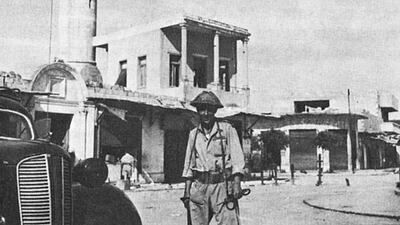
An Israeli soldier in central Al Lydd in 1948. -

Dahmash Mosque in 2012, pictured during a Nakba memorial tour organised by Zochrot. Courtesy: Zochrot -
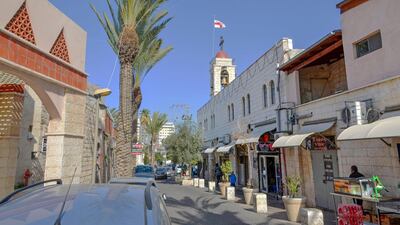
Church of St George, built in 1870, pictured in modern-day Lod, Israel. It is built over a ruined 12th-century Crusader structure. Alamy -
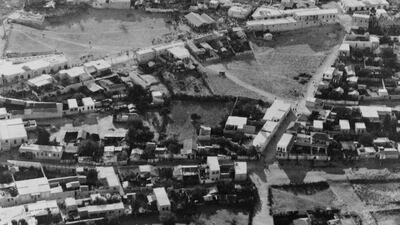
Aerial view of Al Lydd in 1932. Jewish paramilitary forces captured the city in 1948 and renamed it Lod. Courtesy: Library of Congress -
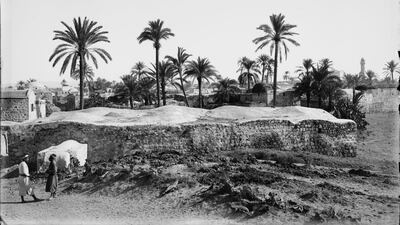
Al Lydd pictured between 1898 and 1914. Courtesy: Library of Congress -
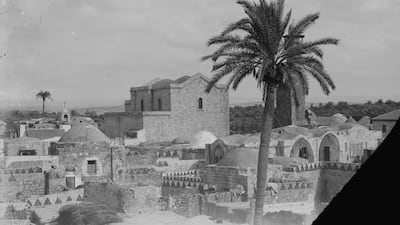
The Church of St George in Al Lydd pictured between 1900 and 1920. Courtesy: Library of Congress -
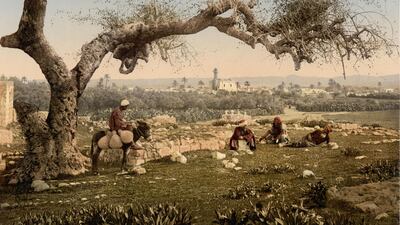
Al Lydd between 1890 and 1900. Courtesy: Library of Congress


Scuffles between Palestinians and Israelis in Al Lydd began soon after the establishment of the state of Israel but the city was not captured by Israeli forces until July.
By then, its population of 20,000 had doubled as refugees from neighbouring areas fled there for safety.
According to Benny Morris, Israeli forces began bombing Al Lydd on the evening of July 9, with a land raid beginning two days later, when a column of vehicles drove through the city, machine-gunning anything that moved.
Dozens of armed Palestinian civilians and members of the Arab Legion – the Transjordanian army – threw grenades at the convoy but they were overwhelmed and eventually surrendered.
By the evening, up to 400 Israeli soldiers entered the town and separated the women and children from the men in makeshift detention compounds in the city's Dahmash mosque and Church of St George.
On July 12, two Arab Legion vehicles entered the city and began firing at the Israeli battalion. A few Palestinians took up arms and engaged in what Morris describes as a 30-minute firefight.
New York Herald Tribune
What followed was labelled a massacre by some historians. Israeli forces were ordered to shoot any clear targets, while soldiers threw grenades into homes they suspected contained snipers.
One Palmach soldier, Yerachmiel Kahanovich, recounted single-handedly killing about 170 civilians sheltered in the mosque.
“I fired a [British-made anti-tank] PIAT projectile in there,” he said in a 2012 interview with Zochrot and the Common Archive project of Palestine.
“[I saw] an empty hall. Everyone on the walls,” he said.
The estimated death toll from the fight was around 400 Palestinians and 10 Israeli soldiers.
In The Ethnic Cleansing of Palestine, Israeli historian Ilan Pappe quoted a story written from the ground for the New York Herald Tribune, which read: “The corpses of Arab men, women, and even children were strewn about the streets in the wake of this ruthlessly brilliant charge.”
The same day, the Israeli government issued an expulsion order, signed by Yitzhak Rabin, who was deputy commander of the operation and would go on to become the fifth prime minister of Israel.
All but 1,000 of Al Lydd's 50,000 inhabitants were pushed out of the city on July 13, and forced to walk more than a dozen kilometres to Barfiliya, south-east of Al Lydd.
Some died of heat exhaustion or thirst on the way and the rest settled in Ramallah or escaped to Jordan or Lebanon.
“People carried their children and their furniture. They could not walk for long distances. The Israelis shouted: ‘Out! Out!’ and people began to flee,” said Raifa Abu Manneh, who was 14 when she and her family were expelled from Al Lydd.
“The ones that remained were shot. Bodies were strewn across the streets.”
Zochrot's Umar Al Ghubari said those who were not killed were taken by Israeli forces for labour.
“They were forced to clean up the mosque in the aftermath of the massacre,” he said. “It was traumatising for them.”
The emptied homes were looted and the lands confiscated, divided and redistributed among Jews who immigrated to Israel from Europe, Asia and Africa between 1948 and 1951.
By 1950, there were 8,400 Jews and 1,000 Palestinians in the city, renamed Lod.
“Palestinians are not a minority, they were minoritised. It was not a natural process,” said Mr Al Ghubari.
Streets and localities in Al Lydd across the former Palestinian villages and cities were given Hebrew names.
“This is part of the process to Judaise Palestinian land and to further deepen the rift between Palestinians and their historic homes,” said Mr Al Ghubari.
The square where the Dahmash Mosque killings took place over 70 years ago is now known as Palmach Street.
Iqrit, Acre. Renamed Granot Hagalil, Goren.
-
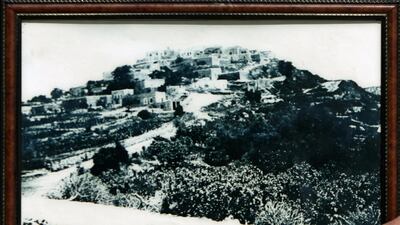
A photograph of Iqrit, Galilee, in 1937, before Israeli forces depopulated the hill-top community in 1948. AFP -
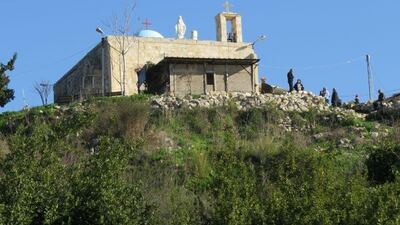
The church of Iqrit pictured in December 2014. Courtesy: Zochrot -
Palestinian refugees of Iqrit and their descendants visit the predominantly Christian village on December 26, 2014. Courtesy: Zochrot -
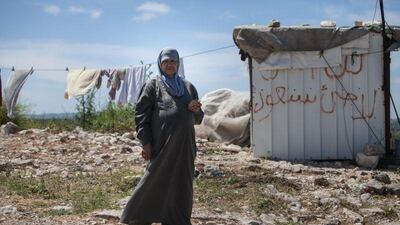
Iqrit refugees and their descendants return to the village after its capture and partial destruction by Israeli forces. Courtesy: Zochrot -

A view from the church, the only remaining structure in Iqrit. AFP -
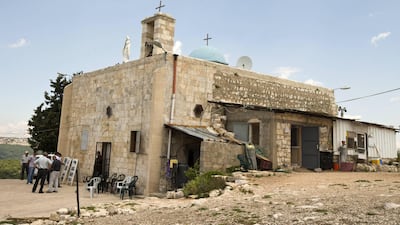
Former residents of Iqrit visit the church in 2013. AFP


High in the mountains, kilometres from the border with Lebanon, was the Palestinian village of Iqrit.
According to Pappe, its predominantly Maronite Christian community surrendered to an Israeli battalion without a fight on October 31, 1948, because they expected to be welcome in the new Jewish state.
The battalion's commander ordered the people to leave for their safety but promised they could return two weeks later, once military operations were over.
On November 6, the village's inhabitants were evicted from their homes. Some crossed into southern Lebanon, while others were taken to Rama, further south in Jenin, in lorries. Only 50 of the roughly 570 villagers were permitted to stay but were driven out six months later.
Families that were expelled from the village sought to return to their homes but, in September 1949, the Israeli government applied Emergency Regulations, which prevented the repatriation the commander previously promised.
In May 1951, the people of Iqrit brought their case to the Israeli Supreme Court, which ruled the eviction was illegal and ordered the army to allow the villagers to return to their homes.
To bypass the ruling, the army retroactively issued a formal expulsion order, such as those issued for the hundreds of other Palestinian villages that were depopulated from 1947 to 1948.
To prevent further repatriation attempts, the Israeli army demolished all the houses in Iqrit on Christmas Eve in 1951. Only the church and cemetery were spared.
According to Pappe, the army later claimed the village was destroyed in a military exercise.
The Israeli villages of Shomera, Even Machem and Gornot HaGalil were established on the ruins of Iqrit and neighbouring villages.
Despite the destruction of their homes, the families continued to fight for their right to return to Iqrit. In the 1970s, villagers conducted sit-ins in the old church over a series of six years.
In 1972, Golda Meir, the fourth Israeli prime minister, said Palestinians from Iqrit were refused repatriation rights to avoid setting a precedent.
In the early 2000s, a final supreme court ruling rejected the Palestinians' demand to reclaim their land.
The families continue to seek redress through Israeli courts, hoping to one day be allowed to return to their grandparents' homes.
What comes next for Palestinian refugees?
Palestinians have long maintained that the right to return to their original homes, from within Israel, the Palestinian territories and abroad, is fundamental and non-negotiable as part of a lasting peace agreement.
This would encompass the return of at least five million Palestinians – including those who fled or were forcibly expelled in 1948 and their descendants living abroad.
The overwhelming number of people who would potentially go back to the Occupied Palestinian Territories, under such a plan, would undeniably change the demographic of the land and of Israel itself.
“As long as Palestinian refugees don’t have a right to return, the Nakba is ongoing,” said Mr Al Ghubari.
“As long as Palestinians are still facing and living in injustice by and for the creation of Israel – another aspect of Nakba is still ongoing.”
While UN Resolution 194 of 1948 mandates the right of return for refugees and their descendants, 73 years after the creation of Israel, Palestinians continue to be denied the right of repatriation.
Sources:
The Ethnic Cleansing of Palestine (2006) Ilan Pappe
The Birth of the Palestinian Refugee Problem Revisited (2004) Benny Morris
Operation Dani and the Palestinian Exodus from Lydda and Ramle in 1948 by Benny Morris. Middle East Journal Vol. 40, No 1 (Winter, 1986)
All That Remains: The Palestinian Villages Occupied and Depopulated by Israel in 1948 (2006) Walid Al Khalidi
Atlas of Palestine, 1917-1966 (2010) Salman Abu Sitta
*A version of this story was first published in July 2021

