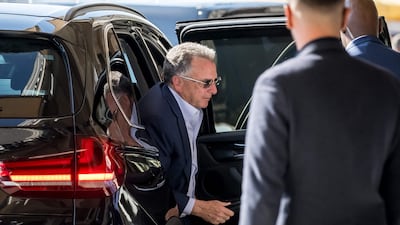

The US and Iran ended a third round of "intensive" nuclear talks late on Thursday, with a deal to resolve their stand-off still elusive as they prepare for a fourth meeting in Vienna next week.
Two sessions of talks stretched into the evening in Geneva as Iran reportedly offered to pause nuclear enrichment. The proposal may fail to satisfy what are described as "tough" American demands to ensure Tehran cannot develop an atomic bomb.
Oman's Foreign Minister Badr Al Busaidi, who is acting as a go-between, declared "significant progress" after the talks ended. "We will resume soon after consultation in the respective capitals. Discussions on a technical level will take place next week in Vienna," he said.

A US aircraft carrier departed a Greek port on Thursday bound for the Middle East, where it could join what President Donald Trump calls an "armada" of military firepower, ready to strike if he gives the order.
Iran's Foreign Ministry spokesman Esmail Baghaei said there were "very serious proposals and initiatives" on the table. "Negotiations have been done in a very serious manner and intensive form," he said during a break in the talks.
Iran's offer includes a "temporary suspension" of uranium enrichment, Tasnim news agency reported. But it said Tehran had rejected demands to hand over its uranium stockpile or negotiate limits on its missiles and defences.
The proposal, in Tehran’s view, is a test of Washington’s seriousness and commitment to a diplomatic resolution, media reports added.
The Iranian offer may not be enought to satisfy the Americans. The Wall Street Journal reported that the US had brought "tough demands" to the talks, including dismantling Iran's enrichment sites and handing over enriched uranium to the US under a deal that would "last forever".

The indirect negotiations, taking place at the Omani embassy in Geneva, are the third since Iran agreed to resume the process this month, with discussions focused on proposals for a potential nuclear agreement. Oman's Foreign Minister, Badr Al Busaidi, is acting as a go-between.
“We’ve been exchanging creative and positive ideas in Geneva,” Mr Al Busaidi said on Thursday afternoon. “We hope to make more progress.”
Iran's Foreign Minister Abbas Araghchi had said a “fair, balanced and equitable deal” was within reach. President Masoud Pezeshkian reiterated that Iran was not seeking to build nuclear weapons in response to US accusations.
Meanwhile, Ali Shamkhani, adviser to Iran's supreme leader, said “an agreement could be reached immediately” if the core issue is ensuring Iran does not seek to build nuclear weapons.
The officials' assurances come as Washington doubles down on its accusations against Tehran. US Vice President JD Vance claimed on Wednesday that Washington had seen evidence of Iran rebuilding its nuclear programme. “The principle is very simple: Iran cannot have a nuclear weapon,” he told reporters on Wednesday. “If they try to rebuild a nuclear weapon, that causes problems for us. In fact, we’ve seen evidence that they have tried to do exactly that.”
Secretary of State Marco Rubio also warned that Tehran was developing its intercontinental ballistic missile and that talks on Thursday would be largely focused on that, despite Iran repeatedly describing the matter as a red line. “I would say that the Iranian insistence on not discussing ballistic missiles is a big, big problem,” Mr Rubio said.
In his State of the Union address on Tuesday, US President Donald Trump said Iran has already developed missiles that can threaten Europe and US bases overseas, and that they are working to build missiles "that could soon reach the US".
Iranian officials swiftly denied the remarks. Mr Aragchi described the claims as “fake news” and said Iran has capped the range of its missiles below 2,000 kilometres “for defence and deterrence”.
Despite negotiations, the danger of war still looms as both sides trade threats while keeping the door open to diplomacy.
The US now has significant firepower stationed within striking range of Iran, with a second American aircraft carrier approaching the region. Mr Trump has warned his “armada” is ready to attack if Tehran does not make a deal, giving the regime a deadline that is fast approaching.
Meanwhile, Iran's Islamic Revolutionary Guard Corps has repeatedly put its military might on show to warn of retaliation against any US strike, with the supreme leader Ayatollah Ali Khamenei warning of sending US warships “to the bottom of the sea”.
The IRGC tested new firepower on Tuesday, one week after conducting live fire drills in the strategic Strait of Hormuz. Iran and Russia also held joint naval exercises last week, as Tehran warned airlines of plans to launch rockets across the south of the country.
Middle East leaders have called for de-escalation, but expect the US to follow through on its military build-up to strike Iran, experts have warned. Additionally, indications show that Iran would fight back on a larger scale than during its 12-day war against Israel.
The war erupted last June with a surprise Israeli strike on Tehran, derailing US-Iran nuclear talks that were continuing at the time.
Senior advisers to Mr Trump prefer that Israel attack Iran before the US launches strikes, according to Politico. “There’s thinking in and around the administration that the politics are a lot better if the Israelis go first and alone and the Iranians retaliate against us, and give us more reason to take action,” says one of the sources quoted in the report.

