



Syria's President Bashar Al Assad landed in China on Thursday for his first visit to the country in almost two decades.
Mr Al Assad and his wife Asma arrived in the eastern city of Hangzhou for the opening ceremony of the Asian Games, which was also attended by leaders from Kuwait, Cambodia and Nepal.
He is also expected to meet China's President Xi Jinping in Beijing after attending a banquet at the Asian Games.
The Syrian leader's office said earlier that he was invited by Mr Xi and would bring with him a high-ranking delegation, including Foreign Minister Faisal Mekdad and Economy and Trade Minister Mohammad Al Khalil.
Mr Al Assad is using the visit to shore up international support.
While its main ally, Tehran, demands more from Damascus, Syria has failed to meaningfully act on recent rapprochements with Arab nations, said Dr Karam Shaar, senior fellow at the Washington-based New Lines Institute think tank.
“The only other country meaningfully backing Syria economically is Iran,” Dr Shaar told The National.
“Bashar now knows Iran is trying to squeeze more concessions out of him and his regime in exchange for continued support, and now the regime is trying to find alternative backers.”
-
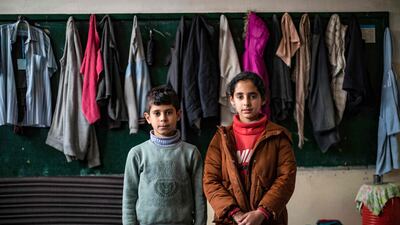
Twins Maha, right, and Mohammad Al Obaid, 11, were born in 2011, the year the Syrian war started. Displaced from Ras Al Ain in north-east Syria three years ago, they are pictured at a school on the outskirts of north-eastern city Hassakeh. All photos: AFP -
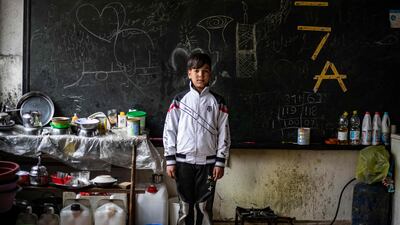
Nimr Alaywi, 11, who was also displaced from Ras Al Ain three years ago, at a school near Hassakeh. -
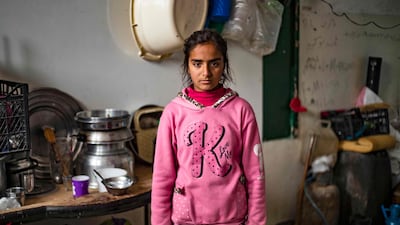
Amani Mahmud, 11, whose family fled Ras Al Ain, pictured at the school near Hassakeh. According to some estimates, 13.3 million Syrians have fled their homes since the civil war began on March 15, 2011. -
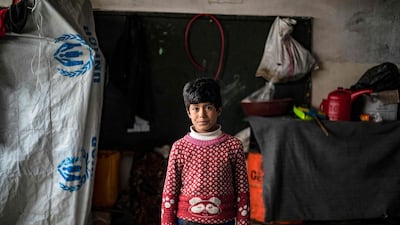
Mohammad Issa, 11, who was also displaced from Ras Al Ain, at the school near Hassakeh. -
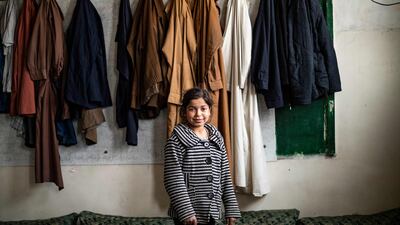
Assil Alaywi, 11, whose family also fled Ras Al Ain for Hassakeh three years ago. Ras Al Ain was the scene of heavy fighting for much of the conflict. -
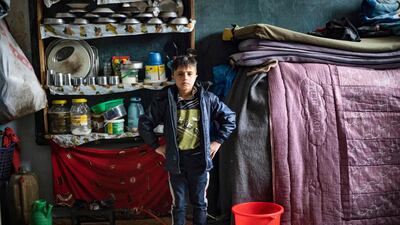
Yazan Khodr, 11, at the school near Hassakeh, after his family fled Ras Al Ain. Various groups, including Syrian government forces, extremists and Kurdish fighters, vied for control of Ras Al Ain. -
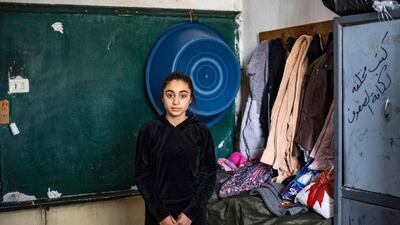
Liana Ali, 11, in the school building on the outskirts of Hassakeh. -

Manaf Mahmud, 11, pictured at the school near Hassakeh. Around four million people, at least half of them displaced, now live in the northern region. -
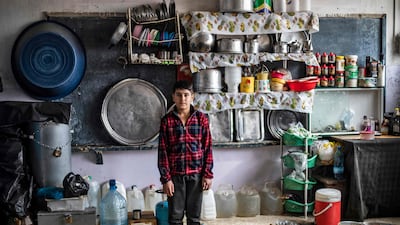
Ahmad Abderrazzak, 11, at the school near Hassakeh. -
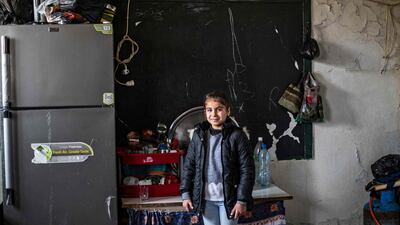
Fatima Barkal, 11, at the school near Hassakeh. -
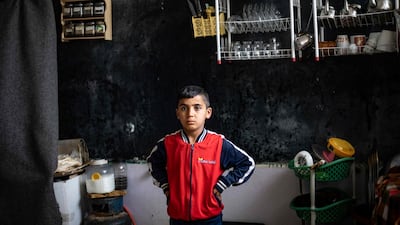
Ammar Al Khodr, 11, at the school near Hassakeh. -
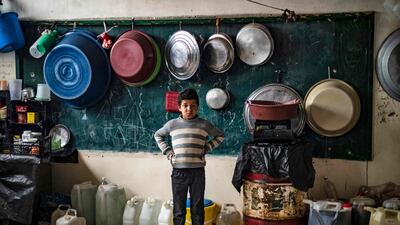
Majd Hassan, 11, at the school near Hassakeh, north-east Syria.


Civil war
Syria's civil war, which started in 2011, has killed more than 500,000 people, displaced millions more and affected the nation's infrastructure and industry.
Damascus hopes Beijing will play a major role in Syria's reconstruction, which is expected to cost tens of billions of dollars.
"Now that the regime is more stable and confident than it was five years ago, it's looking to start rebuilding, but the question is where is the money going to come from," Guy Burton, an adjunct professor at The Brussels School of Governance told The National.
"Trying to attract money from Abu Dhabi and Dubai would be attractive, but (Assad) has never overlooked the possibility of the Chinese."
He said the trip also shows the president is feeling more confident in holding on to power after regaining rebel-held territory lost in the civil war.
"Going to Abu Dhabi and now China suggests that he is a lot more confident about his position and the fate of his regime at home," said Mr Burton.
Mr Al Assad's visit will “deepen mutual political trust and co-operation … pushing bilateral relations to a new level", Chinese Foreign Ministry spokeswoman Mao Ning said before the visit.
“President Xi Jinping and other Chinese officials will meet with him to exchange views in depth at the level of bilateral relations and issues of common interest,” she added, saying the Syrian leader attaches “great importance” to strengthening relations with Beijing.
The Syria-China relationship is similar to relations between Beijing and Tehran, Mr Burton said. "The Syrians need the Chinese more than the Chinese need Syria ... the Assad regime wants to show it's not a pariah," he said.
Syria last year joined China's Belt and Road Initiative, a nearly $1 trillion soft power effort on the part of Beijing to expand its influence in developing countries through infrastructure projects.
Beijing has long provided Damascus with diplomatic support, particularly at the UN Security Council where it is a permanent member.
It has used its veto power eight times to block UN resolutions against Mr Al Assad's government, the latest being in July 2020 to veto a UN extension on cross-border aid into north-west Syria, where millions are reliant on international aid.
Sanam Vakhil, director of the Middle East North Africa Programme at London's Chatham House, told The National that Mr Al Assad was aiming to show his broader rehabilitation beyond the Middle East region.
He is "trying to win Chinese investment commitments to balance and diversify away from dependency on Tehran and Moscow", said Ms Vakhil.
"Despite promising to mediate or hint at Syrian investment, Beijing has yet to provide Mr Al Assad with anything tangible so it will be important to see if he comes away with rhetorical or substantial support," she said.
Beijing's move to invite Mr Al Assad comes as part of China's deepening engagement in the Middle East, Mona Yacoubian, senior adviser at the US Institute of Peace, told The National.
"At the same time, the trip is largely symbolic. It's unclear whether there will be any concrete deliverables of note arising from the visit," she said.
She said his visit comes as "part of the Syrian regime's broader efforts to break years of international isolation in response to Mr Al Assad's brutality against Syrian civilians".
Investment uncertain
Analysts agree Beijing is unlikely to meaningfully invest in Syria given Damascus' lack of action following recent rapprochements with Arab nations, economic issues and prevailing corruption in Syria.
The regional diplomatic push to welcome Syria back into the fold is “more or less already dead", said Dr Shaar.
“The Assad regime has shown no signs of co-operation or interest even when it's at this point where such rapprochement can save the regime, economically at least," he said.
“China nonetheless benefits from the visit by waving the Syria card in front of the West, saying: 'We can support this regime that you despise.'”
Mr Al Assad’s first visit to China was in 2004, a year after the US-led invasion of neighbouring Iraq and at a time when Washington was putting pressure on Syria.
In the last year, China increased its diplomatic efforts in the Arab world, most notably by helping broker a deal to restore ties between Iran and Saudi Arabia in March. Back channel talks between the two countries were held in Iraq, Jordan and Oman.
Beijing would have more appetite to invest in Syria had Mr Al Assad been more proactive in engaging with other Arab nations and assuaging fears over the country's role in Captagon production, Dr Shaar said.
“The top agenda for these countries was Captagon … the people that are known to be the most significant kingpins, the ones that basically roam Syria freely … Bashar Al Assad refuses to even arrest them or even give the impression that he's trying to control the industry," he said.
“China is not going to invest in a country where the political future is unstable and unclear.”
Syria's uncertain future and rampant corruption will make Beijing "think twice" about investing in Syria, said Ibrahim Al Assil, a senior fellow at the Middle East Institute.
"While Assad might harbour hopes of securing economic support from Beijing, the prevailing corruption in Syria, compounded by the lack of a concrete political resolution, makes any potential investments highly risky," he said.
Despite, this growing ties with China may unnerve Russia, a staunch ally of Damascus that has been instrumental in President Al Assad winning the war.
"Moscow is paying equal if not greater attention" to the visit than Washington, Dr Al Assil added, worrying Beijing may try to supersede its influence in the Middle East.

