

Live updates: Follow the latest on Israel-Gaza
Wearing a parachute and altimeter, Maj Mohammed Bashabseh of the Jordanian Royal Special Forces’ Air Operations unit shouted instructions to his flight crew as their plane rumbled onwards 1,000 metres above the Mediterranean Sea – headed directly for the Gaza Strip.
“It says we’re over Beirut,” he said, pointing at his phone to explain how the Israeli military's scrambling technology being used in Gaza messes with its GPS.
“But no problem, everything is going to plan.”
There was a sense of relief in the major’s tone as the Air Force model C-130 approached the besieged enclave.
The aid drop carried out by the Jordanian air force on Wednesday was the first flight the Jordanians had managed in three days; the dismal weather had made executing a mission like this almost impossible.
After finally securing the right conditions, the plane set off from King Abdullah II Air Base in northern Jordan towards Gaza, cruising low along the coastline and over the tightly packed grids of what used to be apartment blocks.
From the hold’s peephole, the destruction of Israel’s military campaign was clear to see: The contents of residential buildings splayed out into empty streets; neighbourhoods scarred with track marks from Israeli tanks and bulldozers.
Over the past 24 weeks, the residents of northern Gaza have endured miserable conditions under a relentless Israeli bombardment carried out in support of the Israeli military's ground offensive in the area.
Most of the residents of northern Gaza, which includes Gaza city, have fled to the south of the enclave. The 300,000 or so who have remained have been cut off almost completely from aid since the outbreak of the war in October.
-
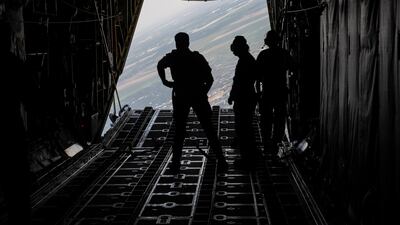
Major Mohammed Bashabseh watches to ensure all the parachutes have deployed to carry the aid safely to the ground. A previous aid drop had killed 5 Palestinians when some parachutes did not open. All photos: Matthew Kynaston/ The National -
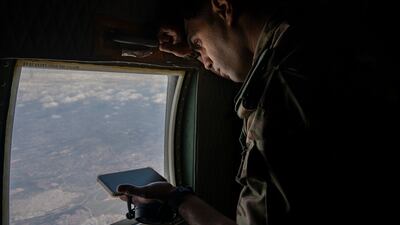
Major Mohammed Bashabseh of the Royal Special Forces, Air operations unit, attempts to track the flight path using a GPS app, but is unable to do so as Israel has scrambled GPS over Gaza. -

An American-made Lockheed C-130 Hercules loaded with 8 tonnes of aid to be dropped over Gaza on the King Abdullah II Air Base in Zarqa, near Amman, Jordan. -

A Jordanian Air Force serviceman looks out over Gaza moments before 8 tonnes of aid is dropped over the beseiged strip. -

The 8 tonnes of food contain approximately 10,000 meals. Approximately 1.1 million Gazan's are now facing starvation, according to the UN. The aid drops are not expected to be able to avert the imminent famine. -
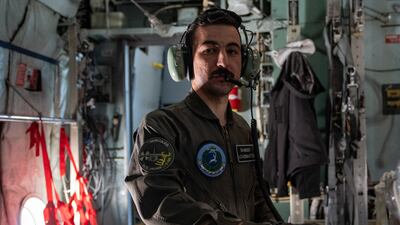
Loadmaster Sameer observes as the eight crates of food and essential items are loaded into the C-130 to be dropped over Gaza. -

The Jordanian Air Force planned two aid drops over Gaza. The aid drops deliver about the same load as one truck, but cost about seven times as much. -

A Jordanian Air Force loadmaster sits in the empty cargo hold as the flight makes its way back to the airbase in Jordan. -

Two Jordanian Air Force loadmasters prepare an aid drop over Gaza on 20 March, 2024. -
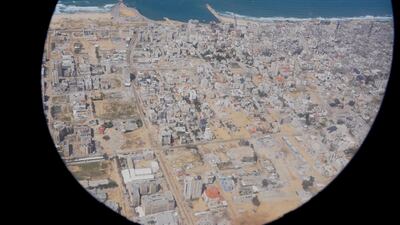
The aid drop happens about 1000m above sea level, clear enough to see the destruction of northern Gaza and the empty streets in between apartment blocks.


Two days after Hamas attacked southern Israel on October 7, Israeli Defence Minister Yoav Gallant announced that Gaza would be blockaded as Israel sought to retaliate against the militant group.
Since then, aid groups say that Israel has prevented food, fuel and other essential goods from reaching northern Gaza, which was the focus of the Israeli military's initial military offensive.
UN human rights chief Volker Turk warned last week that Israel’s “extensive restrictions” on aid entering Gaza, coupled with the continuing war against Hamas, could amount to using starvation as a “weapon of war”, which would be a “war crime”.
For its part, Israel blames the UN and aid agencies for the delays in the delivery of aid.
Conditions in northern Gaza have deteriorated as a result. Some residents have reportedly resorted to eating animal feed, and at least 27 children have now starved to death in Gaza, according to the enclave's Health Ministry.
A report released by the UN’s Integrated Food Security Phase Classification (IPC) last week warned that famine is imminent in the region, with 70 per cent of the population suffering from what the termed as “catastrophic” levels of hunger.
The report detailed that acute hunger and malnutrition had already “far exceeded” the threshold for famine in northern Gaza and anticipated a “major acceleration of death and malnutrition”.
This is the “highest number of people facing catastrophic hunger ever recorded anywhere, anytime,” said UN Secretary General Antonio Guterres.
Israel has exacerbated the situation by blocking food convoys from UNRWA, the main UN agency tasked with delivering aid to Palestinians, from entering northern Gaza.
The UN agency already had the majority of its funding cut in January after Israel accused 12 of its more than 30,000 staff of being Hamas members.

By air and sea
This dire situation has forced international actors and aid groups to find alternative ways to get aid into Gaza.
Aid drops by Jordan's air force, co-ordinated with the US and the UAE among other countries, have been part of the relief effort.
Since Jordan and the US began their aid drops at the beginning of March, Singapore, Belgium, France and the Netherlands have begun dropping aid, food, medicine and other essential goods.
Aid agencies have warned that these aerial deliveries are only a drop in the ocean of the aid that is needed to avert famine.
“Anything that gets more aid in is welcome but air drops are absolutely not the panacea that they are sometimes painted to be,” said Jonathan Fowler, senior communications manager at UNRWA.
“They are extremely expensive and it is impossible to monitor where the aid goes.”
According to the WFP, aid drops cost roughly seven times more than lorry deliveries and lack the channels of distribution to ensure that supplies get to the most vulnerable.
The US is also in the process of constructing an “aid jetty” on the site of Gaza’s old port, along with the NGO, World Central Kitchen, to allow aid to be delivered by sea from Cyprus.
However, that project is not expected to be ready until May 1.

Mr Fowler stressed that permitting aid lorries into Gaza was the only feasible and practical way to get enough aid in.
“In the context of Gaza, there is a much easier way to reach people in need and that is through the opening of more crossings by road, the regular and increased flow of humanitarian assistance into Gaza via Israel and Egypt, including through increasing working hours of current crossings and the increase of trucks.”
On March 13, under pressure from the US and other allies, Israel announced that it would flood Gaza with aid from several entry points.
But on the day that The National joined the Jordanian aid drop, only 181 lorries entered into Gaza, according to UN data – still significantly less than the 500 a day that entered the strip before the war, when the enclave needed far less aid.
With the rear door of the cargo compartment open, Maj Bashabseh watched as the eight one-tonne crates rolled along the tracks on the floor of the hold and out the back of the plane, with the fixed-line parachutes deploying immediately.
There is no celebration – only relief – when word gets around that all eight parachutes have deployed.
In early March, five Palestinians were crushed to death by falling aid when a parachute failed to open.
“It’s a success. We hit our target,” said the major. “Is it enough? No, but that is all we can do for today.”

