Jenin hospital staff in shock after disguised Israeli troops kill patients in their beds


Thomas Helm
  • English
  • Arabic

Live updates: Follow the latest news on Israel-Gaza

Israeli soldiers left behind a gruesome scene at Ibn Sina Hospital in Jenin, in the occupied West Bank, after killing three young Palestinians while they were sleeping in their beds.

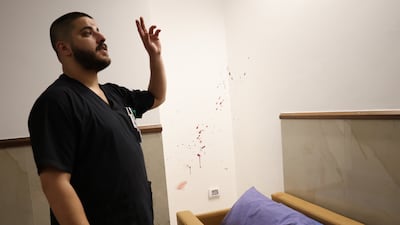
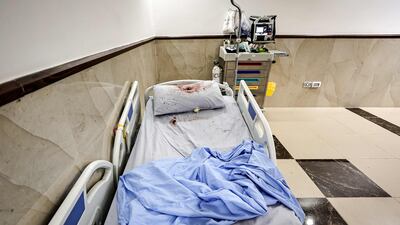
The National spoke to hospital staff, who were still in shock after witnessing the raid, and visited the room of Bassel Ghazzawi, 18, who was killed alongside two others by Israeli troops wearing disguises.

By Tuesday night, his body had been removed from the bed in which he was shot dead.

Uneaten food and a copy of the Quran sat next to his bed.

In Gaza you see them in the air, but here you see them for real
Hospital eyewitness

His killing was the work of Israeli special forces who entered the hospital in disguise, armed with assault rifles and silenced pistols, in an operation confirmed by the Israeli army.

Security footage showed at least three soldiers dressed in women's clothing and two disguised as medical staff.

Staff at the hospital told The National of the terrifying moments the Israeli soldiers approached them before entering the hospital ward and shooting dead the three Palestinians.

A female nurse was grabbed by a man dressed as an elderly religious leader who hit her while pointing a gun in her face, two of her colleagues said.

He then rushed into the room of the patient along with other troops, who were also in disguise.

The troops then shot all three Palestinians in the head at point-blank range.

The nurse told The National she was still in a state of shock and has not been able to tell her friends and family.

Two other male nurses on shift also said they were still in shock on Tuesday night.

  • Israeli agents disguised as medical staff and patients enter the Ibn Sina hospital in the West Bank city of Jenin, where they killed three men they claim were militants. AFP
    Israeli agents disguised as medical staff and patients enter the Ibn Sina hospital in the West Bank city of Jenin, where they killed three men they claim were militants. AFP
  • CCTV captures the moment the disguised agents draw assault rifles from their clothes. Reports said they used silenced pistols to execute the suspects. AFP
    CCTV captures the moment the disguised agents draw assault rifles from their clothes. Reports said they used silenced pistols to execute the suspects. AFP
  • Women embrace near Ibn Sina Hospital as mourners carried the dead men through the streets. AFP
    Women embrace near Ibn Sina Hospital as mourners carried the dead men through the streets. AFP
  • A hospital worker shows reporters the bed on which one of the men was shot to death. EPA
    A hospital worker shows reporters the bed on which one of the men was shot to death. EPA
  • A bullet hole on a pillow covered in blood on a hospital bed at Ibn Sina Hospital. AFP
    A bullet hole on a pillow covered in blood on a hospital bed at Ibn Sina Hospital. AFP

One man who was visiting the hospital to get treatment for his two-year-old son said the ward was full at the time of the attack.

The man, who is originally from Gaza but had left the enclave before October 7, said that Israeli soldiers had thrust a gun in his face. He described being shocked to see them there.

“In Gaza you see them in the air, but here you see them for real,” he told The National.

The Palestinian news agency Wafa named the three dead as Mohammed Jalamneh, 27, Mohammed Ghazzawi, 23, and Mr Ghazzawi.

The Israeli army said the operation was targeting Mr Jalamneh, who it alleged was planning an attack on Israel and had been in contact with Hamas headquarters abroad.

“Jalamneh planned to carry out a terror attack in the immediate future and used the hospital as a hiding place, and therefore was neutralised,” the Israeli military said.

The Israeli military said the other two Palestinians killed were also militants from Jenin who had been involved in recent attacks. One of them was a member of the Hamas-allied Islamic Jihad group while the other was part of a group of gunmen in Jenin, it said.

The Palestinian Authority's Health Ministry confirmed the incident had taken place, saying: “This morning, three young men were martyred by the bullets of the occupation [Israeli] forces, who stormed the Ibn Sina Hospital in Jenin and shot them.”

Bassel Ghazzawi had been in the hospital for nearly four months after being hit by fragments of a missile fired from an Israeli drone, causing paralysis in his lower limbs, Wafa reported.

“What happened was the assassination of a wounded man who was unable to move or manage his needs on his own. We, as a medical institution, guarantee the right of all patients to obtain treatment, regardless of their backgrounds,” said Dr Tawfiq Al Shobaki, the hospital's medical director.

Jenin's health director, Wissam Subeihat, called the incident “a crime against hospitals” and said Israel had “violated the sanctity of the doctor’s and nurse’s uniforms and the sanctity of the hospital, which is supposed to be a safe place”.

On October 7, Hamas launched a raid into southern Israel, leading to a retaliatory assault on the Gaza Strip and a surge in violence in the occupied West Bank. During the past month, Israel has killed at least 60 Palestinians in the West Bank.


Key figures in the life of the fort

Sheikh Dhiyab bin Isa (ruled 1761-1793) Built Qasr Al Hosn as a watchtower to guard over the only freshwater well on Abu Dhabi island.

Sheikh Shakhbut bin Dhiyab (ruled 1793-1816) Expanded the tower into a small fort and transferred his ruling place of residence from Liwa Oasis to the fort on the island.

Sheikh Tahnoon bin Shakhbut (ruled 1818-1833) Expanded Qasr Al Hosn further as Abu Dhabi grew from a small village of palm huts to a town of more than 5,000 inhabitants.

Sheikh Khalifa bin Shakhbut (ruled 1833-1845) Repaired and fortified the fort.

Sheikh Saeed bin Tahnoon (ruled 1845-1855) Turned Qasr Al Hosn into a strong two-storied structure.

Sheikh Zayed bin Khalifa (ruled 1855-1909) Expanded Qasr Al Hosn further to reflect the emirate's increasing prominence.

Sheikh Shakhbut bin Sultan (ruled 1928-1966) Renovated and enlarged Qasr Al Hosn, adding a decorative arch and two new villas.

Sheikh Zayed bin Sultan (ruled 1966-2004) Moved the royal residence to Al Manhal palace and kept his diwan at Qasr Al Hosn.

Sources: Jayanti Maitra, www.adach.ae

THE%20SPECS
%3Cp%3EEngine%3A%204.4-litre%20twin-turbo%20V8%20hybrid%0D%3Cbr%3EPower%3A%20653hp%20at%205%2C400rpm%0D%3Cbr%3ETorque%3A%20800Nm%20at%201%2C600-5%2C000rpm%0D%3Cbr%3ETransmission%3A%208-speed%20auto%0D%3Cbr%3E0-100kph%20in%204.3sec%0D%3Cbr%3ETop%20speed%20250kph%0D%3Cbr%3EFuel%20consumption%3A%20NA%0D%3Cbr%3EOn%20sale%3A%20Q2%202023%0D%3Cbr%3EPrice%3A%20From%20Dh750%2C000%0D%3Cbr%3E%3C%2Fp%3E%0A
Dubai Bling season three

Cast: Loujain Adada, Zeina Khoury, Farhana Bodi, Ebraheem Al Samadi, Mona Kattan, and couples Safa & Fahad Siddiqui and DJ Bliss & Danya Mohammed 

Rating: 1/5

Real estate tokenisation project

Dubai launched the pilot phase of its real estate tokenisation project last month.

The initiative focuses on converting real estate assets into digital tokens recorded on blockchain technology and helps in streamlining the process of buying, selling and investing, the Dubai Land Department said.

Dubai’s real estate tokenisation market is projected to reach Dh60 billion ($16.33 billion) by 2033, representing 7 per cent of the emirate’s total property transactions, according to the DLD.

Mercer, the investment consulting arm of US services company Marsh & McLennan, expects its wealth division to at least double its assets under management (AUM) in the Middle East as wealth in the region continues to grow despite economic headwinds, a company official said.

Mercer Wealth, which globally has $160 billion in AUM, plans to boost its AUM in the region to $2-$3bn in the next 2-3 years from the present $1bn, said Yasir AbuShaban, a Dubai-based principal with Mercer Wealth.

Within the next two to three years, we are looking at reaching $2 to $3 billion as a conservative estimate and we do see an opportunity to do so,” said Mr AbuShaban.

Mercer does not directly make investments, but allocates clients’ money they have discretion to, to professional asset managers. They also provide advice to clients.

“We have buying power. We can negotiate on their (client’s) behalf with asset managers to provide them lower fees than they otherwise would have to get on their own,” he added.

Mercer Wealth’s clients include sovereign wealth funds, family offices, and insurance companies among others.

From its office in Dubai, Mercer also looks after Africa, India and Turkey, where they also see opportunity for growth.

Wealth creation in Middle East and Africa (MEA) grew 8.5 per cent to $8.1 trillion last year from $7.5tn in 2015, higher than last year’s global average of 6 per cent and the second-highest growth in a region after Asia-Pacific which grew 9.9 per cent, according to consultancy Boston Consulting Group (BCG). In the region, where wealth grew just 1.9 per cent in 2015 compared with 2014, a pickup in oil prices has helped in wealth generation.

BCG is forecasting MEA wealth will rise to $12tn by 2021, growing at an annual average of 8 per cent.

Drivers of wealth generation in the region will be split evenly between new wealth creation and growth of performance of existing assets, according to BCG.

Another general trend in the region is clients’ looking for a comprehensive approach to investing, according to Mr AbuShaban.

“Institutional investors or some of the families are seeing a slowdown in the available capital they have to invest and in that sense they are looking at optimizing the way they manage their portfolios and making sure they are not investing haphazardly and different parts of their investment are working together,” said Mr AbuShaban.

Some clients also have a higher appetite for risk, given the low interest-rate environment that does not provide enough yield for some institutional investors. These clients are keen to invest in illiquid assets, such as private equity and infrastructure.

“What we have seen is a desire for higher returns in what has been a low-return environment specifically in various fixed income or bonds,” he said.

“In this environment, we have seen a de facto increase in the risk that clients are taking in things like illiquid investments, private equity investments, infrastructure and private debt, those kind of investments were higher illiquidity results in incrementally higher returns.”

The Abu Dhabi Investment Authority, one of the largest sovereign wealth funds, said in its 2016 report that has gradually increased its exposure in direct private equity and private credit transactions, mainly in Asian markets and especially in China and India. The authority’s private equity department focused on structured equities owing to “their defensive characteristics.”

%20Ramez%20Gab%20Min%20El%20Akher
%3Cp%3E%3Cstrong%3ECreator%3A%3C%2Fstrong%3E%20Ramez%20Galal%3C%2Fp%3E%0A%3Cp%3E%3Cstrong%3EStarring%3A%3C%2Fstrong%3E%20Ramez%20Galal%3C%2Fp%3E%0A%3Cp%3E%3Cstrong%3EStreaming%20on%3A%20%3C%2Fstrong%3EMBC%20Shahid%3C%2Fp%3E%0A%3Cp%3E%3Cstrong%3ERating%3A%20%3C%2Fstrong%3E2.5%2F5%3C%2Fp%3E%0A
The 12 Syrian entities delisted by UK 

Ministry of Interior
Ministry of Defence
General Intelligence Directorate
Air Force Intelligence Agency
Political Security Directorate
Syrian National Security Bureau
Military Intelligence Directorate
Army Supply Bureau
General Organisation of Radio and TV
Al Watan newspaper
Cham Press TV
Sama TV

Updated: January 31, 2024, 7:09 AM