


Live updates: Follow the latest news on Israel-Gaza
The UN General Assembly adopted on Tuesday a resolution demanding an immediate humanitarian ceasefire in the two-month-long Israel-Gaza war after the US vetoed the same call last week at a Security Council meeting.
The resolution, which was proposed in the name of 22 Arab countries, was co-sponsored by more than 100 states. It was approved with 153 votes in favour, 10 against and 23 abstentions.
UN General Assembly resolutions are non-binding in nature, primarily serving as symbolic expressions of global sentiment.
Expressing concern at the “catastrophic humanitarian situation in the Gaza Strip”, the resolution “demands an immediate humanitarian ceasefire,” and calls for the protection of civilians, humanitarian access, and the “immediate and unconditional” release of all hostages.
It reiterates the call for all warring parties to comply with international law, specifically with regard to the protection of civilians.
Palestine’s UN envoy Riyad Mansour said the overwhelming vote in favour of a humanitarian ceasefire in Gaza, marked a "historic day".
"Today was a historic day in terms of the powerful message that was sent from the General Assembly. And it is our collective duty to continue in this path until we see an end to this aggression against our people," said Mr Mansour.
“This draft resolution demands an immediate humanitarian ceasefire. Let me repeat, demands … it does not call for or urges ... it demands."
Speaking ahead of the vote, Egypt’s UN ambassador Osama Abdel Khalek, told member states the draft resolution tabled today is “very simple, clear and explicit” and only includes four operative paragraphs.
However, the implementation of these paragraphs has yet to happen by the international community, even though the Palestinians are subjected to “barbaric attacks” by Israeli occupation forces against civilians in Gaza, he said.
“This has led to an unbearable humanitarian suffering. It has threatened international peace and security,” he noted.
Washington’s proposed amendment, which condemned and rejected “the heinous terrorist attacks by Hamas” on October 7, and Austria's amendment stating that hostages held in Gaza are “held by Hamas and other groups”, failed to secure the two-thirds majority needed to pass.
Linda Thomas-Greenfield, Washington’s UN envoy, said “any ceasefire right now would be temporary at the best and dangerous at worst”.
UN Security Council envoys visit Gaza border to demand ceasefire - video
Earlier on Tuesday, Mr Mansour accused the US of politicising the issue.
“We are determined that we will not allow such amendments to succeed we will oppose them,” he told reporters at UN headquarters.
The US and Israel oppose a ceasefire because they believe it would only benefit Hamas.
Washington instead supports extended humanitarian pauses in fighting to protect civilians and allow the release of hostages taken by Palestinian militants in the October 7 attack on Israel.
In October, the General Assembly called for “an immediate, durable and sustained humanitarian truce leading to a cessation of hostilities” in a resolution adopted with 121 votes in favour, 14 against – including the US – and 44 abstentions.
Israel has said it will continue its siege of Gaza until all hostages are released and Hamas is destroyed.
But according to a report by the International Crisis Group, destroying Hamas “will be a tall order without decimating what remains of Gaza”.
“The human toll is already almost unimaginable,” it added. “The longer the campaign drags on, the graver the danger it triggers a wider Middle East war.”
US President Joe Biden warned on Tuesday that Israel was losing international support because of its “indiscriminate bombing” of Gaza.
“Israel's security can rest on the United States, but right now it has more than the United States. It has the European Union, it has Europe, it has most of the world supporting them,” Mr Biden said during a re-election fundraising event.
“They’re starting to lose that support by indiscriminate bombing that takes place.”
The vote by the 193-member General Assembly comes a day after 12 Security Council ambassadors visited the Egyptian side of the Rafah border crossing, where limited humanitarian aid deliveries have been made to Gaza.
The trip came as the 15-member council negotiates a UAE-drafted resolution, seen by The National, that demands the warring parties “allow the use of all land, sea and air routes to and throughout” Gaza for aid, including through the “Gaza port and available border crossings”.
It would also establish a UN-run aid monitoring mechanism in Gaza Strip “with notification by the United Nations to the Palestinian Authority and to Israel as the occupying power, in order to confirm the humanitarian nature of these relief consignments”.
It was not immediately known when the draft resolution could be put to a vote.
Latest from Israel-Gaza war – in pictures
-
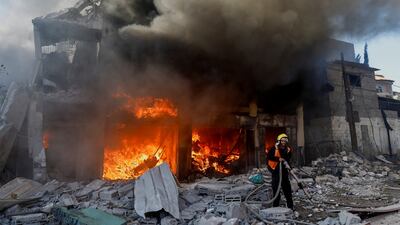
A Palestinian firefighter tackles a blaze at a house after an Israeli strike in Khan Younis, in the south of the Gaza Strip. Reuters -
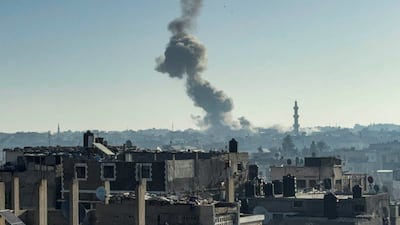
Smoke rises after an Israeli air strike in Khan Younis. Reuters -

A girl mourns during a funeral at Nasser hospital, in Khan Younis. Reuters -

An Israeli fighter jet flies over an area in southern Israel, near the border with the Gaza Strip. AFP -

Palestinians walk amid the rubble of buildings destroyed by an Israeli strike, in Khan Younis. Reuters -

Wounded Palestinians sit on the floor at Nasser hospital following Israeli air strikes in Khan Younis. Reuters -
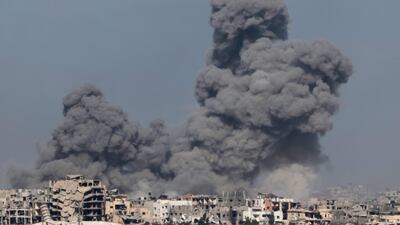
Smoke rises above buildings during an Israeli strike in Gaza. AFP -
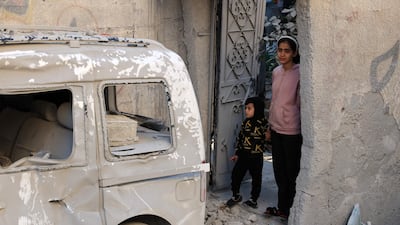
Children walk past a damaged car after an early morning Israeli strike in Rafah. AFP -

Israeli soldiers prepare to launch a drone along the border with Gaza. AFP -
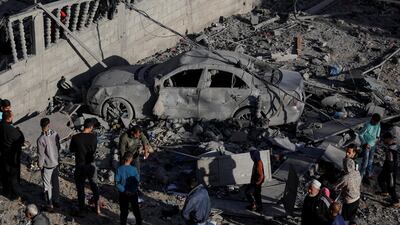
Palestinians inspect the damage at the site of an Israeli strike. Reuters -
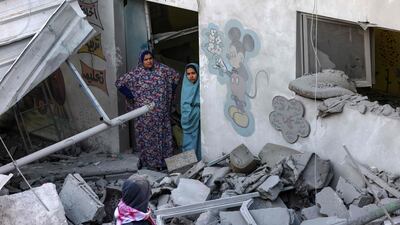
A woman and a child stand amid the rubble at a kindergarten hit by Israeli bombing in Rafah. AFP



