A woman reacts after the bodies of Palestinians killed during Israeli strikes on Ma'an school, east of Khan Younis, were laid out at Nasser Hospital. Reuters

Israel mounts deadly offensive in southern Gaza Strip


  • English
  • Arabic

Live updates: Follow the latest news on Israel-Gaza

The Israeli military pushed further south into the Gaza Strip on Tuesday, driving deep into the city of Khan Younis and bringing a new wave of destruction to an area crammed with displaced Palestinians who had fled from the north.

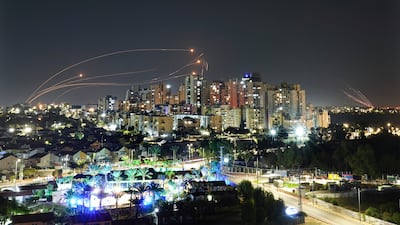
Hamas militants meanwhile fired a barrage of rockets into southern Israel, striking an apartment building in Ashkelon, north of Gaza, and causing light damage elsewhere.

Israeli tanks entered the eastern parts of Khan Younis, where scores of Palestinians were reported to have been killed or wounded.

A few kilometres away in Israel, warplanes were seen in the skies and heavy cannon and artillery fire was directed at the Gaza Strip as the Israeli assault enters a fierce new phase nearly two months after the war started.

As The National drove south into Israel, parallel to the Gaza Strip, a group of Israeli soldiers guarded a field filled with the remains of approximately 2,000 cars and motorcycles that had been destroyed on October 7 when Hamas killed about 1,200 people in a rampage that triggered the current conflict.

Vehicles are laid out in rows or stacked up in towers while authorities decide what to do with them. Many had been burnt to a shell, others had been hit by rockets or strewn with automatic gunfire. Some had bullet holes in the windscreen with corresponding chunks missing on the driver-side seats, evidence of executions.

The cars might end up being buried and the field turned into a memorial, said Israel Maki, a policeman guarding it.

He said rabbis were in the process of scouring the vehicles for any human remains that could then be buried according to Jewish custom.

“If they find shoes, they look for blood and then bury the shoes,” Mr Maki said.

The scent of death hung in the air by some vehicles.

Thousands of cars that were destroyed on October 7 have been collected in a field in southern Israel near Tkuma. Thomas Watkins / The National

In the nearby town of Sderot, which overlooks the Gaza Strip and which was overrun by Hamas militants, the streets remained largely deserted and the air smelt of gunpowder from outgoing Israeli artillery.

Two people were hurt in the rocket strike on the apartment building in nearby Ashkelon, the ambulance service said. Rocket fire was reported elsewhere including in the Western Negev area, and in central Israel one person was lightly injured.

Israel, which flattened much of the northern half of Gaza last month before pausing for last week's seven-day ceasefire, is now focusing on the southern part of the enclave in its bid to wipe out Hamas.

Defence Minister Yoav Gallant warned that the fate of Hamas militants would be “the same and worse” as in the north, though Israel has yet to provide an estimate of how many Hamas fighters have been killed.

“We're moving ahead with the second stage now, a second stage that is going to be difficult militarily,” government spokesman Eylon Levy told reporters.

Israel is facing global condemnation for the high death toll in the Gaza Strip, where local authorities say nearly 16,000 people have been killed, most of them women and children.

The US on Monday said it expects Israel to avoid attacking areas in southern Gaza that it identified as “no-strike” zones to allow Palestinian civilians to find safety during Israeli military operations.

White House National Security Adviser Jake Sullivan said the Biden administration was speaking daily with Israeli leaders about protecting civilians in Gaza, and would continue to push for the entry of more humanitarian aid into the besieged enclave.

Israel was open to “constructive feedback” on reducing harm to civilians as long as the advice is consistent with its aim of destroying Hamas, Mr Levy said.

Israel's air-and-ground offensive has pushed three-quarters of Gaza's 2.3 million residents from their homes – and new orders to evacuate areas around Khan Younis are cramming people into ever-shrinking areas of the tiny coastal strip.

At Nasser Hospital in Khan Younis, ambulances brought dozens of wounded people in, including a young boy in a bloody shirt whose hand had been blown off, Reuters reported.

The UN agency for Palestinian refugees, UNRWA, said one of its schools where people were sheltering took collateral damage from a nearby strike, killing four people and wounding seven.

Renewed misery in Gaza as Israel recommences air strikes – in pictures

  • Palestinians help a man injured in an Israeli strike in Rafah, in the southern Gaza Strip. AFP
    Palestinians help a man injured in an Israeli strike in Rafah, in the southern Gaza Strip. AFP
  • Palestinians assess the damage after an Israeli strike in Rafah. AFP
    Palestinians assess the damage after an Israeli strike in Rafah. AFP
  • A drone flies above Gaza after a temporary truce between Israel and Palestinian militant group Hamas expired. Reuters
    A drone flies above Gaza after a temporary truce between Israel and Palestinian militant group Hamas expired. Reuters
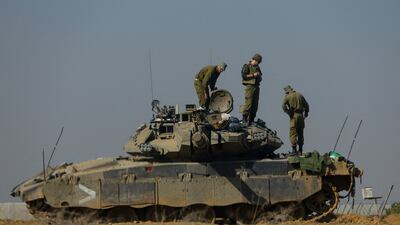
  • Israeli soldiers work on a tank near the border with Gaza. Reuters
    Israeli soldiers work on a tank near the border with Gaza. Reuters
  • Palestinians help a boy injured in an Israeli strike in Rafah. AFP
    Palestinians help a boy injured in an Israeli strike in Rafah. AFP
  • A Palestinian girl sits on the floor of Nasser hospital in Khan Younis after an Israeli strike. Reuters
    A Palestinian girl sits on the floor of Nasser hospital in Khan Younis after an Israeli strike. Reuters
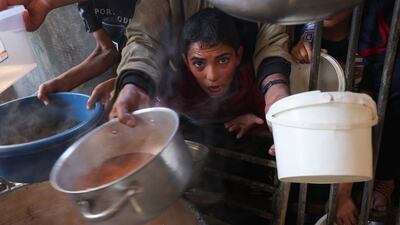
  • Palestinians wait to receive food aid as the conflict between Israel and Hamas continues. Reuters
    Palestinians wait to receive food aid as the conflict between Israel and Hamas continues. Reuters
  • A woman injured in an Israeli strike sits amid the rubble in Rafah. AFP
    A woman injured in an Israeli strike sits amid the rubble in Rafah. AFP
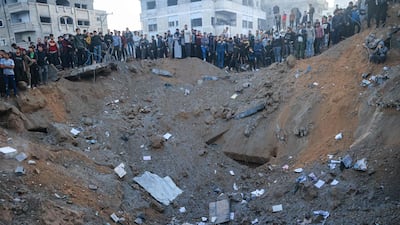
  • Palestinians stand on the edge of a crater after an Israeli strike in Rafah. AFP
    Palestinians stand on the edge of a crater after an Israeli strike in Rafah. AFP
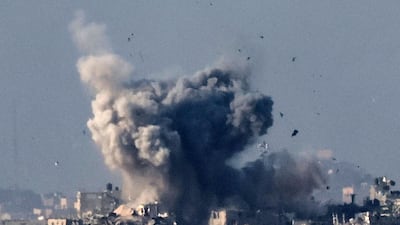
  • Smoke billows over the Gaza Strip on Saturday after a temporary truce between Israel and Hamas ended. AFP
    Smoke billows over the Gaza Strip on Saturday after a temporary truce between Israel and Hamas ended. AFP
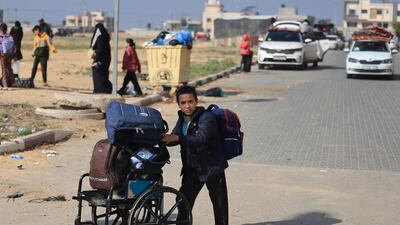
  • A Palestinian boy carries bags on a wheelchair as he flees with family members after receiving notice of an imminent Israeli strike. AFP
    A Palestinian boy carries bags on a wheelchair as he flees with family members after receiving notice of an imminent Israeli strike. AFP
  • People mourn next to the bodies of Palestinians killed in Israeli strikes at Nasser hospital, in Khan Younis. Reuters
    People mourn next to the bodies of Palestinians killed in Israeli strikes at Nasser hospital, in Khan Younis. Reuters
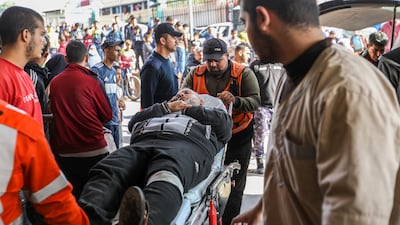
  • Palestinians wounded in Israeli air strikes arrive at Nasser Hospital. Getty Images
    Palestinians wounded in Israeli air strikes arrive at Nasser Hospital. Getty Images
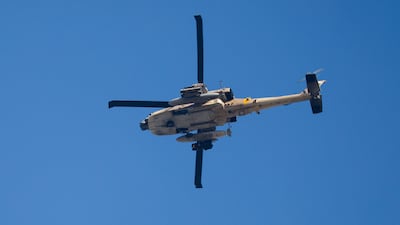
  • An Apache helicopter of the Israeli military patrols over a territory near Gaza. Reuters
    An Apache helicopter of the Israeli military patrols over a territory near Gaza. Reuters
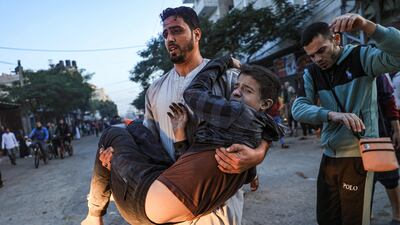
  • A Palestinian man carries a child injured during Israeli bombardment in Rafah. AFP
    A Palestinian man carries a child injured during Israeli bombardment in Rafah. AFP
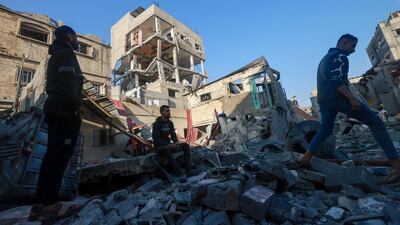
  • Palestinians inspect a building damaged during Israeli bombardment in Rafah. AFP
    Palestinians inspect a building damaged during Israeli bombardment in Rafah. AFP
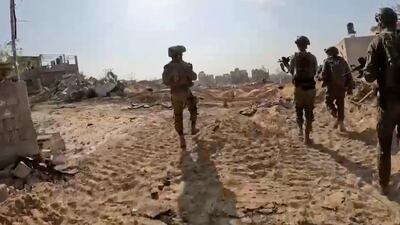
  • Israeli soldiers operate in the Gaza Strip, after a temporary truce expired between Israel and the Palestinian group Hamas. Reuters
    Israeli soldiers operate in the Gaza Strip, after a temporary truce expired between Israel and the Palestinian group Hamas. Reuters
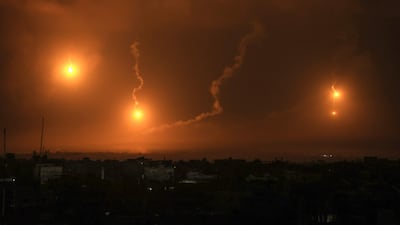
  • Israeli flares light the sky above Khan Younis in the southern Gaza Strip. AFP
    Israeli flares light the sky above Khan Younis in the southern Gaza Strip. AFP
  • The Israeli Iron Dome air defence system fires to intercept a rocket fired from the Gaza Strip, in Ashkelon, Israel. AP
    The Israeli Iron Dome air defence system fires to intercept a rocket fired from the Gaza Strip, in Ashkelon, Israel. AP
In numbers: China in Dubai

The number of Chinese people living in Dubai: An estimated 200,000

Number of Chinese people in International City: Almost 50,000

Daily visitors to Dragon Mart in 2018/19: 120,000

Daily visitors to Dragon Mart in 2010: 20,000

Percentage increase in visitors in eight years: 500 per cent

How it works

A $10 hand-powered LED light and battery bank

Device is operated by hand cranking it at any time during the day or night 

The charge is stored inside a battery

The ratio is that for every minute you crank, it provides 10 minutes light on the brightest mode

A full hand wound charge is of 16.5minutes 

This gives 1.1 hours of light on high mode or 2.5 hours of light on low mode

When more light is needed, it can be recharged by winding again

The larger version costs between $18-20 and generates more than 15 hours of light with a 45-minute charge

No limit on how many times you can charge


ANATOMY%20OF%20A%20FALL
%3Cp%3E%3Cstrong%3EDirector%3A%20%3C%2Fstrong%3EJustine%20Triet%3C%2Fp%3E%0A%3Cp%3E%3Cstrong%3EStarring%3A%20%3C%2Fstrong%3ESandra%20Huller%2C%20Swann%20Arlaud%2C%20Milo%20Machado-Graner%3C%2Fp%3E%0A%3Cp%3E%3Cstrong%3ERating%3A%3C%2Fstrong%3E%205%2F5%3C%2Fp%3E%0A

Mercer, the investment consulting arm of US services company Marsh & McLennan, expects its wealth division to at least double its assets under management (AUM) in the Middle East as wealth in the region continues to grow despite economic headwinds, a company official said.

Mercer Wealth, which globally has $160 billion in AUM, plans to boost its AUM in the region to $2-$3bn in the next 2-3 years from the present $1bn, said Yasir AbuShaban, a Dubai-based principal with Mercer Wealth.

Within the next two to three years, we are looking at reaching $2 to $3 billion as a conservative estimate and we do see an opportunity to do so,” said Mr AbuShaban.

Mercer does not directly make investments, but allocates clients’ money they have discretion to, to professional asset managers. They also provide advice to clients.

“We have buying power. We can negotiate on their (client’s) behalf with asset managers to provide them lower fees than they otherwise would have to get on their own,” he added.

Mercer Wealth’s clients include sovereign wealth funds, family offices, and insurance companies among others.

From its office in Dubai, Mercer also looks after Africa, India and Turkey, where they also see opportunity for growth.

Wealth creation in Middle East and Africa (MEA) grew 8.5 per cent to $8.1 trillion last year from $7.5tn in 2015, higher than last year’s global average of 6 per cent and the second-highest growth in a region after Asia-Pacific which grew 9.9 per cent, according to consultancy Boston Consulting Group (BCG). In the region, where wealth grew just 1.9 per cent in 2015 compared with 2014, a pickup in oil prices has helped in wealth generation.

BCG is forecasting MEA wealth will rise to $12tn by 2021, growing at an annual average of 8 per cent.

Drivers of wealth generation in the region will be split evenly between new wealth creation and growth of performance of existing assets, according to BCG.

Another general trend in the region is clients’ looking for a comprehensive approach to investing, according to Mr AbuShaban.

“Institutional investors or some of the families are seeing a slowdown in the available capital they have to invest and in that sense they are looking at optimizing the way they manage their portfolios and making sure they are not investing haphazardly and different parts of their investment are working together,” said Mr AbuShaban.

Some clients also have a higher appetite for risk, given the low interest-rate environment that does not provide enough yield for some institutional investors. These clients are keen to invest in illiquid assets, such as private equity and infrastructure.

“What we have seen is a desire for higher returns in what has been a low-return environment specifically in various fixed income or bonds,” he said.

“In this environment, we have seen a de facto increase in the risk that clients are taking in things like illiquid investments, private equity investments, infrastructure and private debt, those kind of investments were higher illiquidity results in incrementally higher returns.”

The Abu Dhabi Investment Authority, one of the largest sovereign wealth funds, said in its 2016 report that has gradually increased its exposure in direct private equity and private credit transactions, mainly in Asian markets and especially in China and India. The authority’s private equity department focused on structured equities owing to “their defensive characteristics.”

How%20champions%20are%20made
%3Cp%3E%0D%3Cstrong%3EDiet%3C%2Fstrong%3E%20%0D%3Cbr%3E7am%20-%20Protein%20shake%20with%20oats%20and%20fruits%0D%3Cbr%3E10am%20-%205-6%20egg%20whites%0D%3Cbr%3E1pm%20-%20White%20rice%20or%20chapati%20(Indian%20bread)%20with%20chicken%0D%3Cbr%3E4pm%20-%20Dry%20fruits%20%0D%3Cbr%3E7.30pm%20-%20Pre%20workout%20meal%20%E2%80%93%20grilled%20fish%20or%20chicken%20with%20veggies%20and%20fruits%0D%3Cbr%3E8.30pm%20to%20midnight%20workout%0D%3Cbr%3E12.30am%20%E2%80%93%20Protein%20shake%20%0D%3Cbr%3E%3Cstrong%3ETotal%20intake%3A%3C%2Fstrong%3E%204000-4500%20calories%20%0D%3Cbr%3E%3Cstrong%3ESaidu%E2%80%99s%20weight%3A%3C%2Fstrong%3E%20110%20kg%0D%3Cbr%3E%3Cstrong%3EStats%3A%3C%2Fstrong%3E%20Biceps%2019%20inches.%20Forearms%2018%20inches%3C%2Fp%3E%0A
Specs

Engine: Dual-motor all-wheel-drive electric

Range: Up to 610km

Power: 905hp

Torque: 985Nm

Price: From Dh439,000

Available: Now

Updated: December 06, 2023, 6:19 AM