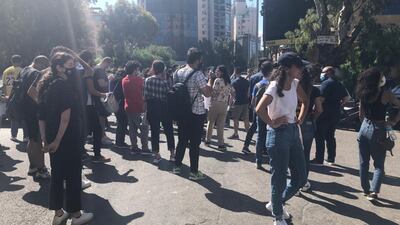
Lebanon’s military interrogated a prominent student activist on Monday after he took part in a university protest, a move rights defenders say is a worrying attempt to stifle dissent.
Karim Safieddine, a student leader from the Mada Network, a political youth group that has gained momentum in the aftermath of the October protests, said he was summoned by military police for allegedly throwing rocks at security forces during a protest against tuition fee hikes at the American University of Beirut last December.
He denies allegations of violence and said on Twitter that he “did not touch one stone”.
"This is an attempt to intimidate us," Mr Safieddine told The National after his interrogation.
“Authorities are sending us a political message because our student grassroots movement is becoming more widespread.”
Activists and human rights defenders said Mr Safieddine’s interrogation was part of a wider clampdown on individuals who were active in the mass anti-government protest movement of late 2019.
An army representative declined to comment on the issue.
More than a million Lebanese took to the streets in October 2019 to demand the downfall of the ruling elite, widely accused of corruption and fomenting one of the worst financial crises in the country’s history.
Inspired by this movement, the protests at AUB drew students from all sects, a rarity in a country where people’s politics fall along sectarian lines. They also inspired other universities to mobilise.
About 50 supporters of Mr Safieddine gathered outside the military police station where he was interrogated.
They held banners that read “state oppression does not scare us, the student movement lives on” and chanted “the military is stifling protesters”.
Protester Farah El Baba, 25, said Mr Safieddine’s interrogation was meant to dissuade other young people from speaking out and mobilising.
“They picked one of the most vocal activists in order to scare others,” she said.
The Mada Network has helped students across Lebanese campuses create independent, mostly secular clubs in the past year and mobilise against Lebanon’s ruling elite.
Authorities are cracking down on people who are prominent in the October protests
Jad El Hani, 21, an activist at AUB, said the security forces have been calling student leaders to inquire about their activities since the December protests.
“The establishment considers us to be a threat to them and they are targeting our members and our co-ordinators one by one,” he said. “With parliamentary elections coming in a year, they are sending us a clear message.”
Human rights organisations have decried crackdowns on activists since the onset of the October 2019 protests.
Aya Majzoub, a Lebanon researcher at Human Rights Watch, said security forces are using interrogations as a tool to harass and intimidate protesters.
"Authorities are cracking down on people who are prominent in the October protests," Ms Majzoub told The National.
“That makes people think twice before participating in protests. It’s a form of intimidation. It’s definitely a trend we are very worried about.”
Military courts in Lebanon can interrogate and try civilians, a practice that has often been criticised by rights groups.
In February, 35 protesters including two children were charged by a military tribunal with offences including terrorism after they took part in demonstrations against deteriorating living conditions.
“No civilians should be under the jurisdiction of the military courts,” Ms Majzoub said.

FROM%20THE%20ASHES
%3Cp%3EDirector%3A%20Khalid%20Fahad%3C%2Fp%3E%0A%3Cp%3EStarring%3A%20Shaima%20Al%20Tayeb%2C%20Wafa%20Muhamad%2C%20Hamss%20Bandar%3C%2Fp%3E%0A%3Cp%3ERating%3A%203%2F5%3C%2Fp%3E%0A
Which honey takes your fancy?
Al Ghaf Honey
The Al Ghaf tree is a local desert tree which bears the harsh summers with drought and high temperatures. From the rich flowers, bees that pollinate this tree can produce delicious red colour honey in June and July each year
Sidr Honey
The Sidr tree is an evergreen tree with long and strong forked branches. The blossom from this tree is called Yabyab, which provides rich food for bees to produce honey in October and November. This honey is the most expensive, but tastiest
Samar Honey
The Samar tree trunk, leaves and blossom contains Barm which is the secret of healing. You can enjoy the best types of honey from this tree every year in May and June. It is an historical witness to the life of the Emirati nation which represents the harsh desert and mountain environments
Mercer, the investment consulting arm of US services company Marsh & McLennan, expects its wealth division to at least double its assets under management (AUM) in the Middle East as wealth in the region continues to grow despite economic headwinds, a company official said.
Mercer Wealth, which globally has $160 billion in AUM, plans to boost its AUM in the region to $2-$3bn in the next 2-3 years from the present $1bn, said Yasir AbuShaban, a Dubai-based principal with Mercer Wealth.
“Within the next two to three years, we are looking at reaching $2 to $3 billion as a conservative estimate and we do see an opportunity to do so,” said Mr AbuShaban.
Mercer does not directly make investments, but allocates clients’ money they have discretion to, to professional asset managers. They also provide advice to clients.
“We have buying power. We can negotiate on their (client’s) behalf with asset managers to provide them lower fees than they otherwise would have to get on their own,” he added.
Mercer Wealth’s clients include sovereign wealth funds, family offices, and insurance companies among others.
From its office in Dubai, Mercer also looks after Africa, India and Turkey, where they also see opportunity for growth.
Wealth creation in Middle East and Africa (MEA) grew 8.5 per cent to $8.1 trillion last year from $7.5tn in 2015, higher than last year’s global average of 6 per cent and the second-highest growth in a region after Asia-Pacific which grew 9.9 per cent, according to consultancy Boston Consulting Group (BCG). In the region, where wealth grew just 1.9 per cent in 2015 compared with 2014, a pickup in oil prices has helped in wealth generation.
BCG is forecasting MEA wealth will rise to $12tn by 2021, growing at an annual average of 8 per cent.
Drivers of wealth generation in the region will be split evenly between new wealth creation and growth of performance of existing assets, according to BCG.
Another general trend in the region is clients’ looking for a comprehensive approach to investing, according to Mr AbuShaban.
“Institutional investors or some of the families are seeing a slowdown in the available capital they have to invest and in that sense they are looking at optimizing the way they manage their portfolios and making sure they are not investing haphazardly and different parts of their investment are working together,” said Mr AbuShaban.
Some clients also have a higher appetite for risk, given the low interest-rate environment that does not provide enough yield for some institutional investors. These clients are keen to invest in illiquid assets, such as private equity and infrastructure.
“What we have seen is a desire for higher returns in what has been a low-return environment specifically in various fixed income or bonds,” he said.
“In this environment, we have seen a de facto increase in the risk that clients are taking in things like illiquid investments, private equity investments, infrastructure and private debt, those kind of investments were higher illiquidity results in incrementally higher returns.”
The Abu Dhabi Investment Authority, one of the largest sovereign wealth funds, said in its 2016 report that has gradually increased its exposure in direct private equity and private credit transactions, mainly in Asian markets and especially in China and India. The authority’s private equity department focused on structured equities owing to “their defensive characteristics.”
Results
%3Cp%3E%3Cstrong%3EStage%203%3A%3C%2Fstrong%3E%3Cbr%3E1.%20Einer%20Rubio%20(COL)%20Movistar%20Team%20-%204h51%E2%80%9924%E2%80%9D%3Cbr%3E2.%20Remco%20Evenepoel%20(BEL)%20Soudal%20Quick-Step%20-%2014%22%3Cbr%3E3.%20Adam%20Yates%20(GBR)%20UAE%20Team%20Emirates%20-%2015%22%3Cbr%3E%3Cstrong%3EGeneral%20classifications%3A%3C%2Fstrong%3E%3Cbr%3E1.%20Remco%20Evenepoel%20(BEL)%20Soudal%20Quick-Step%3Cbr%3E2.%20Lucas%20Plapp%20(AUS)%20Ineos%20Grenaders)%20-%207%22%3Cbr%3E3.%20Pello%20Bilbao%20(ESP)%20Bahrain%20Victorious%20-%2011%22%3C%2Fp%3E%0A
Ms Yang's top tips for parents new to the UAE
- Join parent networks
- Look beyond school fees
- Keep an open mind
The biog
Favourite film: Motorcycle Dairies, Monsieur Hulot’s Holiday, Kagemusha
Favourite book: One Hundred Years of Solitude
Holiday destination: Sri Lanka
First car: VW Golf
Proudest achievement: Building Robotics Labs at Khalifa University and King’s College London, Daughters
Driverless cars or drones: Driverless Cars
Living in...
This article is part of a guide on where to live in the UAE. Our reporters will profile some of the country’s most desirable districts, provide an estimate of rental prices and introduce you to some of the residents who call each area home.
The Word for Woman is Wilderness
Abi Andrews, Serpent’s Tail
Results
Ashraf Ghani 50.64 per cent
Abdullah Abdullah 39.52 per cent
Gulbuddin Hekmatyar 3.85 per cent
Rahmatullah Nabil 1.8 per cent
UAE currency: the story behind the money in your pockets
