

Students of the American University of Beirut have called for a tuition strike after the administration adopted a new dollar exchange rate last month, equal to a 160 per cent rise in annual fees.
They launched the “We won’t pay” campaign, urging students not to pay the tuition fees that are due on February 5, which have become largely unaffordable for many in the crisis-hit nation.
"I may be putting my education at risk because I only have one semester left before I graduate, but I will not pay the full tuition," Karim Saadeh, treasurer of AUB's Student Faculty Committee, told The National.
In a race against time, student leaders hope the strike will delay payments so the government can pass a new law capping tuition rises in private universities. Lebanon's legislators are, however, notoriously slow to act.
Students have been protesting against the increase in tuition fee at AUB, Lebanon's leading university, over the past month, but a three-week Covid-19 lockdown beginning on Thursday may limit their ability to mobilise before the fees are due. Demonstrations have sometimes turned violent and the standoff with the administration has intensified in the past few weeks.
The Lebanese-American University adopted the 3,900 lira rate shortly after the AUB and others are expected to follow suit.
Students say the new rates jeopardise their access to higher education, one of Lebanon’s last functioning sectors and a field that the country has long been renowned for in the region. They are asking for the state to regulate private university fees before students are forced to drop out.
"This is the last chance for the government to intervene," said Jad El Hani, of the AUB Secular Club.
Mr El Hani said student leaders had met caretaker Minister of Education Tarek Majzoub seeking action, but to no effect. A bill limiting the fee rises was set to be discussed when parliament last convened in December, but it was the last item on the agenda and the session ended before it was reached.
-
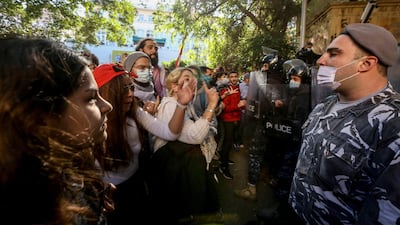
Lebanese policemen and students at the American University of Beirut (AUB) clash during a protest in front of the university over an effective tuition fee hike caused by the changing of the exchange rate from Lebanese lira to US dollar. EPA -
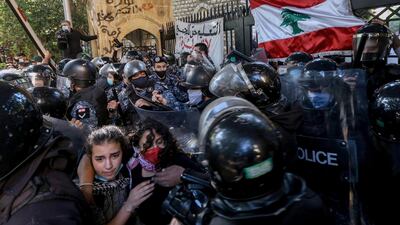
Lebanese policemen and students at the American University of Beirut (AUB) clash during a protest in front of the university over an effective tuition fee hike caused by the changing of the exchange rate from Lebanese lira to US dollar. EPA -
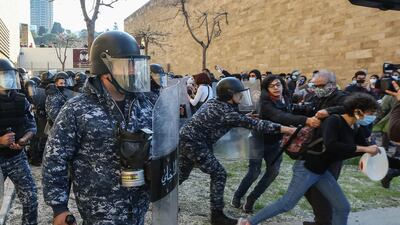
Lebanese policemen and students at the American University of Beirut (AUB) clash during a protest in front of the university over an effective tuition fee hike caused by the changing of the exchange rate from Lebanese lira to US dollar. EPA -
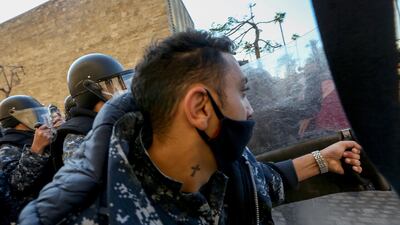
Lebanese policemen and students at the American University of Beirut (AUB) clash during a protest in front of the university over an effective tuition fee hike caused by the changing of the exchange rate from Lebanese lira to US dollar. EPA -
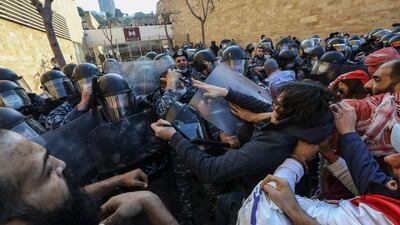
Lebanese policemen and students at the American University of Beirut (AUB) clash during a protest in front of the university over an effective tuition fee hike caused by the changing of the exchange rate from Lebanese lira to US dollar. EPA -
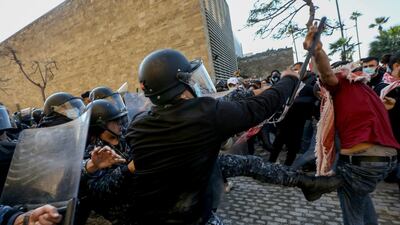
Lebanese policemen and students at the American University of Beirut (AUB) clash during a protest in front of the university over an effective tuition fee hike caused by the changing of the exchange rate from Lebanese lira to US dollar. EPA -
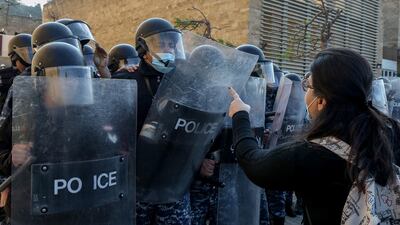
Lebanese policemen and students at the American University of Beirut (AUB) clash during a protest in front of the university over an effective tuition fee hike caused by the changing of the exchange rate from Lebanese lira to US dollar. EPA -

Lebanese policemen and students at the American University of Beirut (AUB) clash during a protest in front of the university over an effective tuition fee hike caused by the changing of the exchange rate from Lebanese lira to US dollar. EPA -

Lebanese policemen and students at the American University of Beirut (AUB) clash during a protest in front of the university over an effective tuition fee hike caused by the changing of the exchange rate from Lebanese lira to US dollar. EPA -

Lebanese policemen and students at the American University of Beirut (AUB) clash during a protest in front of the university over an effective tuition fee hike caused by the changing of the exchange rate from Lebanese lira to US dollar. EPA


Student leaders said the AUB administration did not consult them before increasing fees, and has not responded to requests to meet student representatives to discuss the issue.
A financial crisis largely triggered by a shortage of foreign currencies has devalued the Lebanese pound, now worth about 8,500 to the American dollar on the black market.
As a result, AUB President Fadlo Khuri announced last month that tuition fees, calculated in dollars, must be paid at a rate of 3,900 lira to the dollar instead of the official, but mostly abandoned, rate of 1,515 lira to the dollar.
Mr Khuri said the decision was necessary “for the financial survival of AUB”.
The university's Interim Provost Dr Lina Choueiri said there were plans to help those hardest hit by the fee rise by distributing an additional $20 million in financial aid for the spring semester, funded in part by tuition revenue. More aid has already been distributed to needy students.
“Before the end of December, a first batch of over 2,400 AUB students have been notified of a notable increase in their financial aid support for the spring term,” Dr Choueiri said.
Students, however, are wary of the university’s financial aid system, which they say is influenced by the sectarian parties that rule the country, and cannot support all those in need.
“A lot of what happens in the country is reflected in the university,” Mr Saadeh said.
“The university’s plan is to increase the financial aid budget. But students don’t trust this system and they don’t believe it will help everyone regardless of sect, connections and party-affiliations.”
Mr Saadeh said he could have been granted financial aid in his first year of university, but turned down the offer in protest against the way aid was being distributed.
Dr Choueiri denied the claims. "AUB is committed to the principle of equal opportunity in education in which any kind of discrimination is not tolerated," she told The National in an email. "This principle governs a wide range of generous financial assistance options, managed under stringent, fully audited processes that are overseen by the Office of Financial Aid and a committee including representatives from each faculty to prevent any undue influence.”
For the first time in post-war Lebanon, independent students won university elections last year, bolstered by an anti-government protest movement that began in October 2019. They have accused Lebanon’s sectarian political system, which is widely seen as corrupt, of fomenting the current economic crisis and hijacking their future.
Tanios El Kassis of the Parents and University Students Union said he refused to pay the tuition of his son, a student at AUB, and that suggesting parents should rely on financial aid was humiliating. The Union has called for AUB and LAU to revert to the official dollar exchange rate.
“AUB is not behaving like it is based in Lebanon. Can’t they see the economic situation here is terrible? Can’t they see that people have lost their jobs, and 60 per cent of Lebanese are now poor?” said Mr El Kassis.
The Union plans to meet Mr Majzoub again in the coming days, alongside student leaders, to push for the state to take action as the deadline for paying tuition fees approaches.
“As parents, we are doing this for our kids who want to stay in Lebanon. The ruling thugs want young people to leave so that they can continue to govern us. Even worse, they want to deprive them of their education,” Mr El Kassis said.
“We are not begging for help. We have the solution and we want it to be implemented.”

