A Russian business delegation met Lebanese officials on Monday to discuss plans to rebuild the grain silos destroyed last year in a massive explosion at Beirut's port, a Lebanese minister said.
The visit by the Russian team, including officials from the country's Hydro Engineering and Construction company, comes as Lebanon is going through the worst economic crisis in its modern history.
Nearly 3,000 tonnes of ammonium nitrate, a highly explosive material used in fertilisers, had been improperly stored in the port for years. The nitrate ignited on August 4, causing a catastrophic blast that killed 211 people and injured more than 6,000, devastating nearby neighbourhoods.
A government-commissioned study after the explosion said the 50-year-old silos could collapse at any moment and should be demolished. Several countries are said to be interested in rebuilding the port and the surrounding areas, including Turkey, Germany and China.
Lebanon's caretaker Public Works and Transpiration Minister Michel Najjar said the Russian delegation expressed a desire to co-operate and would offer technical support for the silos repair at the port of Beirut.
Mr Najjar said the Russians were also interested in building a silo in the port of the northern city of Tripoli.
The Russian team will spend three days at each facility “and they will study the possibility of building new grain silos", he said.
In April, representatives of several German companies outlined a multi-billion-dollar plan to rebuild the port of Beirut and surrounding neighbourhoods. Germany’s consortium, led by Hamburg Port Consulting and Colliers, was the first to visit Lebanon with a plan in hand that they presented to Lebanese officials.
In 2019, Lebanon signed a deal with Russia’s largest oil company, Rosneft, to upgrade and operate storage installations in Tripoli. The deal made Rosneft manage storage operations.
Lebanon protests – in pictures
-

Drivers wait in a long queue for fuel in Beirut, Lebanon, where the caretaker prime minister on Friday granted approval to allow fuel imports to be financed at a rate higher than the official exchange rate, effectively reducing fuel subsidies that have been in place for decades. AP Photo -

A woman in a queue for petrol in Beirut uses the time to work on her laptop. AP Photo -

Drivers queue for fuel as traffic flows past on the Tripoli-Beirut motorway in the coastal city of Batroun. The head of Hezbollah, Lebanon's powerful Shiite movement on June 8 said that the country could soon be forced to rely on fuel imports from Iran. AFP -

An anti-government protester in Jal El Dib, in north Beirut, next to Lebanese soldiers during a protest against power cuts, high cost of living and low purchasing power of the Lebanese pound. Protesters, closed the streets with rubbish bins and burning tyres to express their anger at the growing economic crisis, as well as the failure of political leaders to form a government after months of deadlock. EPA -

Protesters block a motorway in north Beirut, Lebanon, where state-provided electricity has reached record-low levels. EPA -

A traffic jam in Jal El Dib, Beirut, caused by protesters expressing their anger at the growing economic crisis. EPA -
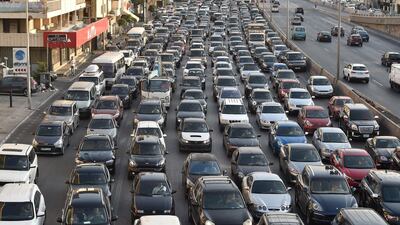
Traffic in Beirut backed up by a protest against the Lebanese government's inability to find a way out of the economic crisis crippling the country. EPA -

A Lebanese soldier tries to re-open the main motorway leading to Rafik Hariri International Airport that was blocked by anti-government protesters. EPA -
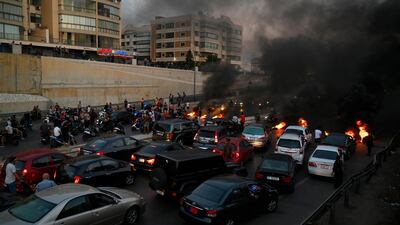
Burning tyres block the road to Rafik Hariri International Airport during anti-government protests in Lebanon. EPA -

Lebanese soldiers dismantle a burning roadblock set up by anti-government protesters in Beirut. EPA



