

In a small Christian village outside Jounieh, concerned locals gather on their balconies. An ambulance pulls up outside an apartment block and three paramedics in white bodysuits clamber up the stairs into the house.
The arrival of these space-like creatures is a fearful sight in these communities, but it is increasingly common, even in the more isolated villages of Mount Lebanon – it means Covid-19 has come to town.
The three paramedics are volunteers with the Lebanese Red Cross, the closest thing the country has to a public ambulance service, and they have been called to a covid-19 positive patient.
What starts with pleasantries and a relaxed call-out escalates rapidly when the family tells paramedics that the man, in his 60s, has hypertension and a history of cardiac problems.
-
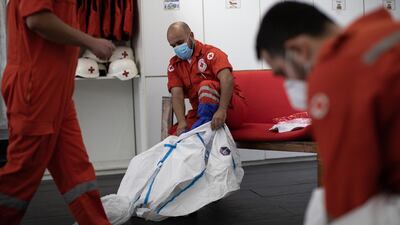
Lebanese Red Cross volunteer paramedic David 'Abbout' Ayache puts on Coronavirus PPE at Jounieh station. Davids nickname means 'grasshopper', and his day job is working as an internet provider. Tom Nicholson for The National -
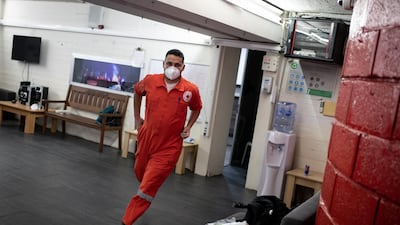
Lebanese Red Cross volunteer paramedic Patrick 'Ratatouille' Khoueiry reacts in response to a call out during a day shift at the Jounieh station. Patrick got his nickname as when he's not volunteering, he is a chef in a hotel in the Achrafieh district of Beirut. Tom Nicholson for The National -

Lebanese Red Cross volunteer paramedic David Abbout Ayache writes his colleague Patricks nickname 'Ratatouille' on his Coronavirus PPE at the Jounieh station. Tom Nicholson for The National -
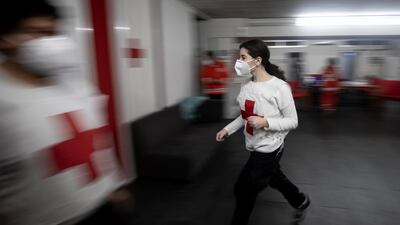
Lebanese Red Cross volunteer paramedics react in response to a call out during a night shift at the Jounieh station. Tom Nicholson for The National -
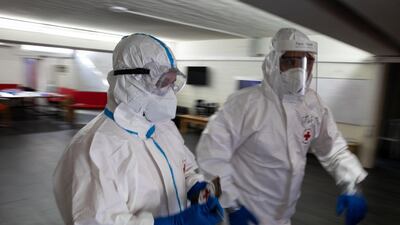
Lebanese Red Cross volunteer paramedics speak to the family member of a patient with Coronavirus on a night shift in the Jounieh region. Tom Nicholson for The National -
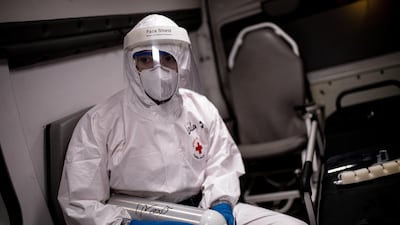
A Lebanese Red Cross volunteer paramedic holds an oxygen canister in the back of an ambulance during a callout to a patient with Coronavirus on a night shift in the Jounieh region. Tom Nicholson for The National -

A Lebanese Red Cross volunteer paramedic prepares equipment ahead of a night shift at the Jounieh station. Tom Nicholson for The National -
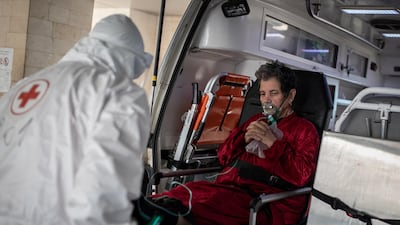
A patient with Coronavirus is transferred from a Lebanese Red Cross ambulance to a hospital in the Jounieh region. Tom Nicholson for The National -
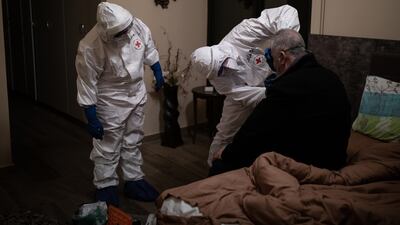
Lebanese Red Cross volunteer paramedics speak to a patient with Coronavirus on a night shift in the Jounieh region. Tom Nicholson for The National -
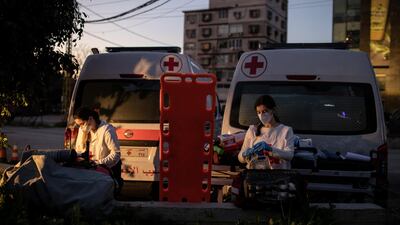
Lebanese Red Cross volunteer paramedics prepare equipment ahead of a night shift at the Jounieh station. Tom Nicholson for The National


This combination of age and a pre-existing condition means he is a bullseye for the virus paralysing Lebanon.
“He is a red patient, he must go to a hospital immediately,” says Eva Hawa, one of the paramedics attending to him.
A record 81 people succumbed to the virus in Lebanon on Monday and the country has repeatedly broken the bleak records for daily deaths in the past two weeks.
The crisis in this country is acute, and urgent – of the more than 3,100 deaths attributed to the virus in the past year, 51 per cent occurred in January.
In any other country, what happens next is clear. The critical patient is taken to the nearest hospital and doctors and nurses go about their work. Yet record levels of the virus mean Lebanon's hospitals are at capacity. And although the ambulance has arrived, it is not clear where the patient can be taken.
Increasingly paramedics find themselves arriving at full hospitals, where staff refuse to accept additional patients.
A disjointed response to the pandemic means Lebanon's various institutions are pulling in different directions. Co-ordination between hospitals is minimal, and it is increasingly resulting in ambulances being loaded with patients with no clear idea of which hospitals might have the capacity to take them.
-
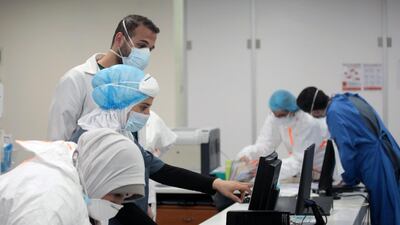
Medical staff members work in an intensive care unit for patients suffering from the coronavirus, at Rafik Hariri University Hospital, in Beirut, Lebanon. Reuters -
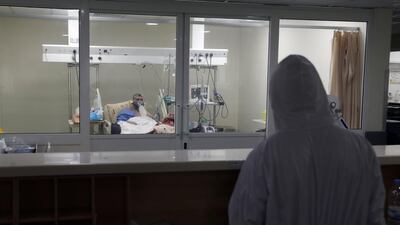
A medical worker looks at a Covid-19 patient in the intensive care unit of the Rafik Hariri University Hospital in Beirut, Lebanon. AP -
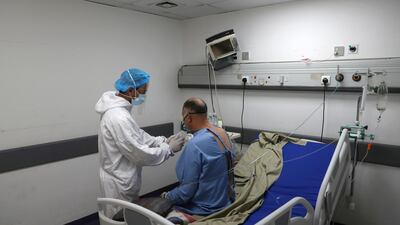
A medical worker assists a Covid-19 patient in the intensive care unit of the Rafik Hariri University Hospital in Beirut, Lebanon. AP -

A medical worker assists a patient suffering from coronavirus, in an intensive care unit at Rafik Hariri University Hospital, in Beirut, Lebanon. Reuters -
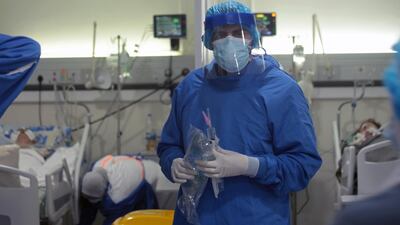
Medical staff members work at an intensive care unit for patients suffering from coronavirus, at Rafik Hariri University Hospital, in Beirut, Lebanon. Reuters -
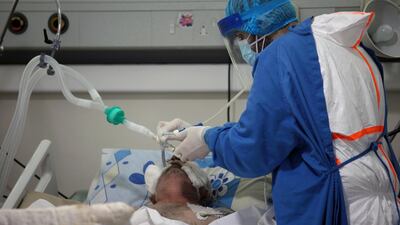
A medical staff member assists a patient suffering from coronavirus, in an intensive care unit at Rafik Hariri University Hospital, in Beirut, Lebanon. Reuters -
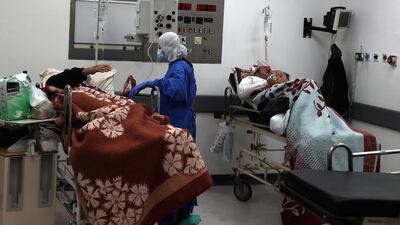
A medical worker takes care of Covid-19 patients in the intensive care unit of the Rafik Hariri University Hospital in Beirut, Lebanon. AP -
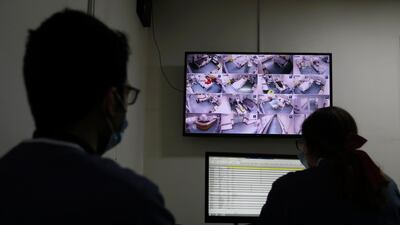
Medical staff monitor Covid-19 patients on CCTV screens in the intensive care unit of the Rafik Hariri University Hospital in Beirut, Lebanon. AP


The Red Cross has taken to pleading with people to phone ahead to the hospitals and try to book space, yet in the heat of a call-out, this is easier said than done, and often fruitless anyway.
Ajad Dibo, 29, a civil engineer by training, now heads the Jounieh station of the Lebanese Red Cross, overseeing a team of more than 90 volunteers. Their work has become especially critical in recent weeks, as Lebanon has repeatedly registered record numbers of coronavirus deaths.
But despite the urgent need for their services, the Red Cross has not been immune from Lebanon's economic woes. The station is rapidly losing volunteers, with many graduates drawn to better prospects overseas. "We lost about 13 rescuers, most of them left to Europe," he says.
“It was very tough on us to sustain all the rescuers we had.”

One of his three-person team is likely to be next. Karl Hawa, 21, recently received an offer to study veterinary sciences in the United Kingdom. With an absent government and cascading crisis, young professionals like Mr Hawa who have stepped in to fill many of the voids during this pandemic, feel that staying is no longer an option
Yet despite the pressure on hospitals, there are some spaces, often in hospitals in the country’s north – the issue is, ambulance crew do not know where these spaces are.
The system's failings are not entirely unexpected; indeed some have been trying to fix them long before coronavirus came to town.
Dr Mazen El Sayed is an emergency medicine specialist at the American University of Beirut's Medical Centre, where the ER department has been turned into a makeshift coronavirus ward where patients are crammed in, two to a bay. In the cafeteria, there are beds next to the snack machines, but still ambulances arrive.
Dr El Sayed says he has spent years trying to convince the government of the need the build a system that might be able to offer better co-ordination.
“Lebanon has always lacked a way of organising the EMS [Emergency Medical Services] system.”
“While the Red Cross is extremely helpful with patient transfer, they are facing a major problem over where they offload patients – the whole system is not well co-ordinated.”
In 2011, Dr El Sayed proposed establishing a national office to co-ordinate EMS in the country. A central system that might today have provided paramedics up-to-date information on where beds and resources are available. His proposals fell on deaf ears.
“The goal was to come up with an EMS system that functions during routine operations, but that can be scaled up during disasters,” he says.
“That didn’t happen, and now we are seeing a lot of fragmentation”.

