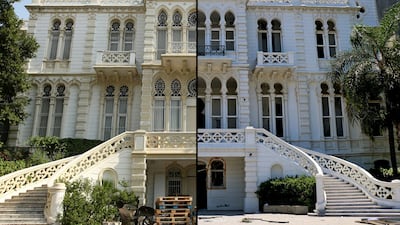
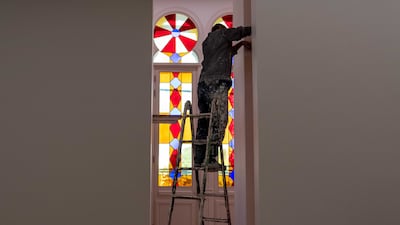
Inside the Nicolas Ibrahim Sursock Museum, dozens of construction workers bustled around, painting and plastering the walls and completing the final touches to rehabilitate the historic Beirut villa devastated by the deadly port explosion two years ago.
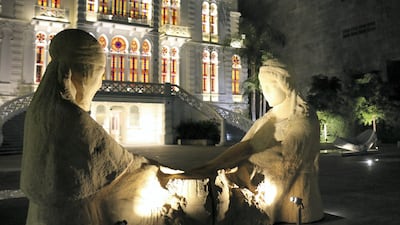
The Sursock Museum, Beirut’s largest and oldest independent cultural institution, was the result of the will of Nicolas Sursock, a Lebanese collector and a member of one of Beirut’s most prominent families, to promote art in his country.
Over the past few years, the museum has played a prominent role in the art community in Lebanon by hosting exhibitions of local and international artists, and organising regular talks, screenings and workshops.
For the city of Beirut, the long-awaited reopening of the 20th-century building on Friday is a symbol of rebirth, two and a half years after a deadly explosion at the Beirut port destroyed large areas of the capital and killed more than 200 people.
The museum was heavily damaged in the blast and had to close its doors for nearly two years, but the cherished cultural institution has almost completely recovered from its wounds and will be ready to welcome visitors on Friday.
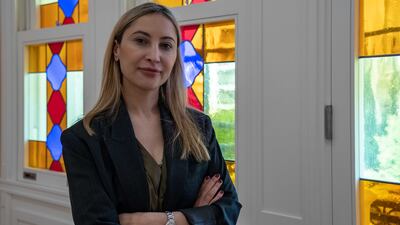
“It has been a collective healing process to see the museum rising from its ashes,” said Karina El Helou, the museum's director.
No media has toured the premises for months as the museum carried out extensive renovation work in the last phase of its rehabilitation.
The Salon Arabe on the historic first floor, renowned for its hand-carved woodwork imported from Damascus, has now been restored, while the facade's colourful stained glass, shattered by the explosion, has been recreated with the exact design.
The museum is now ready to hang artworks on the freshly painted walls of the exhibition spaces, while all 50 of the art pieces damaged during the explosion have been restored.
Sursock is Beirut’s largest art museum with a collection of 1,500 works that include masterpieces by prominent Lebanese artists such as Shafic Abboud, Paul Guiragossian and Jean Khalife.
“I feel it is a privilege to be here during this moment of revival,” Ms El Helou said as she walked up the stairs of the centuries-old villa surrounded by labourers busy at work.
Thanks to an outpouring of solidarity after the blast, the museum raised more than $2 million to fund restoration works, without any help from Lebanon’s bankrupt government.
The funds came mainly from the Italian government, which donated $965,000 under Unesco's Li Beirut initiative. The French Ministry of Culture and the International Alliance for the Protection of Heritage in Conflict Areas, a global fund dedicated to the rehabilitation of cultural heritage in conflict zones, each donated $500,000.
Upon his death in 1952, Sursock donated his mansion to the city of Beirut, saying at the time that he wanted his country “to receive a substantial contribution of fine artworks”.
The museum holds more than 12,000 archives on the art history in Lebanon and the region.
Rebirth in a time of collapse
Challenges remain for the newly appointed director, Ms El Helou, who took the position several months ago.
With Lebanon in the throes of a deepening economic crisis that has plunged 80 per cent of the population into poverty since 2019, the museum was forced to rethink its financial model.
“Before the crisis, the museum's activities were mostly financed by a tax on building permits levied by the Beirut Municipality,” Ms El Helou said.
But the municipality’s contribution in Lebanese pounds has become almost worthless, as the local currency crash lost more than 97 per cent of its market value against the dollar
“It now covers less than 2 per cent of our expenses,” Ms El Helou said.
The museum has had to deal, like all Lebanon businesses, with skyrocketing expenses, as it relies on costly private generators in the near absence of state electricity.
“This is our new challenge: creating a new fund-raising strategy to survive amid complete collapse,” Ms El Helou added.
Despite these financial challenges, charging visitors is out of the question. “Offering free access to art was in the will of Nicolas Ibrahim Sursock and we will always respect this,” she said.
A tribute to resilience
From the very beginning, facing and overcoming challenges has been an integral part of the museum’s history.
It took nine years for Sursock’s will to be implemented, as former Lebanese president Camille Chamoun decided to turn the villa into a palais d’hotes — for welcoming visiting heads of states — instead of a museum.
The museum remained open during most of the 1975 to 1990 civil war, despite gun battles between rival militias, foreign invasions, and political turmoil.
In 2008, it closed for major renovation works, and reopened in 2015, before closing again after the Beirut blast.
“The museum’s history is deeply intertwined with that of Beirut, this makes it a depository of a Lebanese culture,” Ms Helou said.
The museum's new programming will be a tribute to its rebirth and resilience.
The exhibition space on the first floor will be dedicated to the history of the museum and its artists, including archives, pictures and press cuttings.
The second floor will, for a year, host an exhibition dedicated to some of the Sursock Museum's permanent collection around the history of the Salon d’automne, an annual exhibition for new artists to display their work and win awards.
“Looking back at our history is a way to pay tribute to those who helped by celebrating our institution,” Ms Helou said.
Scars from the Beirut blast are, however, still visible on the wooden entrance of the Salon Arabe, deliberately preserved as a reminder of the tragedy, widely blamed on endemic state corruption and negligence and for which no one has yet been held accountable.
“Reopening the museum does not mean we can forget what happened,” Ms El Helou said.
*This article story was originally published on February 3

Emirates exiles
Will Wilson is not the first player to have attained high-class representative honours after first learning to play rugby on the playing fields of UAE.
Jonny Macdonald
Abu Dhabi-born and raised, the current Jebel Ali Dragons assistant coach was selected to play for Scotland at the Hong Kong Sevens in 2011.
Jordan Onojaife
Having started rugby by chance when the Jumeirah College team were short of players, he later won the World Under 20 Championship with England.
Devante Onojaife
Followed older brother Jordan into England age-group rugby, as well as the pro game at Northampton Saints, but recently switched allegiance to Scotland.
Ten tax points to be aware of in 2026
1. Domestic VAT refund amendments: request your refund within five years
If a business does not apply for the refund on time, they lose their credit.
2. E-invoicing in the UAE
Businesses should continue preparing for the implementation of e-invoicing in the UAE, with 2026 a preparation and transition period ahead of phased mandatory adoption.
3. More tax audits
Tax authorities are increasingly using data already available across multiple filings to identify audit risks.
4. More beneficial VAT and excise tax penalty regime
Tax disputes are expected to become more frequent and more structured, with clearer administrative objection and appeal processes. The UAE has adopted a new penalty regime for VAT and excise disputes, which now mirrors the penalty regime for corporate tax.
5. Greater emphasis on statutory audit
There is a greater need for the accuracy of financial statements. The International Financial Reporting Standards standards need to be strictly adhered to and, as a result, the quality of the audits will need to increase.
6. Further transfer pricing enforcement
Transfer pricing enforcement, which refers to the practice of establishing prices for internal transactions between related entities, is expected to broaden in scope. The UAE will shortly open the possibility to negotiate advance pricing agreements, or essentially rulings for transfer pricing purposes.
7. Limited time periods for audits
Recent amendments also introduce a default five-year limitation period for tax audits and assessments, subject to specific statutory exceptions. While the standard audit and assessment period is five years, this may be extended to up to 15 years in cases involving fraud or tax evasion.
8. Pillar 2 implementation
Many multinational groups will begin to feel the practical effect of the Domestic Minimum Top-Up Tax (DMTT), the UAE's implementation of the OECD’s global minimum tax under Pillar 2. While the rules apply for financial years starting on or after January 1, 2025, it is 2026 that marks the transition to an operational phase.
9. Reduced compliance obligations for imported goods and services
Businesses that apply the reverse-charge mechanism for VAT purposes in the UAE may benefit from reduced compliance obligations.
10. Substance and CbC reporting focus
Tax authorities are expected to continue strengthening the enforcement of economic substance and Country-by-Country (CbC) reporting frameworks. In the UAE, these regimes are increasingly being used as risk-assessment tools, providing tax authorities with a comprehensive view of multinational groups’ global footprints and enabling them to assess whether profits are aligned with real economic activity.
Contributed by Thomas Vanhee and Hend Rashwan, Aurifer
HAJJAN
%3Cp%3EDirector%3A%20Abu%20Bakr%20Shawky%C2%A0%3C%2Fp%3E%0A%3Cp%3E%3Cbr%3EStarring%3A%20Omar%20Alatawi%2C%20Tulin%20Essam%2C%20Ibrahim%20Al-Hasawi%C2%A0%3C%2Fp%3E%0A%3Cp%3E%3Cbr%3ERating%3A%204%2F5%3C%2Fp%3E%0A
More from Neighbourhood Watch
How green is the expo nursery?
Some 400,000 shrubs and 13,000 trees in the on-site nursery
An additional 450,000 shrubs and 4,000 trees to be delivered in the months leading up to the expo
Ghaf, date palm, acacia arabica, acacia tortilis, vitex or sage, techoma and the salvadora are just some heat tolerant native plants in the nursery
Approximately 340 species of shrubs and trees selected for diverse landscape
The nursery team works exclusively with organic fertilisers and pesticides
All shrubs and trees supplied by Dubai Municipality
Most sourced from farms, nurseries across the country
Plants and trees are re-potted when they arrive at nursery to give them room to grow
Some mature trees are in open areas or planted within the expo site
Green waste is recycled as compost
Treated sewage effluent supplied by Dubai Municipality is used to meet the majority of the nursery’s irrigation needs
Construction workforce peaked at 40,000 workers
About 65,000 people have signed up to volunteer
Main themes of expo is ‘Connecting Minds, Creating the Future’ and three subthemes of opportunity, mobility and sustainability.
Expo 2020 Dubai to open in October 2020 and run for six months
More from UAE Human Development Report:
Results
%3Cp%3E%3Cstrong%3EStage%206%3A%3C%2Fstrong%3E%3Cbr%3E1.%20Tim%20Merlier%20(BEL)%20Soudal%20Quick-Step%20%E2%80%93%203hrs%2041min%2012sec.%3Cbr%3E2.%20Sam%20Bennett%20(GBR)%20Bora%20%E2%80%93%20Hansgrohe%20%E2%80%93%20ST%3Cbr%3E3.%20Dylan%20Groenewegen%20(NED)%20Team%20Jayco%20Alula%20%E2%80%93%20ST%3Cbr%3E%3Cstrong%3EGeneral%20classification%3A%3C%2Fstrong%3E%3Cbr%3E1.%20Remco%20Evenepoel%20(BEL)%20Soudal%20Quick-Step%3Cbr%3E2.%20Lucas%20Plapp%20(AUS)%20Ineos%20Grenaders%20%E2%80%93%209sec%3Cbr%3E3.%20Pello%20Bilbao%20(ESP)%20Bahrain%20Victorious%20%E2%80%93%2013sec%3C%2Fp%3E%0A
Infiniti QX80 specs
Engine: twin-turbocharged 3.5-liter V6
Power: 450hp
Torque: 700Nm
Price: From Dh450,000, Autograph model from Dh510,000
Available: Now
Tips for used car buyers
- Choose cars with GCC specifications
- Get a service history for cars less than five years old
- Don’t go cheap on the inspection
- Check for oil leaks
- Do a Google search on the standard problems for your car model
- Do your due diligence. Get a transfer of ownership done at an official RTA centre
- Check the vehicle’s condition. You don’t want to buy a car that’s a good deal but ends up costing you Dh10,000 in repairs every month
- Validate warranty and service contracts with the relevant agency and and make sure they are valid when ownership is transferred
- If you are planning to sell the car soon, buy one with a good resale value. The two most popular cars in the UAE are black or white in colour and other colours are harder to sell
Tarek Kabrit, chief executive of Seez, and Imad Hammad, chief executive and co-founder of CarSwitch.com
'Skin'
Dir: Guy Nattiv
Starring: Jamie Bell, Danielle McDonald, Bill Camp, Vera Farmiga
Rating: 3.5/5 stars
GOLF’S RAHMBO
- 5 wins in 22 months as pro
- Three wins in past 10 starts
- 45 pro starts worldwide: 5 wins, 17 top 5s
- Ranked 551th in world on debut, now No 4 (was No 2 earlier this year)
- 5th player in last 30 years to win 3 European Tour and 2 PGA Tour titles before age 24 (Woods, Garcia, McIlroy, Spieth)
Company%C2%A0profile
%3Cp%3E%3Cstrong%3ECompany%20name%3A%20%3C%2Fstrong%3ETuhoon%0D%3Cbr%3E%3Cstrong%3EYear%20started%3A%20%3C%2Fstrong%3EJune%202021%0D%3Cbr%3E%3Cstrong%3ECo-founders%3A%20%3C%2Fstrong%3EFares%20Ghandour%2C%20Dr%20Naif%20Almutawa%2C%20Aymane%20Sennoussi%0D%3Cbr%3E%3Cstrong%3EBased%3A%20%3C%2Fstrong%3ERiyadh%0D%3Cbr%3E%3Cstrong%3ESector%3A%20%3C%2Fstrong%3Ehealth%20care%0D%3Cbr%3E%3Cstrong%3ESize%3A%20%3C%2Fstrong%3E15%20employees%2C%20%24250%2C000%20in%20revenue%0D%3Cbr%3EI%3Cstrong%3Envestment%20stage%3A%20s%3C%2Fstrong%3Eeed%0D%3Cbr%3E%3Cstrong%3EInvestors%3A%20%3C%2Fstrong%3EWamda%20Capital%2C%20Nuwa%20Capital%2C%20angel%20investors%3C%2Fp%3E%0A
Dust and sand storms compared
Sand storm
- Particle size: Larger, heavier sand grains
- Visibility: Often dramatic with thick "walls" of sand
- Duration: Short-lived, typically localised
- Travel distance: Limited
- Source: Open desert areas with strong winds
Dust storm
- Particle size: Much finer, lightweight particles
- Visibility: Hazy skies but less intense
- Duration: Can linger for days
- Travel distance: Long-range, up to thousands of kilometres
- Source: Can be carried from distant regions
LIST OF INVITEES
Shergo Kurdi (am)
Rayhan Thomas
Saud Al Sharee (am)
Min Woo Lee
Todd Clements
Matthew Jordan
AbdulRahman Al Mansour (am)
Matteo Manassero
Alfie Plant
Othman Al Mulla
Shaun Norris
How to wear a kandura
Dos
- Wear the right fabric for the right season and occasion
- Always ask for the dress code if you don’t know
- Wear a white kandura, white ghutra / shemagh (headwear) and black shoes for work
- Wear 100 per cent cotton under the kandura as most fabrics are polyester
Don’ts
- Wear hamdania for work, always wear a ghutra and agal
- Buy a kandura only based on how it feels; ask questions about the fabric and understand what you are buying