


Many have heard of them but few have actually seen them. Despite much fanfare upon their donation in May, many of the French buses purportedly serving the people of Beirut since Monday remain elusive.
Bus drivers, passengers, and cafe owners at Beirut’s main intersections of Dawra, Cola, and Moucharafieh say they are yet to spot the vehicles.
"I know this bus, it is part of the new batch of government buses, I have seen them on Facebook", said Ali while looking on his phone at the picture of a green jade and white RATP bus recognisable to anyone who has ever set foot in Paris.
In May, France donated 50 of them to Lebanon as part of an agreement to improve the country's crumbling transport network, which relies largely on dilapidated government buses and private micro-buses.
"I don’t think these buses serve this area", Ali added, while calling for passengers to hop in a minivan amid the continuous car honks of the crowded and chaotic Moucharafieh's intersection.
"You have just missed it," his friend Mohamed, a minivan driver, corrected. "It will come back in 20 minutes in the other way, you just have to wait."
But time passed by and there is still no sign of the bus. Without clear routes, schedules or stops, catching one of these French-donated buses is like playing hide and seek.
"It seems that it is not your lucky day," said Mohamed, acknowledging the fruitless wait.
-
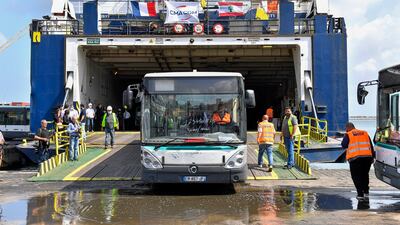
Buses donated by the French government are unloaded at the Port of Beirut. The first batch consists of 50 modern vehicles sent to help develop Lebanon's public transport plan. All photos: EPA -
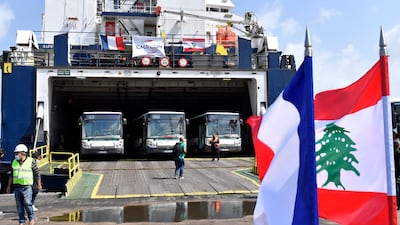
A third of the initial fleet will start connecting areas of greater Beirut, while the remainder will link the capital to other areas of Lebanon. -

French transport authorities will work with Beirut on 'technical assistance and expertise', as well as offering 'an in-depth reflection on the organisation and structuring of urban mobility in Lebanon'. -
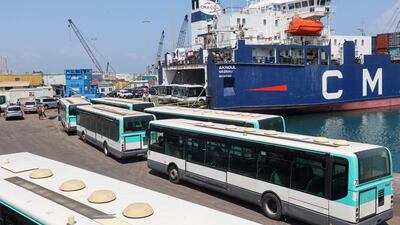
Each of the new single-decker buses can seat up to 92 people. -
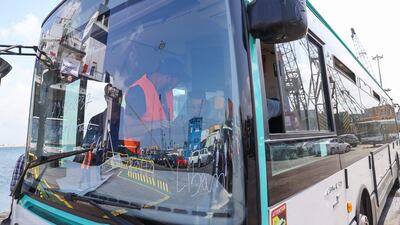
The donation comes at a time of rising fuel prices, which has pushed more people towards using cheaper public transport. -
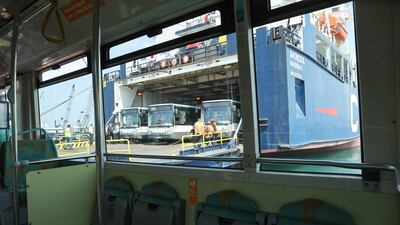
Critics says the new, large buses will toil on Lebanon's winding, pothole-filled roads. -
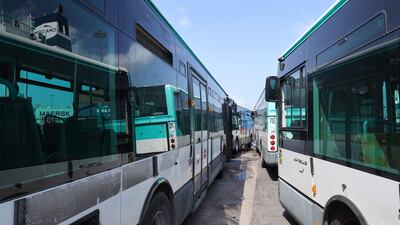
But French officials say 'the expansion of the project will depend on the success of this pilot phase and the ability of the Lebanese authorities to improve the public transport network with these 50 buses'.


The small number of buses running are not helping the search.
Director general of the Office of Railways and Public Transport, Ziad Nasr, told The National that only 10 of the 50 are operating, on four different routes. They have assigned 28 drivers working in shifts in Greater Beirut.
“We do not have the capacity to operate the full batch, because of our limited human and material resources: we need to pay for the fuel, the spare part, and for the employee's salary,” he said.
There is only enough money in the coffers to cover operations for a month and the Office of Railways and Public Transport is looking to get more funds, he added.
The price of a trip is set at 20,000 Lebanese pounds, which is cheaper than most trips in private minivans.
“It is not enough to cover the expenses, but we believe public transportation is a social service that the state should subsidise," Mr Nasr said.
The batch of Parisian buses was received last May, but were not let loose on to the streets until Monday due to administration issues with customs and vehicle registration.
"The public transport sector is back after absence and neglect ... its sustainability is everyone's responsibility," wrote Caretaker Minister for Public Works and Transport, Ali Hamie, in a tweet on Friday.
Even before an unprecedented economic collapse devastated Lebanon in 2019, the country suffered from a transportation crisis, with a quasi-nonexistent public network, and erratic schedules and routes, and the public favouring private cars as the main and only reliable mode of transport.
But the economic crisis described by the World Bank as one of the worst in modern history has crushed public transport and exacerbated inequality in mobility.
Transport costs in Lebanon increased by nearly 200 per cent year-on-year in October according to the Central Administration of Statistics' Consumer Price Index, as petrol prices rocketed after the cash-strapped central bank lifted its subsidies on fuel imports last year.
As a result, many Lebanese can now barely afford to fill their tanks. This has specifically affected the most vulnerable and put them at risk of not being able to access work, education and health care.
“These donated buses are a way to enhance public transport and help Lebanese through the steep crisis they are enduring,” a French diplomatic source told the National.
He said his country had also promised technical assistance on maintenance and operation provided until 2023 by French experts, from driver recruitment, training and route planning. French experts are closely following the project, he added, to ensure its sustainability and avoid buses being left in disrepair because of a lack of resources.

