Lebanese Parliament Speaker Nabih Berri adjourned the session until October 20 after the house failed to secure a quorum. EPA

Lebanon's MPs again fail to elect new president as quorum not met


Jamie Prentis
  • English
  • Arabic

Lebanon's parliament has failed for a second time to elect the country's next president, with not enough MPs present to reach the quorum.

Speaker Nabih Berri adjourned the house until October 20, less than two weeks before the term of incumbent Michel Aoun expires.

With a consensus candidate yet to emerge, the prospect of a presidential vacuum looms. An attendance of two thirds — or 86 MPs ― in the 128-seat Parliament is required to meet the quorum. But only 71 were present in the deeply divided chamber on Thursday.

This is the second time that MPs have failed to elect Lebanon's next head of state after no clear winner emerged during a vote at an initial session on September 29.

On that day, MP Michel Moawad, whose father Rene served as president for 18 days in 1989 before being assassinated, received the most votes, with 36. He was mainly backed by a grouping of MPs who are critical of Iran-backed Hezbollah, the armed group and political party that has significant sway in Lebanon.

“We are ready at any time to elect a president but it is clear today that several parties are not ready for the presidential election because of differences,” said Georges Adwan, a senior MP in the Lebanese Forces party.

The LF, a staunch critic of Hezbollah, supported Mr Moawad in the last round.

In the first polling round, a two-thirds majority is required to win. But only an absolute majority is needed in subsequent votes.

The failure to find a successor to Mr Aoun, 89, in the first two rounds was not unexpected and has precedent — it took 46 sessions and 29 months for parliament to elect the former army commander in 2016.

In the country's confessional system, the presidency is always reserved for a Maronite Christian.

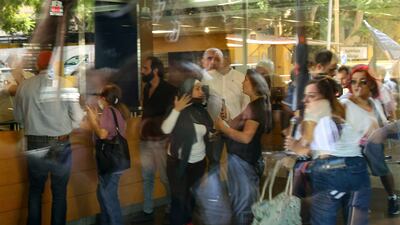
  • A woman identified by Lebanese media as Sally Hafez, second left, wearing green shoes, inside a branch of Blom Bank in central Beirut. Reports say she and others stormed the branch to demand access to their deposits. AFP
    A woman identified by Lebanese media as Sally Hafez, second left, wearing green shoes, inside a branch of Blom Bank in central Beirut. Reports say she and others stormed the branch to demand access to their deposits. AFP
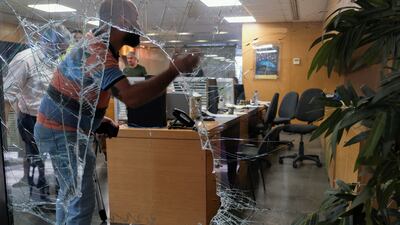
  • A group of depositors, at least one of whom was armed, took hostages at Blom Bank in central Beirut on Wednesday demanding access to their savings, state media reported. AFP
    A group of depositors, at least one of whom was armed, took hostages at Blom Bank in central Beirut on Wednesday demanding access to their savings, state media reported. AFP
  • A security source said a group of depositors, at least one of whom was armed, took hostages. Reuters
    A security source said a group of depositors, at least one of whom was armed, took hostages. Reuters
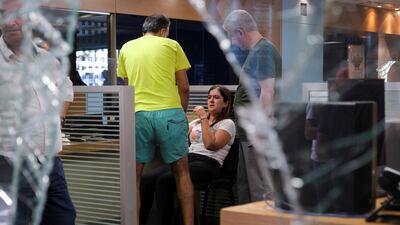
  • A woman is comforted after a group of depositors stormed Blom Bank in the Lebanese capital. Reuters
    A woman is comforted after a group of depositors stormed Blom Bank in the Lebanese capital. Reuters
  • Lebanese policemen at the scene. AP
    Lebanese policemen at the scene. AP
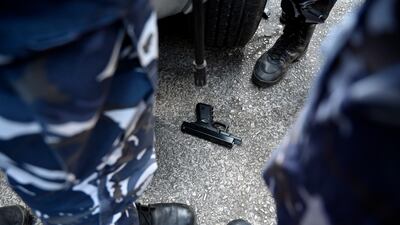
  • Members of the Lebanese security forces stand next to a toy gun that was used by depositors to take hostages. EPA
    Members of the Lebanese security forces stand next to a toy gun that was used by depositors to take hostages. EPA
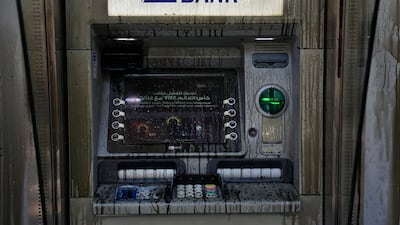
  • Angry depositors also poured diesel on a Blom Bank ATM. AP
    Angry depositors also poured diesel on a Blom Bank ATM. AP

Among the key factions absent from Thursday's session were the 17 MPs from the Free Patriotic Movement (FPM), the party founded by Mr Aoun and led by his son-in-law Gebran Bassil.

Mr Bassil justified his party's lack of attendance by saying the session was scheduled on an important day for the FPM. On October 13, 1990, Mr Aoun — then serving as the commander of the Lebanese Army — was ousted from his base at the presidential palace in Baabda by Syrian forces.

“Some people betrayed this date and did not respect the commemoration,” Mr Bassil said.

Only of a handful of the 13 MPs from Hezbollah were present. Hezbollah MP Hasan Fadlallah said Mr Moawad's candidacy would “not lead to any results”.

If parliament fails to decide on Mr Aoun's successor before his term ends, the government will assume presidential powers.

However, the government itself is in a caretaker capacity, adding to the political paralysis. Najib Mikati was named prime minister-designate in June, a month after parliamentary elections, but political factions have not yet agreed on the distribution of portfolios in his Cabinet.

Lebanon is facing a financial crisis described by the World Bank as one of the worst in modern history, with the local currency plunging in value by more than 95 per cent over the past three years.

There are severe shortages in basic goods such as bread, water, electricity and medicines.

Why your domicile status is important

Your UK residence status is assessed using the statutory residence test. While your residence status – ie where you live - is assessed every year, your domicile status is assessed over your lifetime.

Your domicile of origin generally comes from your parents and if your parents were not married, then it is decided by your father. Your domicile is generally the country your father considered his permanent home when you were born. 

UK residents who have their permanent home ("domicile") outside the UK may not have to pay UK tax on foreign income. For example, they do not pay tax on foreign income or gains if they are less than £2,000 in the tax year and do not transfer that gain to a UK bank account.

A UK-domiciled person, however, is liable for UK tax on their worldwide income and gains when they are resident in the UK.

Things Heard & Seen

Directed by: Shari Springer Berman, Robert Pulcini

Starring: Amanda Seyfried, James Norton

2/5

Mercer, the investment consulting arm of US services company Marsh & McLennan, expects its wealth division to at least double its assets under management (AUM) in the Middle East as wealth in the region continues to grow despite economic headwinds, a company official said.

Mercer Wealth, which globally has $160 billion in AUM, plans to boost its AUM in the region to $2-$3bn in the next 2-3 years from the present $1bn, said Yasir AbuShaban, a Dubai-based principal with Mercer Wealth.

Within the next two to three years, we are looking at reaching $2 to $3 billion as a conservative estimate and we do see an opportunity to do so,” said Mr AbuShaban.

Mercer does not directly make investments, but allocates clients’ money they have discretion to, to professional asset managers. They also provide advice to clients.

“We have buying power. We can negotiate on their (client’s) behalf with asset managers to provide them lower fees than they otherwise would have to get on their own,” he added.

Mercer Wealth’s clients include sovereign wealth funds, family offices, and insurance companies among others.

From its office in Dubai, Mercer also looks after Africa, India and Turkey, where they also see opportunity for growth.

Wealth creation in Middle East and Africa (MEA) grew 8.5 per cent to $8.1 trillion last year from $7.5tn in 2015, higher than last year’s global average of 6 per cent and the second-highest growth in a region after Asia-Pacific which grew 9.9 per cent, according to consultancy Boston Consulting Group (BCG). In the region, where wealth grew just 1.9 per cent in 2015 compared with 2014, a pickup in oil prices has helped in wealth generation.

BCG is forecasting MEA wealth will rise to $12tn by 2021, growing at an annual average of 8 per cent.

Drivers of wealth generation in the region will be split evenly between new wealth creation and growth of performance of existing assets, according to BCG.

Another general trend in the region is clients’ looking for a comprehensive approach to investing, according to Mr AbuShaban.

“Institutional investors or some of the families are seeing a slowdown in the available capital they have to invest and in that sense they are looking at optimizing the way they manage their portfolios and making sure they are not investing haphazardly and different parts of their investment are working together,” said Mr AbuShaban.

Some clients also have a higher appetite for risk, given the low interest-rate environment that does not provide enough yield for some institutional investors. These clients are keen to invest in illiquid assets, such as private equity and infrastructure.

“What we have seen is a desire for higher returns in what has been a low-return environment specifically in various fixed income or bonds,” he said.

“In this environment, we have seen a de facto increase in the risk that clients are taking in things like illiquid investments, private equity investments, infrastructure and private debt, those kind of investments were higher illiquidity results in incrementally higher returns.”

The Abu Dhabi Investment Authority, one of the largest sovereign wealth funds, said in its 2016 report that has gradually increased its exposure in direct private equity and private credit transactions, mainly in Asian markets and especially in China and India. The authority’s private equity department focused on structured equities owing to “their defensive characteristics.”

Hili 2: Unesco World Heritage site

The site is part of the Hili archaeological park in Al Ain. Excavations there have proved the existence of the earliest known agricultural communities in modern-day UAE. Some date to the Bronze Age but Hili 2 is an Iron Age site. The Iron Age witnessed the development of the falaj, a network of channels that funnelled water from natural springs in the area. Wells allowed settlements to be established, but falaj meant they could grow and thrive. Unesco, the UN's cultural body, awarded Al Ain's sites - including Hili 2 - world heritage status in 2011. Now the most recent dig at the site has revealed even more about the skilled people that lived and worked there.

Updated: October 13, 2022, 2:21 PM