


The Lebanese Parliament on Thursday failed to elect a successor to President Michel Aoun at its first attempt, with no candidate receiving enough votes.
In the first round of voting, a two-thirds majority — or 86 seats ― in the 128-seat Parliament is required. Only an absolute majority is needed in subsequent polls.
Of the 122 votes cast in the first round, 63 were blank and 10 were for "Lebanon".
MP Michel Moawad, whose father Rene served as president for 18 days in 1989 before being assassinated, received the most votes with 36.
Businessman Salim Edde received the support of 11 MPs, while one voted for Mahsa Amini, whose death in Iranian police custody has sparked protests around the world.
“We knew that today would not result in an election,” Samy Gemayel, the leader of the Kataeb Party, told The National.
“We will see now in the coming days what will be the strategy for the next round."
Mr Gemayel's father Amine served as president from 1982 to 1988. His uncle, Bachir, was elected president in 1982 but was killed in a bombing that year before taking office.
Electing a president in Lebanon is often a drawn-out affair. It took 46 sessions and 29 months for Parliament to elect Mr Aoun in 2016. In the country's confessional system, the presidency is always held by a Maronite Christian.
Lebanon's Parliament is deeply divided and a consensus figure has not yet emerged. There are fears of a power vacuum when Mr Aoun’s term ends on October 31.
Parliament Speaker Nabih Berri said he would call another session to vote "when there is consensus".
Mohammad Raad, head of the political bloc of Iran-backed armed group Hezbollah, said parliamentary factions are in the “early stages” of finding a head of state who would “bring stability to the country".
“The blocs need to discuss and develop an understanding over a possible consensus candidate,” he said after the meeting.
Mr Moawad said Thursday's session "was an important step to unify the opposition, the majority of which elected me".
"It is necessary that the president be elected on time," he said.
Mr Moawad received the support of the Lebanese Forces — Parliament's largest party — the Kataeb, and a handful of independent MPs.
Mr Edde was backed by MPs from the Forces of Change bloc, which is closely linked to the 2019 nationwide protests against Lebanon's ruling classes that led to a collapse of the government.
A walkout by some MPs meant there was no quorum for a second round of voting.
Among the major parties who voted with a blank paper was the Free Patriotic Movement. This was founded by Mr Aoun and is now led by his son-in-law Gebran Bassil ― who himself has often been talked about as a prominent presidential candidate.
On Wednesday, Mr Bassil said his party would vote blank as "we don't have any candidate that we support now".
-
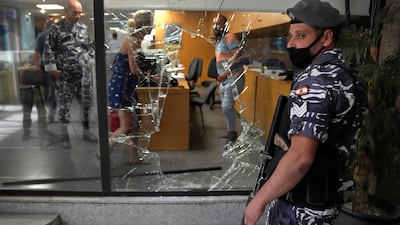
A Lebanese policeman stands guard next to a bank window broken by depositors who had demanded access to their money. An activist group said it will continue to organise bank raids to help people retrieve their trapped savings. AP photo -
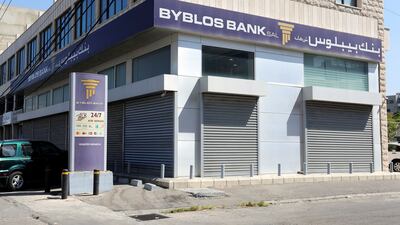
A closed Byblos Bank branch, where a man was reportedly detained after allegedly holding up the bank to access his own savings, in Ghazieh, Lebanon. Reuters -
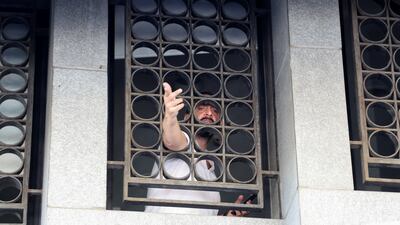
A man identified as Abed Soubra inside a Blom Bank branch, in the Tariq Al Jdideh neighbourhood of Beirut. Reuters -
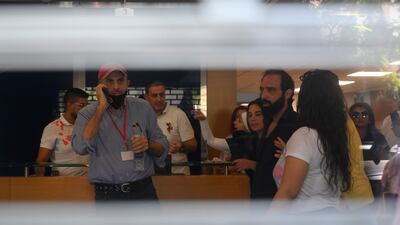
Lebanese depositors inside a Blom Bank branch in Beirut. A group of customers, at least one of whom was armed, took hostages in the bank, demanding access to their savings. They were reportedly able to withdraw $20,000 from an account of one of the depositors before they left. EPA -

An armed woman and a dozen activists reportedly broke into a Beirut bank branch to retrieve more than $13,000 from what she said were her trapped savings. Lebanon's cash-strapped banks since 2019 have imposed strict limits on withdrawals of foreign currency, tying up the savings of millions. AP Photo -

A woman, identified as Sally Hafez, appears to be carrying a gun at a Blom Bank branch in Beirut, in this screengrab taken from Al Jadeed footage. Reuters -

A woman is comforted as she is seen through a shattered window of a Blom Bank branch after a hostage-taking incident. Reuters -
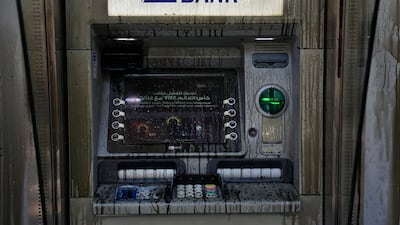
An ATM is covered with diesel fuel, vandalised by angry depositors. AP photo -
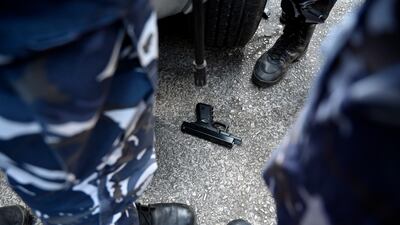
Members of the Lebanese security forces stand around a toy gun allegedly used by depositors in a hostage-taking situation, at a Blom Bank branch in Beirut. EPA -
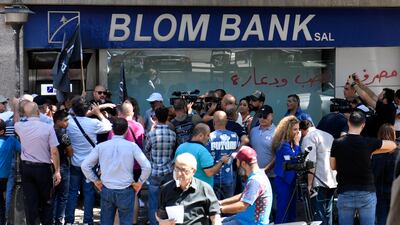
People gather near a Blom Bank branch during an hostage-taking situation in Beirut. EPA


World powers have urged the Parliament to avoid a delay in electing Mr Aoun’s successor amid concerns the economic crisis in the country could worsen.
Lebanon also has not had a proper government since May, and currently functions in a caretaker capacity under Prime Minister Najib Mikati.
If a new president is not elected before the end of Mr Aoun’s term, the government would take on presidential powers.
Lebanon has suffered from an economic collapse since 2019. The local currency has dropped in value by more than 95 per cent and much of the population has been plunged into poverty.
There are widespread shortages of medicine, electricity, bread, water and other basic essentials.

