



Lebanon's politicians have approved the 2022 budget after a day of protests outside the Parliament building.
Agreement on the budget is one of the key conditions set by the International Monetary Fund for a bailout.
Legislators on Monday approved the budget with 63 votes in favour and 37 opposed.
The budget sets expenditure at 41 trillion pounds (about $1.2 billion under black market exchange rates), while revenues were projected at £30tn.
Retired military personnel clashed with security troops outside the parliament in Beirut on Monday, during a protest against the draft 2022 budget and their financial situation.
Dozens of demonstrators broke through a security barrier on a road that leads up to the Parliament, where the budget was being discussed.
But they were pushed back by soldiers in riot gear, who used tear gas.
Some of the retired military personnel wore military fatigues or the berets of their old units.
Parliament had been due to discuss the draft budget 10 days ago, but the session was suspended because of the lack of a quorum.
MPs approved the draft budget late on Monday, which tripled salaries for all public sector workers, including the security forces.
The adoption of an annual budget is one of a handful of reforms that the IMF has demanded if it is to unlock a $3bn aid package that would help to bail out Lebanon.
In passing the budget, MPs approved the use of an exchange rate for customs tax revenues that is significantly below the market value of the Lebanese currency.
But it falls short of an IMF demand that customs taxes be calculated at a "unified exchange rate".
Parliament endorsed a rate of 15,000 pounds to the US dollar, but on Monday the Lebanese pound was trading at about 36,000.
Lebanon is suffering a severe economic collapse that became apparent in 2019, and has been described by the World Bank as one of the worst in modern history.
The local currency has dropped in value by more than 90 per cent and many people have been plunged into poverty.
There are also widespread shortages of medicine, bread, water, electricity and other basic essentials.
The draft law has been criticised by some who say it contains no amendments for a reform of the financial sector and is not accompanied by a rescue plan to bring Lebanon out of the crisis.
An IMF delegation visiting Lebanon last week lamented the slow progress of the country's economic reform, despite a staff-level agreement this year.
“The Lebanese economy remains severely depressed against continued deadlock over much-needed economic reforms and high uncertainty," said Ernesto Ramirez Rigo, who led the mission.
-
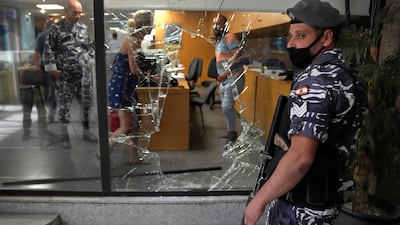
A Lebanese policeman stands guard next to a bank window broken by depositors who had demanded access to their money. An activist group said it will continue to organise bank raids to help people retrieve their trapped savings. AP photo -
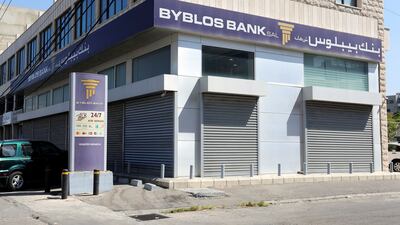
A closed Byblos Bank branch, where a man was reportedly detained after allegedly holding up the bank to access his own savings, in Ghazieh, Lebanon. Reuters -
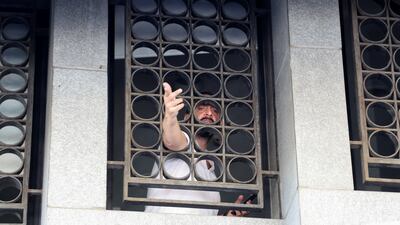
A man identified as Abed Soubra inside a Blom Bank branch, in the Tariq Al Jdideh neighbourhood of Beirut. Reuters -
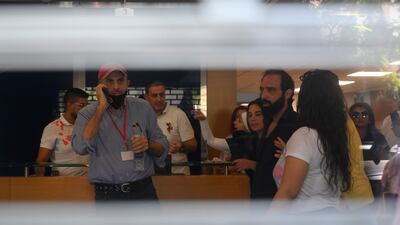
Lebanese depositors inside a Blom Bank branch in Beirut. A group of customers, at least one of whom was armed, took hostages in the bank, demanding access to their savings. They were reportedly able to withdraw $20,000 from an account of one of the depositors before they left. EPA -
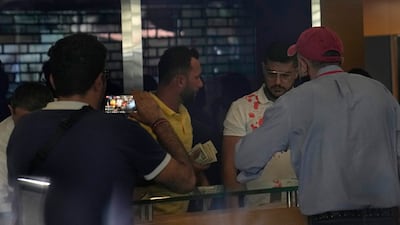
An armed woman and a dozen activists reportedly broke into a Beirut bank branch to retrieve more than $13,000 from what she said were her trapped savings. Lebanon's cash-strapped banks since 2019 have imposed strict limits on withdrawals of foreign currency, tying up the savings of millions. AP Photo -

A woman, identified as Sally Hafez, appears to be carrying a gun at a Blom Bank branch in Beirut, in this screengrab taken from Al Jadeed footage. Reuters -

A woman is comforted as she is seen through a shattered window of a Blom Bank branch after a hostage-taking incident. Reuters -
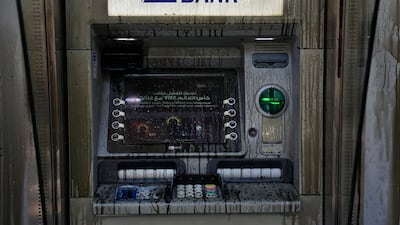
An ATM is covered with diesel fuel, vandalised by angry depositors. AP photo -
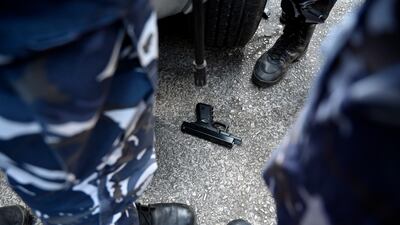
Members of the Lebanese security forces stand around a toy gun allegedly used by depositors in a hostage-taking situation, at a Blom Bank branch in Beirut. EPA -
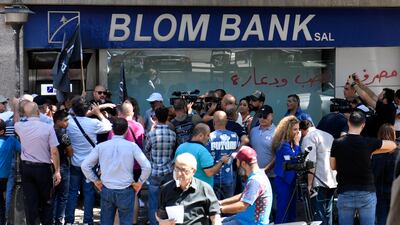
People gather near a Blom Bank branch during an hostage-taking situation in Beirut. EPA


Banks in Lebanon partially reopened on Monday after a week-long closure that came after branches were recently held up by depositors seeking access to their trapped savings.
But many branches remained shut, while some allowed customers in only by appointment. Only a handful are allowing walk-ins.
The Association of Banks in Lebanon said on Sunday that banks would reopen, but only in a limited capacity to businesses, educational institutions and hospitals. Many have increased their security.
ATMs will be available "for everyone else", to allow public and private institutions to transfer salaries, they said.
Since 2019, banks have imposed informal capital controls, severely restricting access to hard currency and compounding the economic difficulties faced by people in Lebanon amid the financial collapse.
This month, seven banks were stormed in a week — including five in one day — with depositors taking matters into their own hands in an attempt to unlock frozen life savings.
As a result, banks announced an initial three-day closure beginning last Monday because of fears for the safety of employees and customers.
It was extended indefinitely on Wednesday. In justifying the shutdown extension, the ABL said bank employers and customers were facing continued risks.
It also pointed to an “absence of any procedures or even assurances” from the government and security forces that would ensure a safe working environment.
A banking source told The National on Sunday that each bank will be in charge of its own security.

