



On a hot summer day 22 years ago, Saad Hariri undertook one of his first political tasks — to go to Damascus to meet Bashar Al Assad just weeks after the new Syrian president had taken over the reins from his father, Hafez.
The young son of former prime minister Rafik Hariri led a fleet of ageing Mercedes carrying an entourage of businessmen and journalists from Beirut to Damascus. The journey was on roads closed to most travellers and tightly controlled by Syrian intelligence, which then ran Lebanon.
Saad Hariri stayed at his father’s villa in the Abu Rumaneh district of Damascus and was there to convey the message that Rafik was keen to support the new Syrian leader's drive to attract foreign investment.
The Hariris even put their own money in. Their now-defunct Oger construction firm and Saudi investors soon announced a $100 million company to invest in the Syrian economy.
But the younger Assad showed no greater signs than his father of loosening his regime’s control of its neighbour.
Throughout the brief trip, Saad — who headed Saudi Oger operations — was uncomfortable, unused to this new political role in the shadow of his father.
The elder Hariri was a charismatic statesman who in the 1990s came to personify post-civil war Lebanon's reconstruction and rejuvenation. So, Saad Hariri did what his father instructed.
-
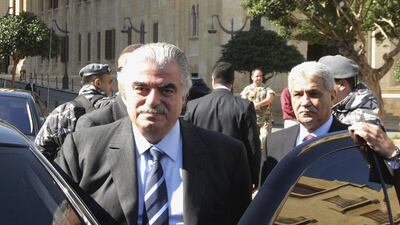
Rafik Hariri, left, and his bodyguard Yahya Arab, leave the Parliament in Beirut, Lebanon in 2005. Minutes later, Hariri and several of his bodyguards were killed in a massive bomb explosion. AP -
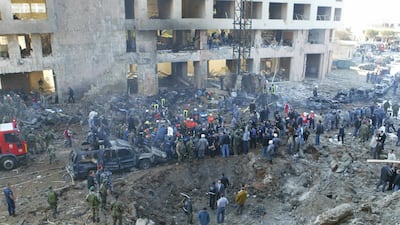
The site of devastation where former Lebanon prime minister Hariri was assassinated in the blast in Beirut on February 14, 2005. AFP -
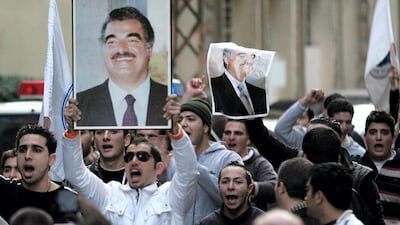
Supporters of former Lebanese prime minister Hariri after Hariri's death outside his house in Beirut. AFP -
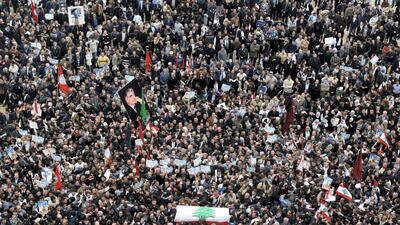
The national flag-draped coffin of Hariri is carried to his final resting place in central Beirut two days after the killing. AFP -
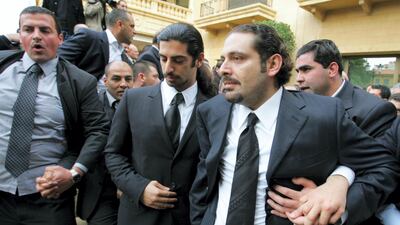
Saad Hariri and other family members leave their family home to join the funeral procession. AFP -
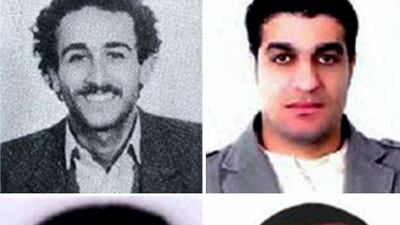
A combination of handout pictures obtained on July 29, 2011 from the website of the Special Tribunal for Lebanon shows four Hezbollah suspects indicted in the assassination case of Hariri, (from top left to right) Mustafa Amine Badreddine, Assad Hassan Sabra, Hussein Hassan Oneissi and Salim Jamil Ayyash. AFP -
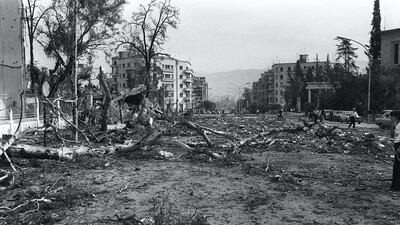
An avenue in central Beirut destroyed by 18 months of civil war is pictured, November 15, 1976. AFP -
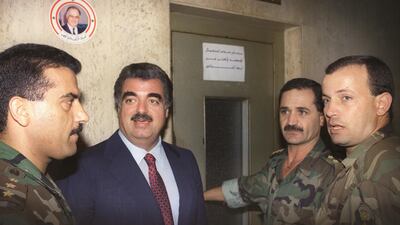
Hariri on October 22, 1992 in Beirut, after being nominated as prime minister by then president Elias Hrawi. AFP -

Hariri and his wife Nazic on September 1, 1996 in their villa in Beirut. AFP -
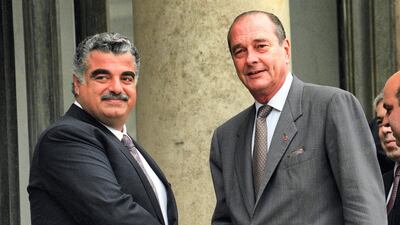
Then French president Jacques Chirac greets Hariri at the Elysee Palace in Paris, September 28, 1996. AFP -
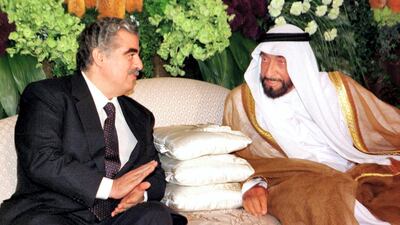
Sheikh Zayed, the Founding Father, meets Hariri in Dubai on March 17, 1999. Hariri was in Dubai for a three-day official visit. AFP -
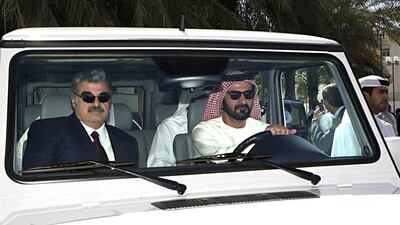
Sheikh Mohammed bin Rashed, then Crown Prince of Dubai, drives Hariri in Dubai on March 6, 2000. AFP -
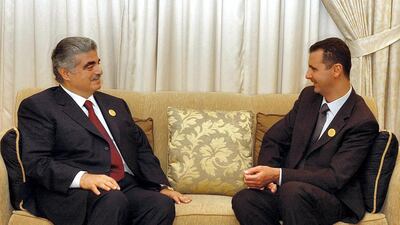
Hariri meets Syrian President Bashar al Assad on the sidelines of the Arab summit in Beirut, March 27, 2002. AFP -
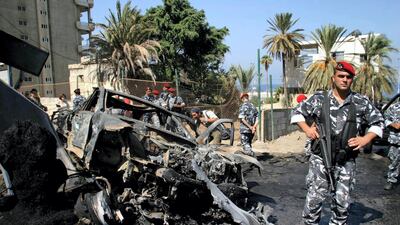
Lebanese policemen gather at the site where outgoing economy and trade minister Marwan Hamadeh's car was targeted by a bomb in Beirut on October 1, 2004. AFP -
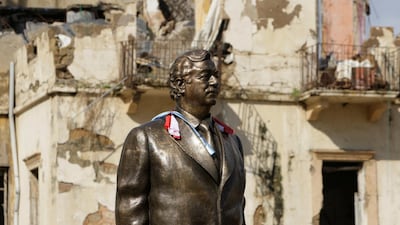
The Hariri monument in Beirut. Reuters


However, it was not long before the younger Hariri was forced to take over the other family business — leading Lebanon's Sunni political bloc. Rafik Hariri was killed in a huge explosion in downtown Beirut on Valentine's Day 2005.
This week, 17 years after his father's assassination and nearly 13 years after he first served as prime minister, Saad Hariri said he was retiring from politics.
He cited the intransigence of Hezbollah and the dominance the Iran-backed militia-cum-party has in Lebanon, as well as a financial and economic collapse that led to his resignation in October 2019.
"I am convinced that there is no positive chance for Lebanon under the shadow of Iranian influence and the international blundering," he said on Monday.
The political life of Saad Hariri, a billionaire with connections few could beat, has been characterised by his own role under the shadow that his father still casts, Lebanon's ties with Syria and his uncomfortable relationship with Hezbollah.
Even as he announced his withdrawal from politics, Saad Hariri continuously referred to his work for more than a decade as that of continuing “the Rafik Hariri project”.
But his more independent decisions strained his relations with his regional and Western allies — whether leading governments in partnership with Hezbollah or dropping his objection to electing Michel Aoun as president in 2016.
When it came to Syria, Mr Hariri had a complex relationship. He was the leader of a political alliance focused on building an independent Lebanon and also blamed Damascus for ordering the 2005 killing of his father — an action that precipitated the end of Syria's occupation of Lebanon after 15 years.
An international court in 2020 found a Hezbollah operative guilty of the killing and although a UN investigation implicated Syrian security officials, the tribunal did not delve into who might have ordered the assassination.
But by the late 2000s, as Mr Al Assad forged new links to the West, Mr Hariri found the need to again visit Damascus.
When he and Mr Al Assad sat down at the presidential palace in the winter of 2009, Mr Hariri looked as uncomfortable as he had nine years earlier. There was no indication his ties to the Syrian regime warmed after the visit.
But two years later, as Syria was engulfed by the still-raging civil war, the policy of Mr Hariri's independent Lebanon “March 14" alliance towards Damascus was to wait and see what happened.
It is unclear if Mr Hariri ever truly mastered the balancing act crucial to running the small but complex state of Lebanon — a feat achieved by only a few of its modern leaders (his larger-than-life father arguably among them).
Lebanon, a country of around 6 million, has played an outsize role since independence in the 1940s, in part because of the international connections of politician-businessmen like the elder Hariri.
During the civil war from 1975 to 1990, Lebanon became a battleground of international powers.
While they all retain significant influence more than 30 years later, much as the surrendering of arms by all the factions bar Hezbollah allowed the group to dominate the domestic scene, its patron in Tehran today holds the greatest sway over affairs in Beirut.
As he stepped down on Monday, Saad Hariri said that, in hindsight, he had compromised too much with Hezbollah over the years.
Lebanese University professor Fadi Al Ahmar, who specialises in geopolitics, says these compromises were given too easily and for too little return. He says this left the three-time prime minister with no place to go other than out.
“In politics, you seek to defeat your opponents. You cannot blame your opponent for your failure. For sure, Hezbollah has been out to destroy his father and him,” Prof Al Ahmar said.
Mr Hariri's terms from 2016 to 2020 were the result of a deal with Hezbollah that was frowned upon by most of his Arab allies — he returned as prime minister and Mr Aoun, Hezbollah's main Christian ally, would become president.
Mr Hariri's announcement came a day after Kuwaiti Foreign Minister Sheikh Ahmed Nasser visited Beirut to present a 12-point list to restore Lebanon's relations with the Gulf.
Several Gulf states removed ambassadors, Saudi Arabia cut trade with Lebanon and relations were downgraded last year after a prolonged souring of ties due to Hezbollah's perceived control of the state and the increase in drug smuggling (tied to Hezbollah) from Beirut to the region.
“Hariri could not continue as a Sunni political figure providing a political cover for Hezbollah without being able to change anything in the political formula in Lebanon," Prof Al Ahmar said.
While the elder Hariri symbolised the country’s resurgence from the civil war, the younger Hariri could not retain the confidence of investors or debt markets. Public debt grew to a glacial scale, combining with corruption to bring down the economy.
Years of losing consecutive power struggles with Hezbollah left Mr Hariri a diminished figure.

