

Last month, policeman Abdelhakim Assayed was shocked to discover that a large, centuries-old fir tree on a high plateau near his home in north Lebanon had been cut down and carried away overnight.
“If you had seen it, you would have cried,” he said, as he walked around the small branches scattered around what was left of the tree’s trunk. “It’s like killing your child.”
Mr Assayed, 40, suspects that like hundreds of other trees that have been illegally felled in recent weeks, the fir tree was chopped up and sold locally as firewood, which is openly sold in the streets as winter approaches. With the country's crisis making heating unaffordable for many, concerns mount that the situation is getting worse.
When The National visited the forest, which lies nearly 2,000 metres above sea level in the region of Fneidek, a dozen freshly chopped tree trunks, as well as still standing trees missing most of their branches, were visible.
mayor of Fneidek
Mr Assayed has blocked a nearby dirt track with rocks in an attempt to deter illegal loggers, but he knows they will return. Only 10 policemen like him patrol hundreds of hectares of forest that includes cedars, junipers, pine trees and a rare kind of oak called azar in Arabic.
They can do little to stop the tree cutters who operate at night and often shoot in the air before fleeing, during attempts to catch them red-handed.
“People are ignorant,” said Mr Assayed. “They don’t know the value of a tree, and they’ll do whatever they can to stay warm this winter.”
Forests threatened
-
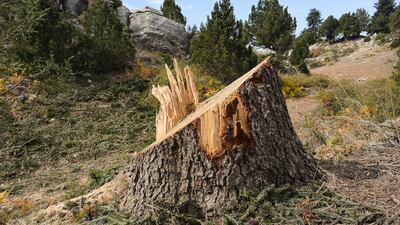
The exposed trunk of a tree, estimated by Assayed to be over 1,000 years old, is seen in a valley above Fneidek. Photo: Finbar Anderson / The National -
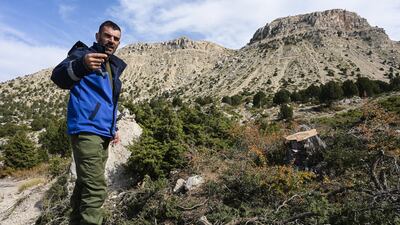
Abdelhakim Assayed of the Fneidek municipal police gestures as he looks at the exposed trunk of a recently felled tree. Photo: Finbar Anderson / The National -

The midday sun shines through the leaves of a forest above the town of Fneidek in north Lebanon. Photo: Finbar Anderson / The National -
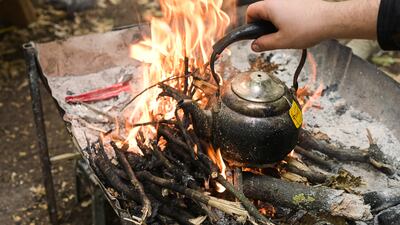
A kettle is boiled over the campfire in Fneidek forest. Photo: Finbar Anderson /The National -
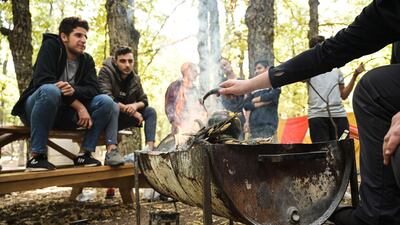
A group of young friends prepares tea around a campfire in Fneidek forest. Photo: Finbar Anderson / The National -
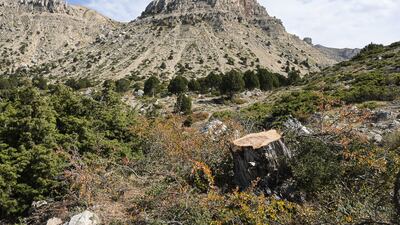
The exposed trunk of a recently felled tree is seen in the mountains above Fneidek, north Lebanon. Photo: Finbar Anderson / The National


The municipality of the town of Fneidek, which owns the forest, is at a loss over how to deal with this new phenomenon, which threatens to deprive the region of its sense of identity and heritage, said Mr Assayed. “If the situation remains like this, the forest will be gone in three or four years. Lebanon without trees is not worth anything. We’re going to become a desert.”
Filing police reports has little impact because of delays in the local judiciary, said the mayor, Samih Abdelaziz Abdelhay. The 56-year-old school director blames the government, not local people. Faced with the country's worst-ever economic crisis, politicians have lifted subsidies on basic goods without offering alternatives to the country’s poor, which comprises almost three-quarters of the population, according to the UN.
“I feel for citizens because they wouldn’t be cutting trees if they were not cold and poor,” said Mr Abdelhay. “I tell people — even if I don’t believe this myself — to be patient and that eventually, an environmental NGO, the Lebanese state or another country will take care of them and give them fuel at a reasonable price.”
Mr Abdelhay has given press conferences in which he pleads for fuel from local authorities, but has received no response. “We are close to losing a national treasure,” he said, referring to the forest. “It’s an environmental catastrophe.”
Many in Fneidek echo his point of view. The local economy, which relied on apple exports, has crashed in the past two years, fuelling anger against the state which has a long history of neglecting the wider region of Akkar.
Fuel crisis deepens
“When you tell people it’s illegal to cut trees, they answer: what am I supposed to do? You can’t stop them completely or they’ll explode. There’s 40,000 people living here and no fuel,” said Mr Assayed.
People worry about the coming winter, which brings with it several metres of snow every year. Few can still afford diesel to heat their homes. Its price has increased more than 10-fold since early 2021, while firewood heating costs are roughly half.
No one admits to chopping the trees, though foraging for dead wood is tolerated. “This is the first year I do this. It’s because of the economic situation,” said labourer Hussein Assayed, 37, as he packed an armful of wood into his red lorry.
Agriculture minister Abbas Al Hajj Hassan did not respond to requests for comment. The ministry oversees the management of Lebanon's forests.
Debt is the only option left for those who refuse to buy firewood. One of the municipality’s employees, Muhammad Addayli, 34, said that he would sell his mobile phone this week for $80 and borrow the $70 extra he needs to buy 200 litres of fuel. This will last a little over a month.
“I have a 20-day old baby and it’s already cold at night,” said Mr Addayli, who has not been paid his monthly wage, now worth just $35, in the past nine months.
Salaries have not changed despite the collapse of the local currency and soaring inflation. Mr Addayli said that if he runs out of fuel later this year, his family will have to move in with neighbours.
-
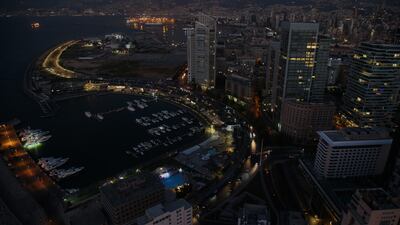
A view of Lebanon's capital, Beirut, with the lights on only in some buildings. Lebanese rely on highly polluting diesel generators run by private neighbourhood operators to make up for shortfalls in electricity supply from the state utility. EPA -
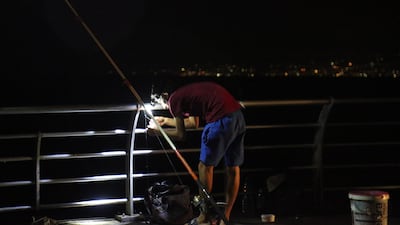
A fisherman uses a headlamp at the seaside corniche in Beirut, Lebanon. EPA -

A vendor sells LED balloons in full darkness at the corniche in Beirut. EPA -
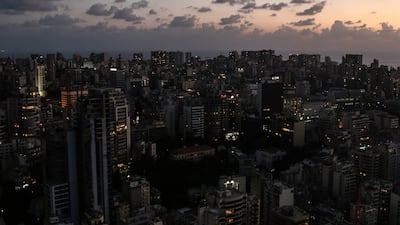
The near collapse of the national grid has increased the duration of power cuts across Lebanon. EPA -
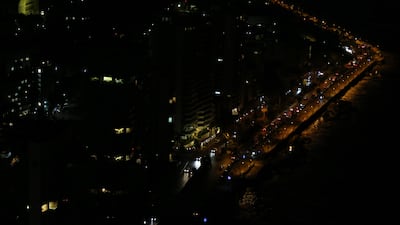
Residents of Beirut are experiencing power cuts of up to 20 hours a day. EPA


Investing in renewable energy is a little-discussed option, though locals are aware of a handful of factories in the region that transform tree residue into small bricks that can be burnt for heating.
The local municipality estimates that opening a similar one in Fneidek would cost $120,000, an investment it cannot afford.
These factories are part of the solution but cannot produce enough energy to respond to local demand for heating, said Sabine Saba, a professor of environmental studies at the University of Balamand, who has worked extensively on renewable energy in north Lebanon.
There is no “magical solution” for the people of Fneidek this winter as long as the state does not intervene, she told The National. “The public is not aware of sustainable solutions and even if they were, they would still have to cut trees to heat themselves. It's a truly catastrophic situation".

