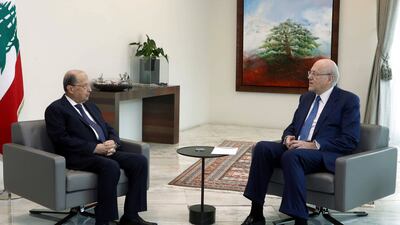
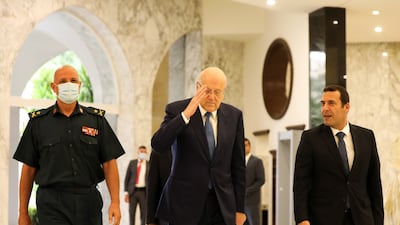
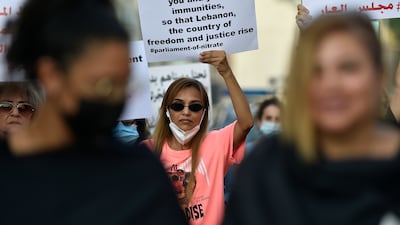
Prime Minister-designate Najib Mikati formed a government of 24 ministers on Friday, exactly one year after his predecessor Hassan Diab resigned in the wake of a deadly blast at Beirut port.
The past year has been marred by political wrangling between Lebanon's sectarian political parties, which have been widely accused of prioritising their interests over the population's.
The country's worst economic crisis, which came to a head in late 2019, stems from decades of corruption in the state and unsustainable financing. The local currency has lost more than 90 per cent of its value and the UN believes about 80 per cent of the population lives in poverty.
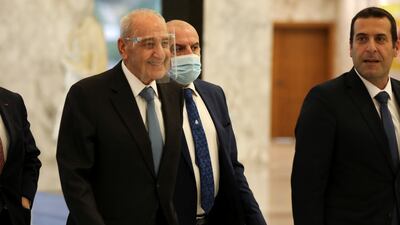
The Cabinet includes 12 Christians and 12 Muslims in line with Lebanon's sectarian politics. The Prime Minister is always Sunni Muslim, the President Christian Maronite, and the Parliament Speaker Shiite Muslim. There is only one woman among the ministers.
Lebanon's new Cabinet
Prime Minister: Najib Mikati
Head of his own political party, the Azm Movement
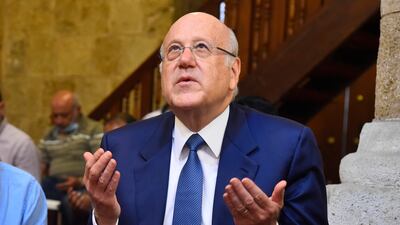
Two-time Prime Minister Najib Mikati is one of Lebanon’s most successful businessmen. Forbes estimates Mr Mikati’s fortune to reach $2.9 billion.
He was picked on July 26 to form a Cabinet after veteran politician Saad Hariri stepped down on July 16, months after diplomat Mustapha Adib also failed to form a government on September 26.
Mr Mikati has previously said he would seek to restart negotiations with the IMF once his government was formed. In his speech on Friday, he vowed to hold next year’s elections on time and promised a “governmental plan to rescue the country”.
Deputy Prime Minister: Saadeh Al Shami
Chosen by: the Syrian Social Nationalist Party
Mr Al Shami was Middle East technical assistance regional office director at the IMF from 2008 to 2013 and worked at the IMF for around two decades, an IMF spokesperson told The National.
Additionally, Lebanese newspaper Al Akhbar previously reported that Mr Al Shami served for five years as the chairman of the Lebanon's Capital Markets Authority.
Foreign Minister: Abdallah Bou Habib
Chosen by: Najib Mikati / former PM Saad Hariri, close to President Michel Aoun
A former World Bank economist with a doctorate in economics from Vanderbilt University in Nashville, Tennessee, Mr Bou Habib served as Lebanon’s ambassador to Washington between 1983 and 1990 - when President Ronald Reagan elected to withdraw US Marines from the country - Lebanon's state-run National News Agency said.
Mr Bou Habib returned to the World Bank in 1992 as an adviser to the head of the MENA regional communications department.
Mr Bou Habib founded the Issam Fares Institute in 2007, a Beirut based think tank. He also headed the office of former deputy prime minister Issam Fares, with whom he was very close.
Interior Minister: Bassam Mawlawi
Chosen by: former PM Saad Hariri
Mr Mawla was a judge of the Chamber of First Instance in Beirut before heading the North Lebanon criminal court, the NNA said.
Defence Minister: Maurice Salem
Chosen by: President Michel Aoun
Born in the town of Kfarshima south-east of Beirut in 1954, Mr Salem joined the military college in 1972, eventually graduating into the artillery corps at the rank of lieutenant, said the NNA.
His final position in the army was Head of Military medicine, until his retirement at the rank of brigadier in 2012. His time in the military included a period of study at the US staff college at Fort Leavenworth.
Finance Minister: Youssef Khalil
Chosen by: Parliament Speaker Nabih Berri, head of political party the Amal Movement
Mr Khalil is the director of the Lebanese central bank’s Financial Operations Department. The website of the Lebanese microfinance association, over which he presides, says that he obtained a doctorate in France from the Centre of Studies and Research in International Development and joined the central bank in 1982 as an economist.
Justice Minister: Henry Khoury
Chosen by: President Michel Aoun
A retired judge, Mr Khoury is the former head of the State Shura Council, Lebanese radio station Voix du Liban said.
Economy Minister: Amin Salam
Chosen by: Najib Mikati
Mr Salam is a corporate lawyer and economist with a degree in leadership and management from the Harvard Kennedy School, the NNA said. He is a former vice-president for business development of the National-US Arab Chamber of Commerce.
Health Minister: Firass Abiad
Chosen by: Saad Hariri
A gastrointestinal surgeon, Mr Abiad has been the chairman of the board of directors of Lebanon’s largest hospital, the Rafic Hariri Hospital, since 2015. Mr Abiad studied at the American University of Beirut, where he obtained an MBA in 2013.
Mr Abiad shot into public consciousness as the face of Lebanon’s response to the coronavirus pandemic.
A recent profile in Slate magazine called him “Lebanon’s version of Anthony Fauci: a medical professional who offers data-driven assessments of the course of the pandemic at a time when many government officials seem asleep at the wheel”.
Environment Minister: Nasser Yassin
Chosen by: Saad Hariri
Mr Yassin is the current director of the crisis observatory at the American University of Beirut. The NNA said he obtained a doctorate in planning sciences from University College London in 2008 and directed the Issam Fares Foundation for public policy and international relations at AUB from 2019-2020.
Public Works and Transport Minister: Ali Hamieh
Chosen by: Hezbollah
Born in the village of Taraya in east Lebanon in 1977, Mr Hamieh holds a PhD in electronics and optical communications from the University of Western Brittany in France, the NNA said. He is a lecturer at a number of local universities.
Agriculture Minister: Abbas Al Hajj Hassan
Chosen by: Amal Movement
Born in 1975 in the town of Chaat in the region of Baalbek, Mr Hajj Hassan is a former journalist who previously worked at France 24 in Paris. He studied law and political science in France, the NNA said.
Labour Minister: Moustafa Bayram
Chosen by: Hezbollah
Mr Bayram has a diploma in public law, and a master's degree in financial law from the Islamic University, the NNA said. Born in 1972, he was appointed head legal observer in the audit department of the Council of Ministers in 1998.
Education Minister: Abbas Halabi
Chosen by: Walid Joumblatt, head of the Progressive Socialist Party
Mr Halabi’s biography states that he is a former judge and vice-chairman of the board of directors and legal counsel at Lebanese bank BBAC and holds a degree in French and Lebanese Law from Saint Joseph University in Beirut. He is vice-president of the Lebanese National Commission for Unesco.
Minister of the Displaced: Issam Sharafeddine
Chosen by: Talal Arslan, head of the Lebanese Democratic Party
Born in the town of Aley in 1954, Mr Sharafeddine is a trained pharmacist who branched out into the business world in the 1990s when he started producing soaps, cosmetics and cleaning products, the NNA said.
He is a co-founder of beauty company Sharafeddine Industrial Laboratories and an adviser to Druze politician Talal Arslan, an opponent to Lebanon’s veteran Druze leader Walid Joumblatt, since 1991.
Information Minister: George Qordahi
Chosen by: Christian political party Marada
Born in 1950, Mr Qordahi, a prominent TV personnality, holds a bachelor’s degree in law and political science from the Lebanese University, the NNA said. He worked as a journalist for MBC FM Radio in London and Lebanese television channel LBC. He has been awarded the title of Goodwill Ambassador for the United Nations Environment Organisation.
Social Affairs: Hector Hajjar
Chosen by: President Michel Aoun
Born in 1965, Mr Hajjar holds a doctorate in dentistry from the Lebanese University, the NNA said. He has worked in NGOs including Caritas and Risala Assalam, which supports people with special needs.
Energy Minister: Walid Fayyad
Chosen by: President Michel Aoun
Mr Fayyad holds a master's in civil and environmental engineering from MIT, the NNA said. He has been managing director of the MENA division at international consulting firm Partners in Performance since 2019.
Tourism Minister: Walid Nassar
Chosen by: President Michel Aoun
Born in the coastal town of Jbeil in 1968, Mr Nassar studied engineering at Beirut’s Saint Joseph University. The NNA describes him as a “founder of several companies in Lebanon and Saudi Arabia in the fields of engineering, contracting and project management”.
He recently worked as a consultant for Lebanon’s participation in the Expo 2020 Dubai.
Administrative Development: Najla Riachi
Independent
Born in the village of Khenshara in the mountains north-east of Beirut, Ms Riachi is the only woman in Mr Mikati’s Cabinet.
Ms Riachi has served in a number of diplomatic positions, including as Lebanon’s permanent representative to the United Nations from 2007 to 2017, the NNA said. She holds two bachelor's degrees from Lebanon’s Saint Joseph University in political and administrative sciences, as well as in history and geography. She directed the office of Lebanon’s minister of foreign affairs from 2012 to 2020.
Sports and Youth: George Kallas
Independent
Born in 1953, Brig Gen Kallas has held a number of administrative positions in Lebanese newspapers and universities, including editor of local daily Annahar’s culture pages and lecturer at the faculty of documentation and information at the Lebanese University, the NNA said.
Industry Minister: George Boujikian
Chosen by: Armenian political party Tashnag
Born in 1965 in the city of Zahle, Mr Boujikian is a businessman who has founded several Lebanese companies according to the NNA, including pharmaceutical companies Technoline and BioDiamond Middle East. He holds both Lebanese and Canadian citizenship.
Telecommunications Minister: Johnny Corm
Chosen by: Marada
Mr Corm has been the director of General Paint, a Lebanese company which specialises in automotive coating, for the past two decades, said the NNA. Born in 1966, he holds an MBA from West Virginia University in the US.
Culture Minister: Mohammad Mortada
Chosen by : Amal
Born in 1972, Mr Mortada is a judge who currently heads the Mount Lebanon criminal court, according to the NNA. Between 2009 and 2018, he was twice a member of the Supreme Judicial Council, an ten-member administrative body which approves the appointment of judges amongst others.

Kandahar%20
%3Cp%3E%3Cstrong%3EDirector%3A%3C%2Fstrong%3E%20Ric%20Roman%20Waugh%3C%2Fp%3E%0A%3Cp%3E%3Cstrong%3EStars%3A%C2%A0%3C%2Fstrong%3EGerard%20Butler%2C%20Navid%20Negahban%2C%20Ali%20Fazal%3C%2Fp%3E%0A%3Cp%3E%3Cstrong%3ERating%3A%3C%2Fstrong%3E%202.5%2F5%3C%2Fp%3E%0A
Ten tax points to be aware of in 2026
1. Domestic VAT refund amendments: request your refund within five years
If a business does not apply for the refund on time, they lose their credit.
2. E-invoicing in the UAE
Businesses should continue preparing for the implementation of e-invoicing in the UAE, with 2026 a preparation and transition period ahead of phased mandatory adoption.
3. More tax audits
Tax authorities are increasingly using data already available across multiple filings to identify audit risks.
4. More beneficial VAT and excise tax penalty regime
Tax disputes are expected to become more frequent and more structured, with clearer administrative objection and appeal processes. The UAE has adopted a new penalty regime for VAT and excise disputes, which now mirrors the penalty regime for corporate tax.
5. Greater emphasis on statutory audit
There is a greater need for the accuracy of financial statements. The International Financial Reporting Standards standards need to be strictly adhered to and, as a result, the quality of the audits will need to increase.
6. Further transfer pricing enforcement
Transfer pricing enforcement, which refers to the practice of establishing prices for internal transactions between related entities, is expected to broaden in scope. The UAE will shortly open the possibility to negotiate advance pricing agreements, or essentially rulings for transfer pricing purposes.
7. Limited time periods for audits
Recent amendments also introduce a default five-year limitation period for tax audits and assessments, subject to specific statutory exceptions. While the standard audit and assessment period is five years, this may be extended to up to 15 years in cases involving fraud or tax evasion.
8. Pillar 2 implementation
Many multinational groups will begin to feel the practical effect of the Domestic Minimum Top-Up Tax (DMTT), the UAE's implementation of the OECD’s global minimum tax under Pillar 2. While the rules apply for financial years starting on or after January 1, 2025, it is 2026 that marks the transition to an operational phase.
9. Reduced compliance obligations for imported goods and services
Businesses that apply the reverse-charge mechanism for VAT purposes in the UAE may benefit from reduced compliance obligations.
10. Substance and CbC reporting focus
Tax authorities are expected to continue strengthening the enforcement of economic substance and Country-by-Country (CbC) reporting frameworks. In the UAE, these regimes are increasingly being used as risk-assessment tools, providing tax authorities with a comprehensive view of multinational groups’ global footprints and enabling them to assess whether profits are aligned with real economic activity.
Contributed by Thomas Vanhee and Hend Rashwan, Aurifer
TRAP
Starring: Josh Hartnett, Saleka Shyamalan, Ariel Donaghue
Director: M Night Shyamalan
Rating: 3/5
Need to know
Unlike other mobile wallets and payment apps, a unique feature of eWallet is that there is no need to have a bank account, credit or debit card to do digital payments.
Customers only need a valid Emirates ID and a working UAE mobile number to register for eWallet account.
Mercer, the investment consulting arm of US services company Marsh & McLennan, expects its wealth division to at least double its assets under management (AUM) in the Middle East as wealth in the region continues to grow despite economic headwinds, a company official said.
Mercer Wealth, which globally has $160 billion in AUM, plans to boost its AUM in the region to $2-$3bn in the next 2-3 years from the present $1bn, said Yasir AbuShaban, a Dubai-based principal with Mercer Wealth.
“Within the next two to three years, we are looking at reaching $2 to $3 billion as a conservative estimate and we do see an opportunity to do so,” said Mr AbuShaban.
Mercer does not directly make investments, but allocates clients’ money they have discretion to, to professional asset managers. They also provide advice to clients.
“We have buying power. We can negotiate on their (client’s) behalf with asset managers to provide them lower fees than they otherwise would have to get on their own,” he added.
Mercer Wealth’s clients include sovereign wealth funds, family offices, and insurance companies among others.
From its office in Dubai, Mercer also looks after Africa, India and Turkey, where they also see opportunity for growth.
Wealth creation in Middle East and Africa (MEA) grew 8.5 per cent to $8.1 trillion last year from $7.5tn in 2015, higher than last year’s global average of 6 per cent and the second-highest growth in a region after Asia-Pacific which grew 9.9 per cent, according to consultancy Boston Consulting Group (BCG). In the region, where wealth grew just 1.9 per cent in 2015 compared with 2014, a pickup in oil prices has helped in wealth generation.
BCG is forecasting MEA wealth will rise to $12tn by 2021, growing at an annual average of 8 per cent.
Drivers of wealth generation in the region will be split evenly between new wealth creation and growth of performance of existing assets, according to BCG.
Another general trend in the region is clients’ looking for a comprehensive approach to investing, according to Mr AbuShaban.
“Institutional investors or some of the families are seeing a slowdown in the available capital they have to invest and in that sense they are looking at optimizing the way they manage their portfolios and making sure they are not investing haphazardly and different parts of their investment are working together,” said Mr AbuShaban.
Some clients also have a higher appetite for risk, given the low interest-rate environment that does not provide enough yield for some institutional investors. These clients are keen to invest in illiquid assets, such as private equity and infrastructure.
“What we have seen is a desire for higher returns in what has been a low-return environment specifically in various fixed income or bonds,” he said.
“In this environment, we have seen a de facto increase in the risk that clients are taking in things like illiquid investments, private equity investments, infrastructure and private debt, those kind of investments were higher illiquidity results in incrementally higher returns.”
The Abu Dhabi Investment Authority, one of the largest sovereign wealth funds, said in its 2016 report that has gradually increased its exposure in direct private equity and private credit transactions, mainly in Asian markets and especially in China and India. The authority’s private equity department focused on structured equities owing to “their defensive characteristics.”
How to avoid crypto fraud
- Use unique usernames and passwords while enabling multi-factor authentication.
- Use an offline private key, a physical device that requires manual activation, whenever you access your wallet.
- Avoid suspicious social media ads promoting fraudulent schemes.
- Only invest in crypto projects that you fully understand.
- Critically assess whether a project’s promises or returns seem too good to be true.
- Only use reputable platforms that have a track record of strong regulatory compliance.
- Store funds in hardware wallets as opposed to online exchanges.
Our family matters legal consultant
Name: Hassan Mohsen Elhais
Position: legal consultant with Al Rowaad Advocates and Legal Consultants.
COMPANY%20PROFILE%20
%3Cp%3E%3Cstrong%3EName%3A%3C%2Fstrong%3E%20Haltia.ai%0D%3Cbr%3E%3Cstrong%3EStarted%3A%3C%2Fstrong%3E%202023%0D%3Cbr%3E%3Cstrong%3ECo-founders%3A%3C%2Fstrong%3E%20Arto%20Bendiken%20and%20Talal%20Thabet%0D%3Cbr%3E%3Cstrong%3EBased%3A%3C%2Fstrong%3E%20Dubai%2C%20UAE%0D%3Cbr%3E%3Cstrong%3EIndustry%3A%3C%2Fstrong%3E%20AI%0D%3Cbr%3E%3Cstrong%3ENumber%20of%20employees%3A%3C%2Fstrong%3E%2041%0D%3Cbr%3E%3Cstrong%3EFunding%3A%3C%2Fstrong%3E%20About%20%241.7%20million%0D%3Cbr%3E%3Cstrong%3EInvestors%3A%3C%2Fstrong%3E%20Self%2C%20family%20and%20friends%26nbsp%3B%3C%2Fp%3E%0A
ABU%20DHABI'S%20KEY%20TOURISM%20GOALS%3A%20BY%20THE%20NUMBERS
%3Cp%3EBy%202030%2C%20Abu%20Dhabi%20aims%20to%20achieve%3A%3C%2Fp%3E%0A%3Cp%3E%3Cstrong%3E%E2%80%A2%2039.3%20million%20visitors%2C%3C%2Fstrong%3E%20nearly%2064%25%20up%20from%202023%3C%2Fp%3E%0A%3Cp%3E%3Cstrong%3E%E2%80%A2%20Dh90%20billion%20contribution%20to%20GDP%2C%3C%2Fstrong%3E%20about%2084%25%20more%20than%20Dh49%20billion%20in%202023%3C%2Fp%3E%0A%3Cp%3E%3Cstrong%3E%E2%80%A2%20178%2C000%20new%20jobs%2C%3C%2Fstrong%3E%20bringing%20the%20total%20to%20about%20366%2C000%3C%2Fp%3E%0A%3Cp%3E%3Cstrong%3E%E2%80%A2%2052%2C000%20hotel%20rooms%2C%3C%2Fstrong%3E%20up%2053%25%20from%2034%2C000%20in%202023%3C%2Fp%3E%0A%3Cp%3E%3Cstrong%3E%E2%80%A2%207.2%20million%20international%20visitors%2C%3C%2Fstrong%3E%20almost%2090%25%20higher%20compared%20to%202023's%203.8%20million%3C%2Fp%3E%0A%3Cp%3E%3Cstrong%3E%E2%80%A2%203.9%20international%20overnight%20hotel%20stays%2C%3C%2Fstrong%3E%2022%25%20more%20from%203.2%20nights%20in%202023%3C%2Fp%3E%0A
LA LIGA FIXTURES
Thursday (All UAE kick-off times)
Sevilla v Real Betis (midnight)
Friday
Granada v Real Betis (9.30pm)
Valencia v Levante (midnight)
Saturday
Espanyol v Alaves (4pm)
Celta Vigo v Villarreal (7pm)
Leganes v Real Valladolid (9.30pm)
Mallorca v Barcelona (midnight)
Sunday
Atletic Bilbao v Atletico Madrid (4pm)
Real Madrid v Eibar (9.30pm)
Real Sociedad v Osasuna (midnight)
The biog
Place of birth: Kalba
Family: Mother of eight children and has 10 grandchildren
Favourite traditional dish: Al Harees, a slow cooked porridge-like dish made from boiled cracked or coarsely ground wheat mixed with meat or chicken
Favourite book: My early life by Sheikh Dr Sultan bin Muhammad Al Qasimi, the Ruler of Sharjah
Favourite quote: By Sheikh Zayed, the UAE's Founding Father, “Those who have no past will have no present or future.”
The specs
Engine: 4.0-litre V8 twin-turbocharged and three electric motors
Power: Combined output 920hp
Torque: 730Nm at 4,000-7,000rpm
Transmission: 8-speed dual-clutch automatic
Fuel consumption: 11.2L/100km
On sale: Now, deliveries expected later in 2025
Price: expected to start at Dh1,432,000
'Panga'
Directed by Ashwiny Iyer Tiwari
Starring Kangana Ranaut, Richa Chadha, Jassie Gill, Yagya Bhasin, Neena Gupta
Rating: 3.5/5
How%20to%20avoid%20getting%20scammed
%3Cul%3E%0A%3Cli%3ENever%20click%20on%20links%20provided%20via%20app%20or%20SMS%2C%20even%20if%20they%20seem%20to%20come%20from%20authorised%20senders%20at%20first%20glance%3C%2Fli%3E%0A%3Cli%3EAlways%20double-check%20the%20authenticity%20of%20websites%3C%2Fli%3E%0A%3Cli%3EEnable%20Two-Factor%20Authentication%20(2FA)%20for%20all%20your%20working%20and%20personal%20services%3C%2Fli%3E%0A%3Cli%3EOnly%20use%20official%20links%20published%20by%20the%20respective%20entity%3C%2Fli%3E%0A%3Cli%3EDouble-check%20the%20web%20addresses%20to%20reduce%20exposure%20to%20fake%20sites%20created%20with%20domain%20names%20containing%20spelling%20errors%3C%2Fli%3E%0A%3C%2Ful%3E%0A
SPECS
Engine: 4-litre V8 twin-turbo
Power: 630hp
Torque: 850Nm
Transmission: 8-speed Tiptronic automatic
Price: From Dh599,000
On sale: Now
MATCH INFO
Manchester United 1 (Fernandes pen 2') Tottenham Hotspur 6 (Ndombele 4', Son 7' & 37' Kane (30' & pen 79, Aurier 51')
Man of the match Son Heung-min (Tottenham)
Labour dispute
The insured employee may still file an ILOE claim even if a labour dispute is ongoing post termination, but the insurer may suspend or reject payment, until the courts resolve the dispute, especially if the reason for termination is contested. The outcome of the labour court proceedings can directly affect eligibility.
- Abdullah Ishnaneh, Partner, BSA Law
APPLE IPAD MINI (A17 PRO)
Display: 21cm Liquid Retina Display, 2266 x 1488, 326ppi, 500 nits
Chip: Apple A17 Pro, 6-core CPU, 5-core GPU, 16-core Neural Engine
Storage: 128/256/512GB
Main camera: 12MP wide, f/1.8, digital zoom up to 5x, Smart HDR 4
Front camera: 12MP ultra-wide, f/2.4, Smart HDR 4, full-HD @ 25/30/60fps
Biometrics: Touch ID, Face ID
Colours: Blue, purple, space grey, starlight
In the box: iPad mini, USB-C cable, 20W USB-C power adapter
Price: From Dh2,099
GIANT REVIEW
Starring: Amir El-Masry, Pierce Brosnan
Director: Athale
Rating: 4/5
The specs: Aston Martin DB11 V8 vs Ferrari GTC4Lusso T
Price, base: Dh840,000; Dh120,000
Engine: 4.0L V8 twin-turbo; 3.9L V8 turbo
Transmission: Eight-speed automatic; seven-speed automatic
Power: 509hp @ 6,000rpm; 601hp @ 7,500rpm
Torque: 695Nm @ 2,000rpm; 760Nm @ 3,000rpm
Fuel economy, combined: 9.9L / 100km; 11.6L / 100km
Who has been sanctioned?
Daniella Weiss and Nachala
Described as 'the grandmother of the settler movement', she has encouraged the expansion of settlements for decades. The 79 year old leads radical settler movement Nachala, whose aim is for Israel to annex Gaza and the occupied West Bank, where it helps settlers built outposts.
Harel Libi & Libi Construction and Infrastructure
Libi has been involved in threatening and perpetuating acts of aggression and violence against Palestinians. His firm has provided logistical and financial support for the establishment of illegal outposts.
Zohar Sabah
Runs a settler outpost named Zohar’s Farm and has previously faced charges of violence against Palestinians. He was indicted by Israel’s State Attorney’s Office in September for allegedly participating in a violent attack against Palestinians and activists in the West Bank village of Muarrajat.
Coco’s Farm and Neria’s Farm
These are illegal outposts in the West Bank, which are at the vanguard of the settler movement. According to the UK, they are associated with people who have been involved in enabling, inciting, promoting or providing support for activities that amount to “serious abuse”.
Sly%20Cooper%20and%20the%20Thievius%20Raccoonus
%3Cp%3E%3Cstrong%3EDeveloper%3A%3C%2Fstrong%3E%20Sucker%20Punch%20Productions%3Cbr%3E%3Cstrong%3EPublisher%3A%3C%2Fstrong%3E%20Sony%20Computer%20Entertainment%3Cbr%3E%3Cstrong%3EConsole%3A%3C%2Fstrong%3E%20PlayStation%202%20to%205%3Cbr%3E%3Cstrong%3ERating%3A%3C%2Fstrong%3E%205%2F5%3C%2Fp%3E%0A
The%20Witcher%20-%20season%20three
%3Cp%3E%3Cstrong%3EDirector%3A%20%3C%2Fstrong%3EVarious%0D%3Cbr%3E%3Cstrong%3E%0D%3Cbr%3EStars%3A%20%3C%2Fstrong%3EHenry%20Cavill%2C%20Freya%20Allan%2C%20Anya%20Chalotra%3Cstrong%3E%0D%3Cbr%3E%0D%3Cbr%3ERating%3A%3C%2Fstrong%3E%203%2F5%3C%2Fp%3E%0A
Strait of Hormuz
Fujairah is a crucial hub for fuel storage and is just outside the Strait of Hormuz, a vital shipping route linking Middle East oil producers to markets in Asia, Europe, North America and beyond.
The strait is 33 km wide at its narrowest point, but the shipping lane is just three km wide in either direction. Almost a fifth of oil consumed across the world passes through the strait.
Iran has repeatedly threatened to close the strait, a move that would risk inviting geopolitical and economic turmoil.
Last month, Iran issued a new warning that it would block the strait, if it was prevented from using the waterway following a US decision to end exemptions from sanctions for major Iranian oil importers.