Demonstrators clashed with police in Tripoli, Lebanon, on Monday during a protest against deteriorating living conditions and the coronavirus lockdown.
Dozens of protesters took to the streets of Tripoli during the day. Later in the evening, security forces used tear gas and fired rubber bullets to disperse crowds after protesters threw stones at the Tripoli Serail.
The demonstrators expressed anger over lockdown-related fines they had received and at the economic consequences of the nationwide shutdown, the National News Agency reported.
The Lebanese Red Cross said it had sent six teams to Al Nour Square in Tripoli during the clashes. Ambulances took 12 people to hospital, while 29 others received treatment on the ground.
-

Demonstrators gather near burning tires during a protest against the lockdown and worsening economic conditions, amid the spread of the coronavirus disease, in Tripoli, Lebanon. Reuters -
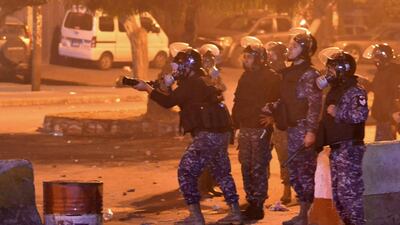
Lebanese security forces fire tear gas to disperse anti-government protesters during a demonstration against dire economic conditions, in the northern city of Tripoli. AFP -

Demonstrators stand near burning tires during a protest against the lockdown and worsening economic conditions, amid the spread of the coronavirus disease, in Tripoli, Lebanon. Reuters -
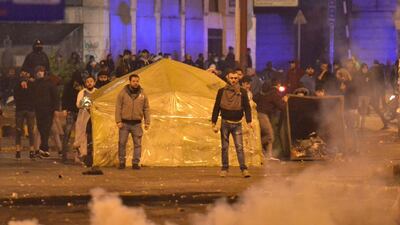
Lebanese anti-government protesters clash with security forces following a demonstration against dire economic conditions, in the northern city of Tripoli. AFP -

Lebanese anti-government protesters clash with security forces following a demonstration against dire economic conditions, in the northern city of Tripoli. AFP -

Lebanese anti-government protesters burn tyres during a demonstration against dire economic conditions, in the northern city of Tripoli. AFP -
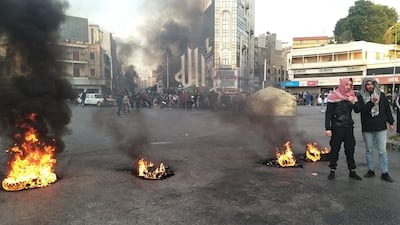
Demonstrators stand near burning tires during a protest against the lockdown and worsening economic conditions, amid the spread of the coronavirus disease, in Tripoli, Lebanon. Reuters
Known as the "bride of the revolution," Tripoli was at the heart of the mass protest movement against corruption and poor economic conditions that rocked Lebanon in October 2019.
The city has been the site of several protests since a more stringent lockdown began on January 14. Many residents say the measures have severely affected their livelihoods. Humanitarian organisations had said that a new lockdown would weigh heavily on the poor and those relying on daily wages.
Another protest against the lockdown was held in the southern coastal city of Sidon the same day.
Lebanon enforced a strict 24-hour curfew on January 14 after Covid-19 cases soared following the December holidays. Non-essential shops have been forced to close, while supermarkets and restaurants are open on a delivery-only basis.
The lockdown, which was meant to end on Wednesday, has been extended until February 8.

Match info
Deccan Gladiators 87-8
Asif Khan 25, Dwayne Bravo 2-16
Maratha Arabians 89-2
Chadwick Walton 51 not out
Arabians won the final by eight wickets
Turkish Ladies
Various artists, Sony Music Turkey
The President's Cake
Director: Hasan Hadi
Starring: Baneen Ahmad Nayyef, Waheed Thabet Khreibat, Sajad Mohamad Qasem
Rating: 4/5
While you're here
Michael Young: Where is Lebanon headed?
Kareem Shaheen: I owe everything to Beirut
Raghida Dergham: We have to bounce back
Sly%20Cooper%20and%20the%20Thievius%20Raccoonus
Abu Dhabi Sustainability Week
WHAT%20MACRO%20FACTORS%20ARE%20IMPACTING%20META%20TECH%20MARKETS%3F
The biog:
Favourite book: The Leader Who Had No Title by Robin Sharma
Pet Peeve: Racism
Proudest moment: Graduating from Sorbonne
What puts her off: Dishonesty in all its forms
Happiest period in her life: The beginning of her 30s
Favourite movie: "I have two. The Pursuit of Happiness and Homeless to Harvard"
Role model: Everyone. A child can be my role model
Slogan: The queen of peace, love and positive energy
While you're here
Cheryl Thompson: Stop the practice of blackface that's as Canadian as hockey
Kareem Shaheen: Alghabra outshines the racists who malign him
Kareem Shaheen: In Canada, I have finally found a home
Key facilities
- Olympic-size swimming pool with a split bulkhead for multi-use configurations, including water polo and 50m/25m training lanes
- Premier League-standard football pitch
- 400m Olympic running track
- NBA-spec basketball court with auditorium
- 600-seat auditorium
- Spaces for historical and cultural exploration
- An elevated football field that doubles as a helipad
- Specialist robotics and science laboratories
- AR and VR-enabled learning centres
- Disruption Lab and Research Centre for developing entrepreneurial skills
UNSC Elections 2022-23
Seats open:
- Two for Africa Group
- One for Asia-Pacific Group (traditionally Arab state or Tunisia)
- One for Latin America and Caribbean Group
- One for Eastern Europe Group
Countries so far running:
- UAE
- Albania
- Brazil
Mercer, the investment consulting arm of US services company Marsh & McLennan, expects its wealth division to at least double its assets under management (AUM) in the Middle East as wealth in the region continues to grow despite economic headwinds, a company official said.
Mercer Wealth, which globally has $160 billion in AUM, plans to boost its AUM in the region to $2-$3bn in the next 2-3 years from the present $1bn, said Yasir AbuShaban, a Dubai-based principal with Mercer Wealth.
“Within the next two to three years, we are looking at reaching $2 to $3 billion as a conservative estimate and we do see an opportunity to do so,” said Mr AbuShaban.
Mercer does not directly make investments, but allocates clients’ money they have discretion to, to professional asset managers. They also provide advice to clients.
“We have buying power. We can negotiate on their (client’s) behalf with asset managers to provide them lower fees than they otherwise would have to get on their own,” he added.
Mercer Wealth’s clients include sovereign wealth funds, family offices, and insurance companies among others.
From its office in Dubai, Mercer also looks after Africa, India and Turkey, where they also see opportunity for growth.
Wealth creation in Middle East and Africa (MEA) grew 8.5 per cent to $8.1 trillion last year from $7.5tn in 2015, higher than last year’s global average of 6 per cent and the second-highest growth in a region after Asia-Pacific which grew 9.9 per cent, according to consultancy Boston Consulting Group (BCG). In the region, where wealth grew just 1.9 per cent in 2015 compared with 2014, a pickup in oil prices has helped in wealth generation.
BCG is forecasting MEA wealth will rise to $12tn by 2021, growing at an annual average of 8 per cent.
Drivers of wealth generation in the region will be split evenly between new wealth creation and growth of performance of existing assets, according to BCG.
Another general trend in the region is clients’ looking for a comprehensive approach to investing, according to Mr AbuShaban.
“Institutional investors or some of the families are seeing a slowdown in the available capital they have to invest and in that sense they are looking at optimizing the way they manage their portfolios and making sure they are not investing haphazardly and different parts of their investment are working together,” said Mr AbuShaban.
Some clients also have a higher appetite for risk, given the low interest-rate environment that does not provide enough yield for some institutional investors. These clients are keen to invest in illiquid assets, such as private equity and infrastructure.
“What we have seen is a desire for higher returns in what has been a low-return environment specifically in various fixed income or bonds,” he said.
“In this environment, we have seen a de facto increase in the risk that clients are taking in things like illiquid investments, private equity investments, infrastructure and private debt, those kind of investments were higher illiquidity results in incrementally higher returns.”
The Abu Dhabi Investment Authority, one of the largest sovereign wealth funds, said in its 2016 report that has gradually increased its exposure in direct private equity and private credit transactions, mainly in Asian markets and especially in China and India. The authority’s private equity department focused on structured equities owing to “their defensive characteristics.”
Match info
What: Fifa Club World Cup play-off
Who: Al Ain v Team Wellington
Where: Hazza bin Zayed Stadium, Al Ain
When: Wednesday, kick off 7.30pm
Iraq negotiating over Iran sanctions impact
- US sanctions on Iran’s energy industry and exports took effect on Monday, November 5.
- Washington issued formal waivers to eight buyers of Iranian oil, allowing them to continue limited imports. Iraq did not receive a waiver.
- Iraq’s government is cooperating with the US to contain Iranian influence in the country, and increased Iraqi oil production is helping to make up for Iranian crude that sanctions are blocking from markets, US officials say.
- Iraq, the second-biggest producer in the Organization of Petroleum Exporting Countries, pumped last month at a record 4.78 million barrels a day, former Oil Minister Jabbar Al-Luaibi said on Oct. 20. Iraq exported 3.83 million barrels a day last month, according to tanker tracking and data from port agents.
- Iraq has been working to restore production at its northern Kirkuk oil field. Kirkuk could add 200,000 barrels a day of oil to Iraq’s total output, Hook said.
- The country stopped trucking Kirkuk oil to Iran about three weeks ago, in line with U.S. sanctions, according to four people with knowledge of the matter who asked not to be identified because they aren’t allowed to speak to media.
- Oil exports from Iran, OPEC’s third-largest supplier, have slumped since President Donald Trump announced in May that he’d reimpose sanctions. Iran shipped about 1.76 million barrels a day in October out of 3.42 million in total production, data compiled by Bloomberg show.
- Benchmark Brent crude fell 47 cents to $72.70 a barrel in London trading at 7:26 a.m. local time. U.S. West Texas Intermediate was 25 cents lower at $62.85 a barrel in New York. WTI held near the lowest level in seven months as concerns of a tightening market eased after the U.S. granted its waivers to buyers of Iranian crude.
Transgender report
While you're here
Hussein Ibish: Biden wants America to re-engage with the world. That's a tough sell
Raghida Dergham: Will Biden's 'maximum diplomacy' with Iran work?
Sholto Byrnes: Joe Biden's Irish soul
Gavin Esler: Biden win put Johnson in Catch-22 situation
FFP EXPLAINED
What is Financial Fair Play?
Introduced in 2011 by Uefa, European football’s governing body, it demands that clubs live within their means. Chiefly, spend within their income and not make substantial losses.
What the rules dictate?
The second phase of its implementation limits losses to €30 million (Dh136m) over three seasons. Extra expenditure is permitted for investment in sustainable areas (youth academies, stadium development, etc). Money provided by owners is not viewed as income. Revenue from “related parties” to those owners is assessed by Uefa's “financial control body” to be sure it is a fair value, or in line with market prices.
What are the penalties?
There are a number of punishments, including fines, a loss of prize money or having to reduce squad size for European competition – as happened to PSG in 2014. There is even the threat of a competition ban, which could in theory lead to PSG’s suspension from the Uefa Champions League.
GIANT REVIEW
Starring: Amir El-Masry, Pierce Brosnan
Director: Athale
Rating: 4/5
Mina Al-Oraibi: Iraq is in a fight to show its people who is really in charge
Khaled Yacoub Oweis: Iraq PM goes from shy writer to the political peak
The National Editorial: Iran's 'failed model' should be discontinued
More Expo 2020 Dubai pavilions:
While you're here
National Editorial: World trade has started to look inwards
Callum Patton: ‘Arrival of Asian century’ has eclipsed US
Robin Mills: Importance of China's energy markets clearer

