
French President Emmanuel Macron and new US President Joe Biden are in agreement on a number of issues from Covid-19 to climate change and intend to work together in the Middle East, the Elysee Palace has said.
Speaking in the first phone call since Mr Biden took office last week, the pair discussed the situation in Lebanon and the Iran nuclear deal that previous president Donald Trump walked out of in 2018.
The White House said Mr Biden and Mr Macron also discussed cooperation on China, the Middle East, Russia and the Sahel.
_____________
Joe Biden in the Middle East - in pictures
-
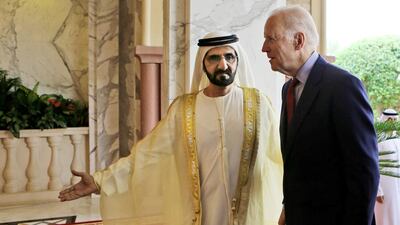
Sheikh Mohammed bin Rashid, Vice President and Ruler of Dubai, welcomes then US Vice President Joe Biden at Zabeel Palace in March 2016. AP Photo -
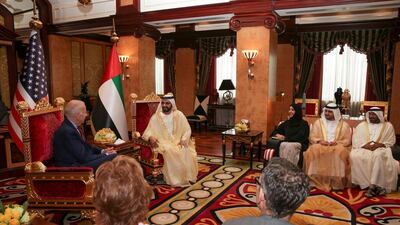
Sheikh Mohammed bin Rashid Vice President and Ruler of Dubai, meets US Vice President Joe Biden in Dubai in 2016. Reuters -
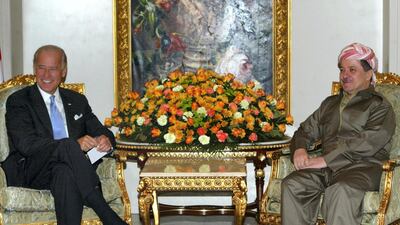
US Vice President Joe Biden meets with Kurdish regional president Massoud Barzani in Arbil on September 17, 2009. Biden held talks in the Kurdish regional capital of Arbil to push Iraqi leaders for progress on stalled legislation ahead of parliamentary elections in January. AFP -
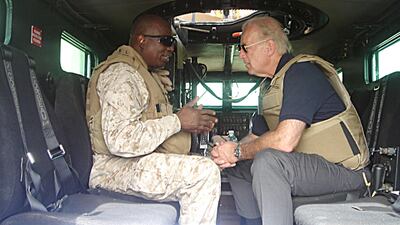
Delaware Senator Joe Biden speaking with an unidentified soldier inside a Mine Resistant Ambush Protected vehicle during a visit to Ramadi, Iraq, 06 September, 2007. AFP -
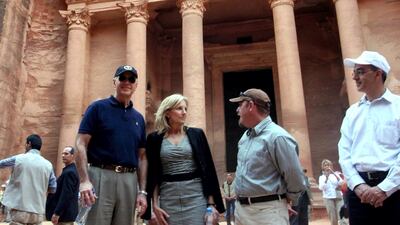
US Vice President Joseph Biden and his wife Dr Jill Biden tour the Nabatean city of Petra in southern Jordan on March 12, 2010. AFP -
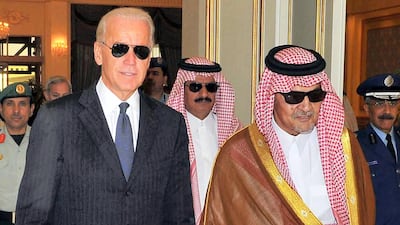
Saudi Foreign Minister Prince Saud al-Faisal welcomes US Vice President Joe Biden at the Riyadh airbase on October 27, 2011, upon his arrival in the Saudi capital with a US official delegation to offer condolences to the King Abdullah bin Abdul Aziz following the death of his brother, Crown Prince Sultan. AFP -
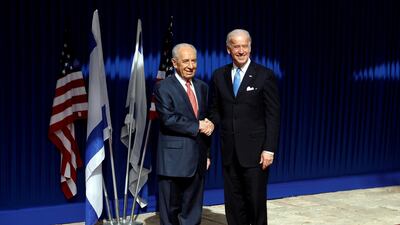
Israel's President Shimon Peres shakes hands with U.S. Vice President Joe Biden before their meeting at the president's residence in Jerusalem March 9, 2010. Reuters -
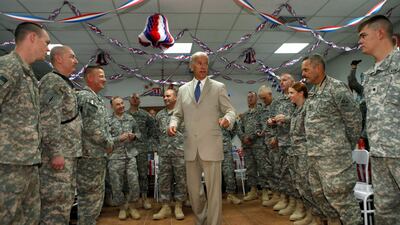
U.S. Vice President Joe Biden talks with soldiers at Camp Victory on the outskirts of Baghdad, Iraq July 4, 2009. Reuters -

U.S. Senator and Democratic presidential candidate Joe Biden talks with soldiers as he travels in a military vehicle to Iraq from Kuwait in this September 6, 2007. Reuters -
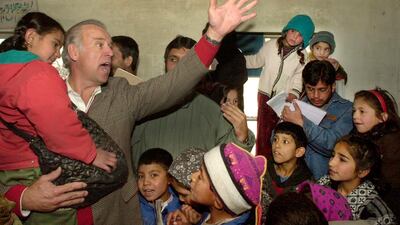
U.S. Sen. Joseph Biden, D-Del., Chairman of the U.S Senate's Foreign Relations Committee, waves as he talks to Afghan children during a visit to the Ariana primary school in Kabul, Jan. 12, 2002. AP Photo -
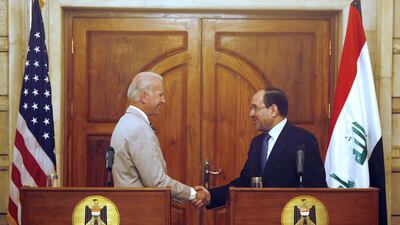
US Vice President Joseph Biden shakes hand with Iraqi Prime Minister Nuri al-Maliki during a joined press conference following a meeting in Baghdad on July 3, 2009. Vice President Joe Biden threatened today that the United States would politically disengage from Iraq if sectarian or ethnic violence resumes, a senior US official told reporters. AFP -

US Sen. Joe Lieberman speaks to Jill, the wife of Vice President Joe Biden as Sen. Lindsay Graham and U.S. Sen. John McCain looks on, during a surprise visit to Baghdad, on July 3, 2010. AFP -
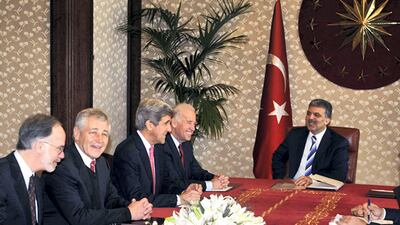
Turkish President Abdullah Gul meets with US congressmen Joseph Biden, John Kerry, Chuck Hagel, and US Ambassador to Turkey Ross Wilson in Ankara, on February 22, 2008. AFP -
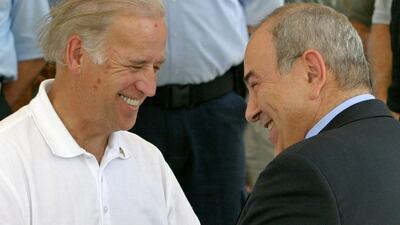
US senator Joseph Biden is greeted by Iraq's interim Prime Minister Iyad Allawi while visiting Baghdad 19 June 2004. Eighteen Iraqis were killed and eight wounded in the Sunni rebel stronghold of Fallujah, hospital officials said, in an attack which local residents blamed on a US air raid. AFP -

US Senator Joseph Biden hosts King Abdullah II of Jordan and Queen Rania at a Senate Foreign Relations luncheon 08 May 2002, during their visit to the US Capitol in Washington, DC. AFP -
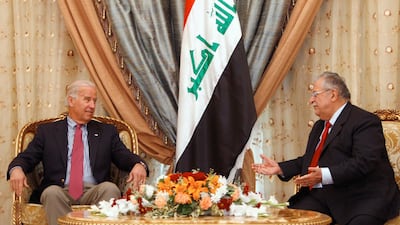
US vice president-elect Joe Biden is seen during a meeting with Iraqi President Jalal Talabani in Baghdad on January 12, 2009. AFP -
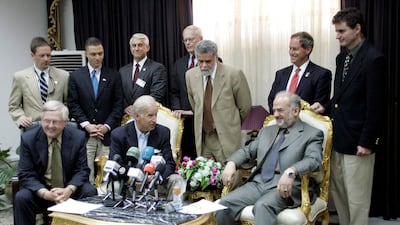
Iraqi Prime Minister Ibrahim Jaafari smiles at Joe Biden during a press conference after a meeting with and Curt Weldon, the head of a US congressional delegation of about a half-dozen members that also includes Rep. Joe Wilson, Rep. Jeff Miller, Rep. Harold Ford, Rep. Mark Green, David Reichert, and Senator Joe Biden, in Baghdad 30 May 2005. AFP -

US Senator Richard Lugar of Indiana and Chuck Hagel of Nebraska listen on as Joe Biden of Delaware speaks to the press at a hotel in Baghdad 23 June 2003. The congressional delegation is touring the capital and attending official meetings. AFP -
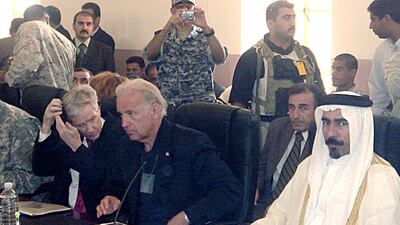
Delaware Senator Joe Biden meeting with Iraqi tribal leaders in the Anbar Province in Iraq, 06 September, 2007. AFP -
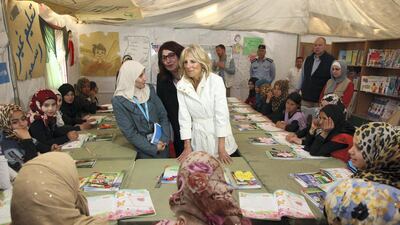
The wife of US vice president, Jill Biden meets Syrian refugee children on March 10, 2016 at the Zaatari refugee camp, located close to the northern Jordanian city of Mafraq near the border with Syria. AFP -
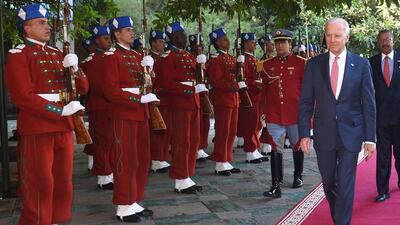
US Vice President Joe Biden arrives for a meeting with Morocco's King Mohammed VI at the royal palace in Fez on November 19, 2014. AFP -
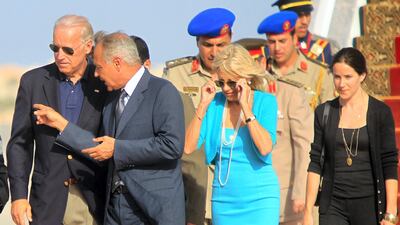
Egyptian Foreign Minister Ahmed Aboul Gheit receives US Vice President Joe Biden and his wife Jill Biden upon their arrival at Sharm el-Sheikh Airport on June 6, 2010, for a meeting with President Hosni Mubarak on the first leg of an African tour. AFP -
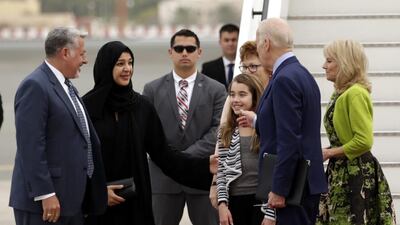
US Vice President Joe Biden and his wife Jill Biden are welcomed by Reem Al Hashimi, Minister of State and Managing Director for the Dubai World Expo 2020 Bid Committee. EPA -
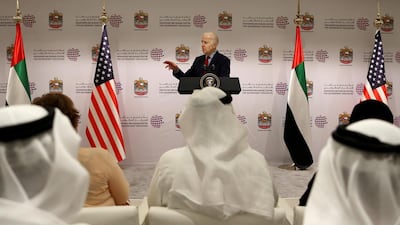
US vice president Joe Biden speaks during a conference with young Emirati entrepreneurs in Dubai. AP Photo -
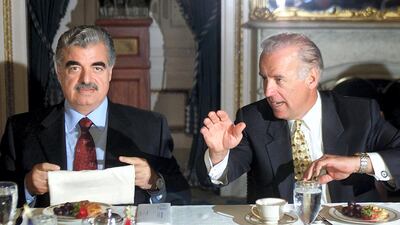
Lebanese Prime Minister Rafiq Hariri attends a meeting with Sen. Joe Biden, (D-DE), and other members of the US Senate Foreign Relations Committee 17 April 2002 at the US Capitol in Washington, DC. AFP -
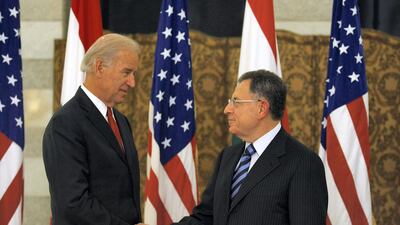
US Vice President Joe Biden shakes hands with Lebanese Prime Minister Fuad Siniora during a meeting at the governmental palace in Beirut on May 22, 2009. AFP -
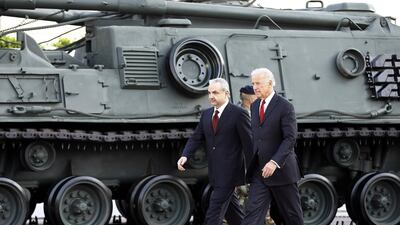
US Vice President Joe Biden and Lebanese Defence Minister Elias Murr walk past a US-made tank during a ceremony at the Rafiq Hariri international airport in Beirut on May 22, 2009. AFP


Over the course of the hour-long call in English, the pair expressed “willingness to act together for peace and stability in the near and Middle East, particularly on the Iranian nuclear issue and the situation in Lebanon,” Elysee Palace said on Sunday.
Mr Macron had already lauded Mr Biden's decision to return to the Paris climate accord and the pair said they “hoped that the US return to the Paris Agreement would open up a new stage of action so that the international community could concretely live up to its commitments.”
Former US President Donald Trump formally pulled the United States out of the Paris climate accord in November last year, claiming it "was designed to kill the American economy" rather than save the environment.
Describing France as America's "oldest ally," a White House statement added that Mr Biden had pledged close coordination with Paris on climate change, Covid-19 and the global economy.
It said Mr Biden "stressed his commitment to bolstering the transatlantic relationship, including through Nato and the United States' partnership with the European Union."
The call was the US leader's latest effort to mend relations with Europe after they were badly strained under Mr Trump.
Mr Macron had initially attempted to forge a close relationship with Mr Trump, but the two later were frequently at odds over Syria, US tariffs and the US president’s withdrawal from the Paris climate accord -- which Mr Biden moved to re-enter on his first day in office.
Mr Biden spoke on Saturday with British Prime Minister Boris Johnson, and the two vowed to deepen cooperation and work together to tackle climate change, the prime minister's office said.
That call was Mr Biden's first to a European leader, according to British newspapers.
His first call to any foreign leader went to Prime Minister Justin Trudeau of Canada on Friday, followed by President Andres Manuel Lopez Obrador of Mexico.
Mr Biden has vowed to return to a more traditional US diplomacy built around close ties to the two North American partners, Western Europe and Asian allies such as Japan and South Korea.
Europeans have responded with expressions of relief, tempered by some doubts that the US is as reliable a friend as it was in the past.
Ursula von der Leyen, president of the European Council, said after Mr Biden's inauguration on Wednesday that the quadrennial ceremony had provided "resounding proof that, once again, after four long years, Europe has a friend in the White House."

