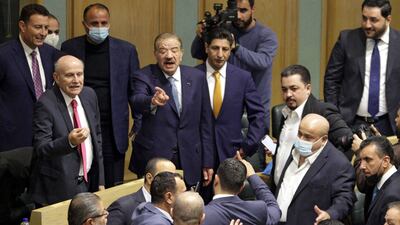
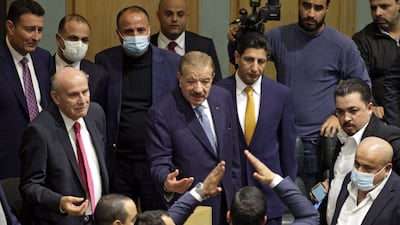
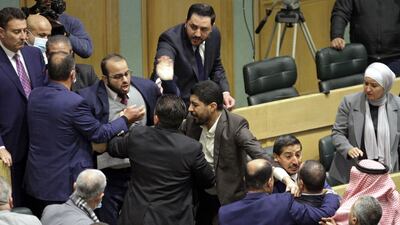
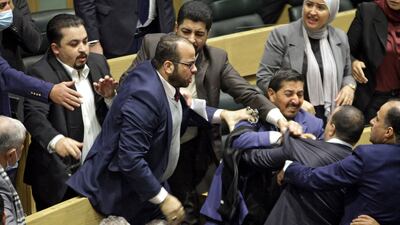
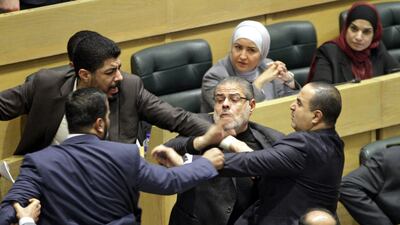
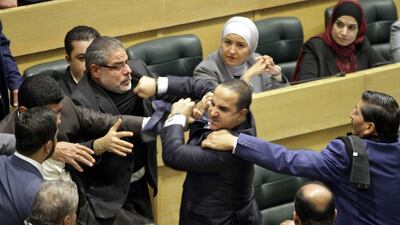
Jordan has passed an amendment to its constitution to add the term "Jordanian women", after a fist-fight erupted between members of parliament in the assembly last week over proposed reforms.
Footage of the brawl between the parliamentarians went viral.
The violence started when a discussion on proposed constitutional amendments escalated. It drew condemnation from other officials as well as the public.
“The behaviour is unacceptable to our people and harms our country's reputation,” said Khalil Atiyeh, a member of parliament who witnessed Tuesday’s brawl.
The phrase was added on Sunday to the title of the second chapter of the constitution, which outlines the rights and duties of Jordanians.
Out of 130 members of parliament, 94 approved the amendment while 26 rejected it and 10 were “absent” from the vote, state news agency Petra said.
Minister of Political and Parliamentary Affairs Musa Maaytah said the change was made to “honour and respect women”. Jordan's current constitution makes reference to women's rights, or "special conditions" in the workplace, under Article 23, but gives no further details.
Parliamentary Legal Committee member Ghazi Al Thneibat was also criticised for on-air comments calling the proposed clauses on the empowerment of women and youths, matters of “aesthetics designed to appease the international community”.
The dispute over the issue highlighted the deep-rooted problems that plague Jordanian society when it comes to traditional norms.
Rights activists point out that foreign spouses and children of Jordanian women, for example, cannot receive Jordanian citizenship while those of Jordanian men can.
Also on Sunday, 106 deputies voted to amend a paragraph in the constitution on motherhood and people with disabilities.
"The law shall protect the rights of persons with disabilities and promote their participation and inclusion in various walks of life. It [the law] shall also protect motherhood, childhood and the elderly, take care of young people and prevent abuse and exploitation," Paragraph 5 of Article 6 now reads.
MPs however voted against allowing the king to preside over the National Security and Foreign Policy Council.
On Monday, the parliament will continue discussing matters pertaining to the rights of people with disabilities and their inclusion in society among 27 proposed amendments.

Set-jetting on the Emerald Isle
Other shows filmed in Ireland include: Vikings (County Wicklow), The Fall (Belfast), Line of Duty (Belfast), Penny Dreadful (Dublin), Ripper Street (Dublin), Krypton (Belfast)
The%20specs%3A%202024%20Mercedes%20E200
%3Cp%3E%3Cstrong%3EEngine%3A%20%3C%2Fstrong%3E2.0-litre%20four-cyl%20turbo%20%2B%20mild%20hybrid%0D%3Cbr%3E%3Cstrong%3EPower%3A%20%3C%2Fstrong%3E204hp%20at%205%2C800rpm%20%2B23hp%20hybrid%20boost%0D%3Cbr%3E%3Cstrong%3ETorque%3A%20%3C%2Fstrong%3E320Nm%20at%201%2C800rpm%20%2B205Nm%20hybrid%20boost%0D%3Cbr%3E%3Cstrong%3ETransmission%3A%20%3C%2Fstrong%3E9-speed%20auto%0D%3Cbr%3E%3Cstrong%3EFuel%20consumption%3A%20%3C%2Fstrong%3E7.3L%2F100km%0D%3Cbr%3E%3Cstrong%3EOn%20sale%3A%20%3C%2Fstrong%3ENovember%2FDecember%0D%3Cbr%3E%3Cstrong%3EPrice%3A%20%3C%2Fstrong%3EFrom%20Dh205%2C000%20(estimate)%3C%2Fp%3E%0A
COMPANY PROFILE
Name: HyperSpace
Started: 2020
Founders: Alexander Heller, Rama Allen and Desi Gonzalez
Based: Dubai, UAE
Sector: Entertainment
Number of staff: 210
Investment raised: $75 million from investors including Galaxy Interactive, Riyadh Season, Sega Ventures and Apis Venture Partners
Infiniti QX80 specs
Engine: twin-turbocharged 3.5-liter V6
Power: 450hp
Torque: 700Nm
Price: From Dh450,000, Autograph model from Dh510,000
Available: Now
Some of Darwish's last words
"They see their tomorrows slipping out of their reach. And though it seems to them that everything outside this reality is heaven, yet they do not want to go to that heaven. They stay, because they are afflicted with hope." - Mahmoud Darwish, to attendees of the Palestine Festival of Literature, 2008
His life in brief: Born in a village near Galilee, he lived in exile for most of his life and started writing poetry after high school. He was arrested several times by Israel for what were deemed to be inciteful poems. Most of his work focused on the love and yearning for his homeland, and he was regarded the Palestinian poet of resistance. Over the course of his life, he published more than 30 poetry collections and books of prose, with his work translated into more than 20 languages. Many of his poems were set to music by Arab composers, most significantly Marcel Khalife. Darwish died on August 9, 2008 after undergoing heart surgery in the United States. He was later buried in Ramallah where a shrine was erected in his honour.
Sinopharm vaccine explained
The Sinopharm vaccine was created using techniques that have been around for decades.
“This is an inactivated vaccine. Simply what it means is that the virus is taken, cultured and inactivated," said Dr Nawal Al Kaabi, chair of the UAE's National Covid-19 Clinical Management Committee.
"What is left is a skeleton of the virus so it looks like a virus, but it is not live."
This is then injected into the body.
"The body will recognise it and form antibodies but because it is inactive, we will need more than one dose. The body will not develop immunity with one dose," she said.
"You have to be exposed more than one time to what we call the antigen."
The vaccine should offer protection for at least months, but no one knows how long beyond that.
Dr Al Kaabi said early vaccine volunteers in China were given shots last spring and still have antibodies today.
“Since it is inactivated, it will not last forever," she said.
Key figures in the life of the fort
Sheikh Dhiyab bin Isa (ruled 1761-1793) Built Qasr Al Hosn as a watchtower to guard over the only freshwater well on Abu Dhabi island.
Sheikh Shakhbut bin Dhiyab (ruled 1793-1816) Expanded the tower into a small fort and transferred his ruling place of residence from Liwa Oasis to the fort on the island.
Sheikh Tahnoon bin Shakhbut (ruled 1818-1833) Expanded Qasr Al Hosn further as Abu Dhabi grew from a small village of palm huts to a town of more than 5,000 inhabitants.
Sheikh Khalifa bin Shakhbut (ruled 1833-1845) Repaired and fortified the fort.
Sheikh Saeed bin Tahnoon (ruled 1845-1855) Turned Qasr Al Hosn into a strong two-storied structure.
Sheikh Zayed bin Khalifa (ruled 1855-1909) Expanded Qasr Al Hosn further to reflect the emirate's increasing prominence.
Sheikh Shakhbut bin Sultan (ruled 1928-1966) Renovated and enlarged Qasr Al Hosn, adding a decorative arch and two new villas.
Sheikh Zayed bin Sultan (ruled 1966-2004) Moved the royal residence to Al Manhal palace and kept his diwan at Qasr Al Hosn.
Sources: Jayanti Maitra, www.adach.ae