


Residents of the northern Iraqi province of Nineveh expressed their disappointment over the resignation of the governor Najim Al Jabouri, weeks before the provincial elections.
Mr Al Jabouri submitted his resignation on Sunday after being excluded from running in the elections due to historical links to Saddam Hussein’s now-outlawed Baath party.
“He was the best governor to see and the province was better during his term in terms of the reconstruction and services,” entrepreneur Omar Sinan, 22, told The National.
Several governors had been removed from the province over charges of corruption and mismanagement between 2017, when Nineveh was recovered from ISIS control in a war that left much of it in ruins, and 2019 when Mr Al Jabouri was appointed.
Over the past four years, Mr Al Jabouri, a former military officer, was often seen roaming the city, following up with projects and talking to residents.
“Things had been smooth over the past years in the province,” Aseel Nawar, 32, said. “There no political wrangling or any tensions as everything was focused on how to get the city back on its feet,” Ms Nawar added.
In September, Iraq’s Commission for Accountability and Justice put Mr Al Jabouri on a list of 100 candidates barred from running in the elections due to previous affiliations with the Baath party.
Mr Al Jabouri served as a commander of a military division and a member of the military intelligence during the rule of Saddam Hussein. He took part in the 1980-88 Iraq-Iran War and the 1991 Gulf War and continued in service until the 2003 US-led invasion.
He appealed the decision barring him from standing in October at the Federal Court of Cassation, but it was rejected,
The Cabinet asked the Parliament to vote on excluding Mr Al Jabouri from the commission’s procedures but it failed to do so.
“Given the failure to complete the procedures of my de-Baathification, due to the failure to vote on that in the parliament, I am requesting your excellency to accept my resignation from my position as governor of Nineveh,” he wrote in his resignation letter addressed to Prime Minister Mohammed Shia Al Sudani this week.

Abdul Kadir Al Dakheel appointed governor
Mr Al Sudani accepted the resignation and appointed Abdul Kadir Al Dakheel as the new governor of Nineveh, provincial spokesman Ali Mahmoud told The National on Thursday.
Mr Al Dakheel is a member of the Executive Office of the Committee of Nineveh Reconstruction and the Service and Engineering Team which are affiliated to the Prime Minster's office. He was also an adviser to Mr Al Jabouri.
“This is a great responsibility, and bearing it is essential to make Nineveh bright and prosperous,” Mr Al Dakheel said on Tuesday.
“This is a sensitive period ahead of the [provincial] elections so we have to continue working to serve the people away from any political agenda,” he added.
“Given the special status of the province which has ethnic and religious diversity, the PM picked up a governor with no political affiliations to better serve its residents,” a government official told The National.

'A true patriot'
Mr Al Jabouri took office in 2019 after retiring as a lieutenant general who commanded Iraqi forces during the battle against ISIS for the city of Mosul. He was seen as a US-backed official since the war against ISIS.
The US Ambassador to Iraq, Alina Romanowski hailed Mr Al Jabouri on X, formerly known as Twitter, as a “true patriot, he helped Iraq defeat ISIS and supported reconstruction work”.
Some Sunnis in Iraq see the antiterrorism and de-Baathification laws as a means to target them by Shiite factions backed by Iran, who came to power in Iraq after Saddam's fall.
“All honourable and loyal people have become victims of those whom you allowed to take responsibilities without any right,” Jamal Al Halbousi, a former military officer, wrote in a reply to the US ambassador's statement.
“Has your government realised that those loyal to their country are victims?” he added. “Change will be inevitable whether America likes it or not, Iraq doesn't deserve all these setbacks,” he said.
Mosul is Iraq's second-largest city and the capital of Nineveh province.
It was captured by ISIS in mid-2014, which brought large parts of northern and western Iraq under its influence.
In October 2016 Iraqi security forces backed by a US-led international coalition launched what was then considered one of the world’s biggest urban battles since the Second World War.
They announced the end of combat operations in mid-2017. It took six more months to claim back Mosul and the surrounding areas. In doing so, tens of thousands died, millions were displaced and entire towns and neighbourhoods were destroyed.
Although the scars of war are still in every corner of the city, life has returned to normal in the province and reconstruction is under way.
Iraq's government has set December 18 as the date for the country’s next provincial elections.
Provincial councils play a vital role as the subnational legislative authority, as well as devising localised development plans.
-

In the early 13th century, Al Nabi Yunus Mosque was built on what was believed to be the site of the grave of the Prophet Yunus, who is mentioned in the Quran. He also features, as Jonah, in the Bible. Photo: Ministry of Culture. -

Tour guide Harith Faris, 24, right, says recent archaeological discoveries around Mosul will help make his home city a tourist attraction. Photo: Harith Faris. -

Although known about for centuries, the palace of the Assyrian King Esarhaddon – who ruled for 12 years in the early 7th century BC – had been hidden. Photo: Ministry of Culture -

After recapturing Mosul in January 2017 by US-backed Iraqi security forces, experts found a network of tunnels dug by ISIS militants. Photo: Ministry of Culture -

Harith Faris takes foreign tourists on a bike tour around Mosul. Photo: Harith Faris -

Archaeologist Musab Mohammed Jassim shows discoveries in a tunnel network running under Al Nabi Yunus Mosque. Reuters -

Mr Jassim examines relief carvings found in tunnels beneath the mosque. Reuters -
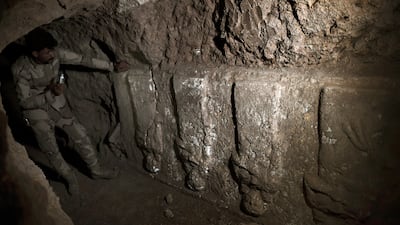
An Iraqi soldier examines carvings in the tunnels. Two winged bulls dating from the Assyrian empire were found in the network dug by ISIS to carry out archaeological excavations. AFP -
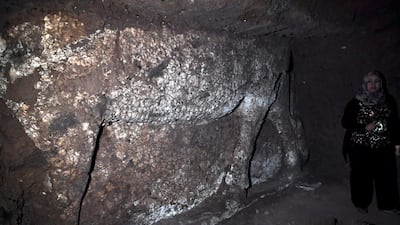
Layla Salih, head of antiquities for Nineveh province, shows a relief carving discovered in the tunnels beneath Al Nabi Yunus Mosque in Mosul. AFP



