


“We were waiting to die,” recalls Rasha Al Amiri, an accountant from Baghdad, moments before a bomb exploded two decades ago.
Iraqis remember the painful memories the war created after the US-led invasion of Iraq toppled Saddam Hussein.
The 2003 war was followed by years of conflict and violent turmoil that led to at least 210,000 civilian deaths and the exodus of hundreds of thousands of Iraqis.
Many Iraqis still remember the horror they went through, following the fall of Saddam’s regime to a US-led Coalition, as if it was yesterday, they tell The National.
Their childhoods were marred by bullets, bombs and bloodshed, the said.
-
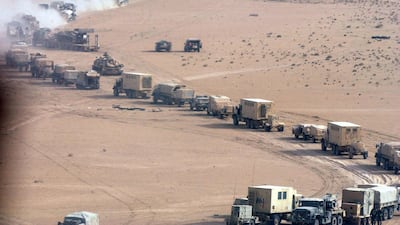
A long US military convoy moving inside an unspecified area of southern Iraq on March 21, 2003. US and British forces were poised to capture the city of Basra on day two of the war to topple President Saddam Hussein. AFP -
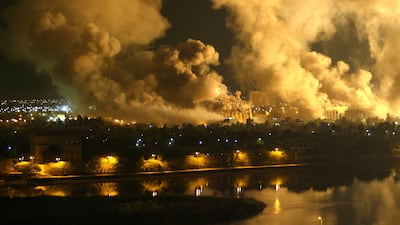
Smoke covers the presidential palace compound in Baghdad on March 21, 2003 during a massive US-led air raid on the Iraqi capital. Smoke billowed from a number of sites, including one of President Saddam Hussein's palaces, an AFP correspondent said. AFP -

Members of Britain's 16 Air Assault Brigade on patrol during a sandstorm in the deserts around the oil fields of Rumaila in southern Iraq on March 25, 2003. AFP -
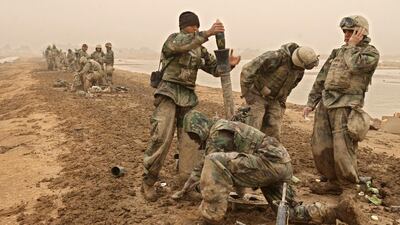
US Marines from the 2nd Batallion 8th Regiment load mortar shells into launchers in Nasiriyah, about 360 kilometres south-east of Baghdad, as they pound Iraqi positions early on March 26, 2003. AFP -
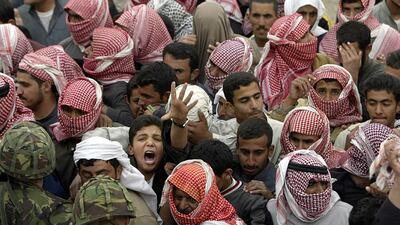
An Iraqi boy struggles amid a crowd to reach for giveaways thrown from a lorry in the southern city of Safwan on March 26, 2003. AFP -

Residents flee the burning town of Basra in southern Iraq on March 28, 2003. British soldiers said the fleeing refugees had described a city still in the grip of an Iraqi military that had hidden large amounts of artillery tanks in civilian and commercial areas. AFP -

Iraqi Republican guards cheer as they pass a wrecked US army Abrams tank, south of Baghdad, on April 6, 2003. AFP -
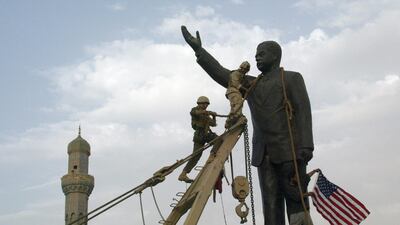
US Marines chain the head of a statue of Saddam Hussein before pulling it down in Baghdad's Firdous Square on April 9, 2003, while an Iraqi waves the US flag. US troops moved into the heart of the Iraqi capital meeting little resistance. AFP -
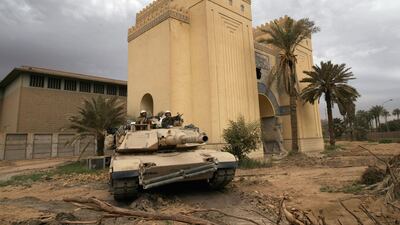
A US tank takes up position outside the plundered Iraqi National Museum in Baghdad on April 16, 2003. Getty Images -
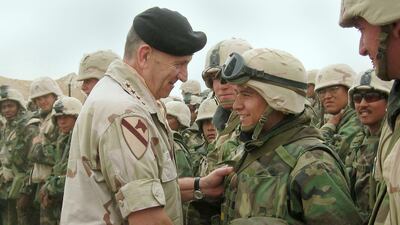
Gen Tommy Franks shakes hands with US Marines of the 1st Marine Expeditionary Force in the Iraqi city of Numaniyah, about 140 kilometres south-east of Baghdad, on April 7, 2003. Getty Images -
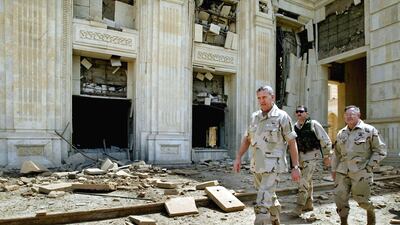
Gen Tommy Franks (c) visits a palace of Saddam Hussein in Baghdad on April 16, 2003. Getty Images -

US Secretary of Defence Donald Rumsfeld (c) is saluted by US Army Lt Gen William Wallace as he arrives at Baghdad International Airport on April 30, 2003. Getty Images -
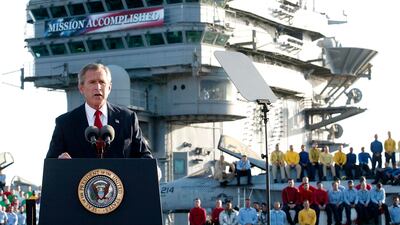
US President George W Bush addresses the nation aboard the nuclear aircraft carrier USS Abraham Lincoln on May 1, 2003. Mr Bush declared that major fighting was over in Iraq, calling it "one victory in a war on terror". AFP


Nightmares still haunt us, said Ms Al Amiri, whose family fled Baghdad as their home was opposite to one of Saddam's palaces, many of which were heavily bombed in March 2003.
They fled to the Sunni town of Anaa, in Anbar province, to seek safety.
"We went to Anaa because we knew it was secure and it did not have any political affiliation to Saddam's regime," Ms Al Amiri said.
Her family managed to rent a big house there, which took them by surprise because everyone from Baghdad was going to Anaa and they feared there would be few homes vacant.
"We discovered from our friendly neighbour that opposite building to us was an alleged intelligence building of the former regime.
A few days after the fall of Baghdad, Ms Al Amiri was walking back home when she saw the sky had turned black.
"A few hours later the building opposite us came under attack by the Americans.
"We all sat in a room, that had no windows, we were all hugging each other and crying. We were waiting to die.
The family had decided that if "we are going to die, we should die together so that no-one will be left alone".
Her father had a Range Rover which they feared looked like a Coalition military vehicle. Her family was scared they would be targeted by terrorists mistaking them for Americans.
However, she said that “as Shiites, we were comfortable to travel to Sunni areas after the war". The people of Anaa were hospitable and accommodating, she said.
Ms Al Amiri’s family survived the attack on the intelligence building, but were traumatised.
“We were just crying so much that we didn’t know what was going on,” she said.
"I remember this moment as if it was yesterday."
Her story echoes the views of millions of Iraqis, from the major cities to the most remote communities, who witnessed seemingly endless violence, an uncertain future and a loss of trust in government.
School attack
Hamza Al Rahmani was a young child when his primary school in central Baghdad came under several attacks in 2005, pushing his family to leave the country.
“I was lucky to have sat on the other side of the classroom, away from the windows, otherwise I wouldn’t be here today,” Mr Al Rahami said.
He was nine years old at the time and recalls how pupils ran out of the class screaming and shouting out of fear, he said.
“I managed to escape from the window and saw many of my friends with severe eye wounds. Each class had around 60 students. There was so much chaos,” Mr Al Rahmani said.
Moments later Iraqi and American troops came to the scene and secured the area. The intended target was a building belonging to the ministry of education that was only 500 metres away from the school.
Like many of his generation, Mr Al Rahmani's story is a reflection of the reality that Iraqis endured for years triggered by violent sectarian clashes leading to the deaths of thousands.
A few months later, another attack occurred near his school.
“We were sitting in class and heard gunshots and every moment that passed it got closer and closer,” Mr Al Rahmani said.
The teachers took the students to a place away from the windows close to the main entrance, he said.
“I was terrified, everything happened so quickly, even though it finished in two minutes but it felt like two years, my heart was beating so fast."
The story of Ms Al Amiri and Al Rahmani is similar to thousands of Iraqi accounts in the past two decades, with street battles, car bombings, kidnapping and murder at one point claiming at least 3,000 lives a month.

