


Major Sunni and Kurdish political parties in Iraq will this month lead fresh efforts to end the country’s prolonged political impasse over forming a new government, legislators said on Tuesday.
The country has been in political stalemate since the national election in last October, the fifth parliamentary vote for a full-term government since the US-led invasion in 2003 that toppled Saddam Hussein.
The main quarrel is among the two largest Shiite groups over who will form the government and how to divide critical posts, including ministerial positions.
The process ground to a halt when a political group endorsed by Shiite cleric Moqtada Al Sadr resigned from Parliament, seeking to dissolve the legislative body and hold snap elections.
But the rival Co-ordination Framework, an umbrella group dominated by pro-Tehran factions, wants a government in place before any new vote can be held. Complicating matters, some within the framework are opposed to a new vote, including former prime minister Nouri Al Maliki, Mr Al Sadr's arch rival.
-
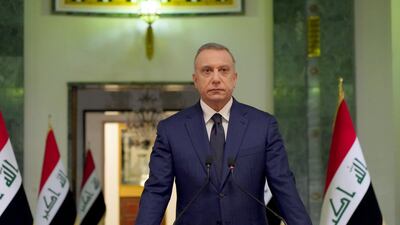
Iraqi Prime Minister Mustafa Al Kadhimi has threatened to resign if the political stand-off in the country is not resolved. Photo: Iraqi Prime Minister's Media Office -

An aerial view of Yafa Street in Baghdad after Shiite cleric Moqtada Al Sadr called on his supporters to withdraw from the Iraqi capital's heavily fortified Green Zone. AP -

Plumes of smoke rise after small fires were lit near the Tomb of the Unknown Soldier and Parliament in Baghdad. AP -
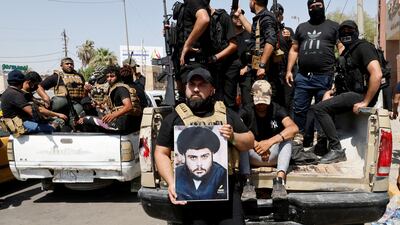
Mr Al Sadr's followers heed his call to withdraw from the Green Zone after violent clashes in Baghdad. Reuters -
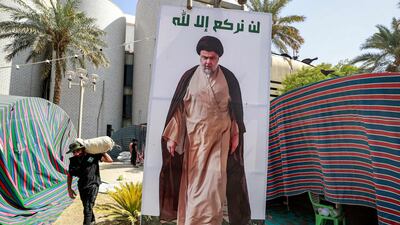
A supporter of Mr Al Sadr helps to dismantle the encampment in Baghdad's high-security Green Zone. AFP -
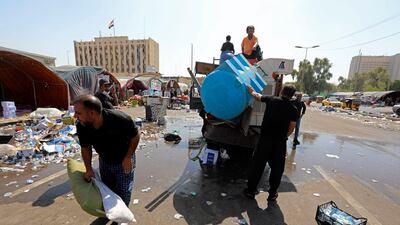
Supporters of Mr Al Sadr pack up belongings as they prepare to leave the Green Zone. AP -
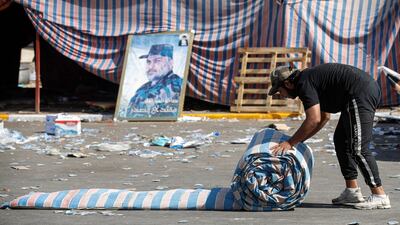
A supporter of Mr Al Sadr rolls up a mattress as their encampment in the Green Zone is dismantled. AFP -
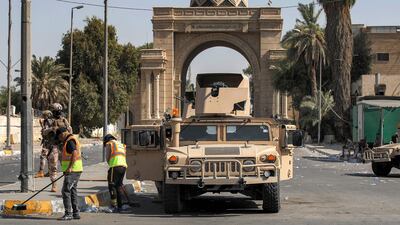
Municipality workers clean up while Iraqi army soldiers guard the entrance to the Green Zone. AFP -
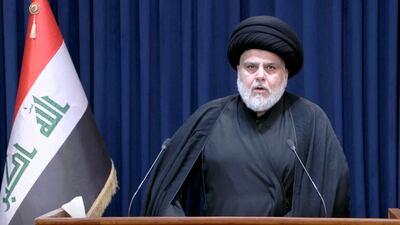
Mr Al Sadr addresses a news conference in Najaf, Iraq. Reuters -

Iraqi Shiite gunmen clash with government forces in the Green Zone of central Baghdad. EPA -
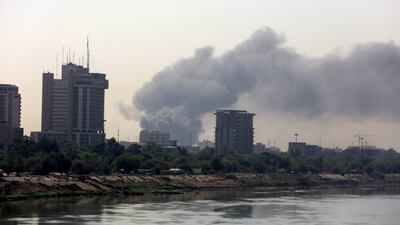
Smoke rises from a building in Baghdad. EPA -
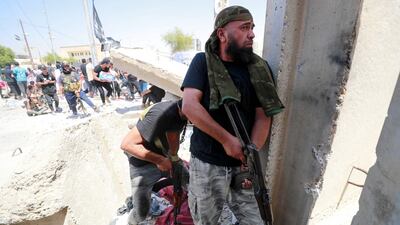
Armed members of Saraya Al Salam, the military wing affiliated with Shiite cleric Moqtada Al Sadr. AFP -
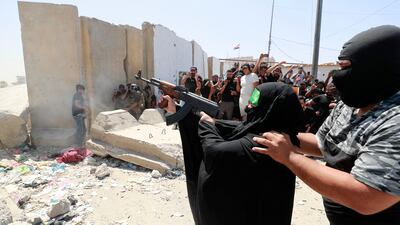
An armed member of Saraya Al Salam. AFP -
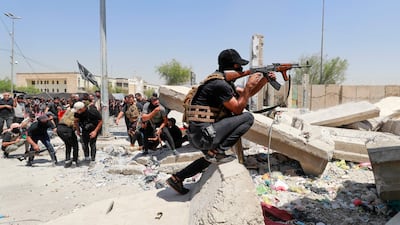
A member of Saraya Al Salam takes aim. AFP -
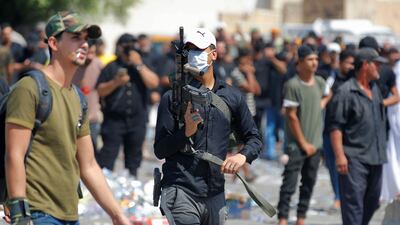
Armed members of the Peace Brigades militia in Baghdad's Green Zone. AFP -
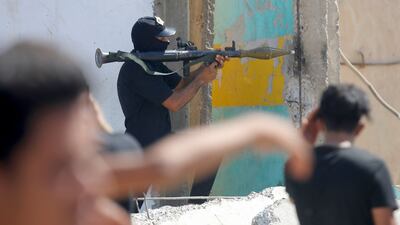
They are affiliated with Shiite cleric Moqtada Al Sadr. AFP -
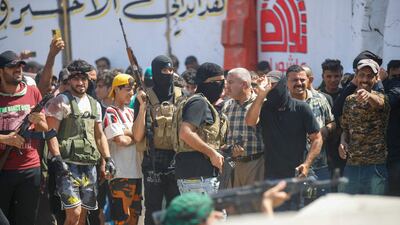
Peace Brigades members clash with security forces in the Iraqi capital. AFP -
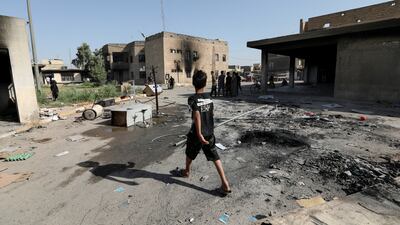
The office of rival Shiite party the Badr Organisation, which was burnt by Sadrists. Reuters -
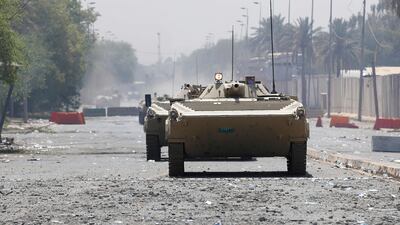
Iraqi security armoured vehicles during clashes with the Peace Brigades in the Green Zone. AFP -
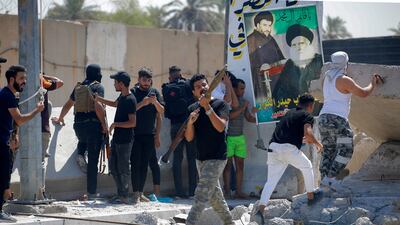
Peace Brigades members carry weapons in the fortified zone. AFP -
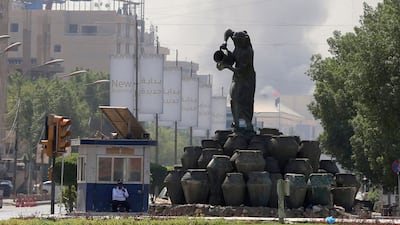
Smoke over Baghdad during an army-imposed curfew, a day after 23 Al Sadr supporters were shot dead. AFP -
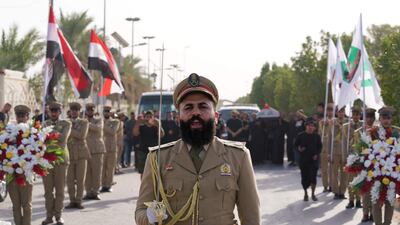
A Peace Brigades member leads a mass funeral in Najaf for Al Sadr supporters killed in the clashes in Baghdad's Green Zone. AFP -
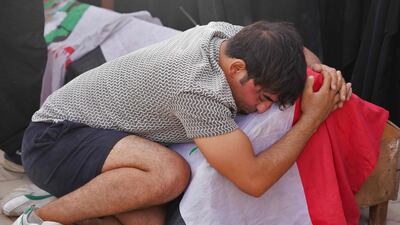
Tears during the mass funeral. AFP -

Mourners pray in front of the coffins of Al Sadr supporters. Reuters -
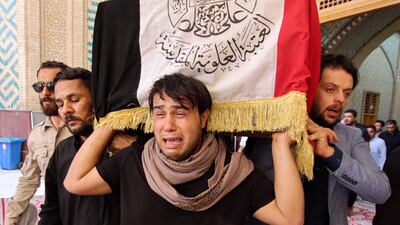
A coffin is carried at the funeral. AFP -
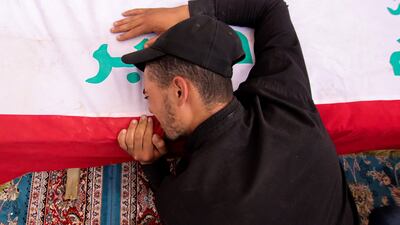
The ceremony took place at a cemetery in Najaf, central Iraq. AFP


This week, the impasse entered a new phase with the majority of political parties calling on the reconvening of Parliament before a new election can be held — an act that could end the deadlock or reignite violent Sadrist protests.
Mr Al Sadr’s Sunni and Kurdish allies — the Sovereignty Alliance headed by Mohammad Al Halbousi, the Speaker of Parliament, and Masoud Barzani’s Kurdistan Democratic Party — on Sunday agreed with the Co-ordination Framework that politicians must return to a constitutional process of forming government, despite calls from Mr Al Sadr to quit Parliament.
In a joint statement, Mr Al Halbousi and Mr Barzani reaffirmed their support for early elections and their rejection of dissolving Parliament. Each party made significant gains in the 2021 vote.
“Both sides stressed the necessity of holding early elections after preparing the legal requirements according to the constitution preceded by the formation of the government,” said the statement.
They say it is important to keep the current Parliament intact until early elections, a position Mr Al Sadr and Mr Al Maliki consider unpalatable.
But on Monday, the framework welcomed their stance, saying it would "continue dialogue with all the parties ... to form a government endowed with full powers".
In a separate statement, it claimed to have reached "understandings with the national forces", saying it would keep its candidate for the post of prime minister — Mohammed Shia Al Sudani — despite Mr Al Sadr’s objection.
Large-scale Sadrist demonstrations erupted when the framework nominated Mr Al Sudani, a former minister close to Mr Al Maliki.
Karim Abu Souda. a politician affiliated to the Sovereignty Alliance, said his group's latest stance did not entail siding with the Co-ordination Framework against Mr Al Sadr.
He said a senior delegation would visit Mr Al Sadr after the Arbaeen pilgrimage to discuss the government formation process, without giving more details.
The religious event marks the end of the 40 days of mourning after the anniversary of the killing of the Prophet Mohammed's grandson Imam Hussein at the battle of Karbala in 680AD. The grieving period ends on Saturday.
“It’s impossible to form a government without political consensus and political understandings are essential to solve the current crisis,” Mr Abu Souda said.
Another Sunni politician, who spoke on condition of anonymity, said Mr Al Halbousi, the President of Kurdistan Region, Nechervan Barzani, and senior Co-ordination Framework leader, Hadi Al Amiri, would be among those attending the meeting.
Mr Al Sadr wants not only to dissolve Parliament, but also to keep the current Prime Minster Mustafa Al Kadhimi and President Barham Salih in office to oversee the early elections, he said.
“But the Co-ordination Framework doesn’t want Al Kadhimi any more,” he said.
Mr Al Sadr said “the delegation could push for another nominee for the prime minister post who’s accepted by Al Sadr as a comprise”.
Green Zone violence
Iraq's latest crisis culminated at the end of August with Mr Al Sadr's supporters clashing with the army and the Iran-backed factions after weeks of protest around Parliament in the Green Zone of Baghdad.
More than 30 of the cleric's supporters were killed and hundreds wounded in nearly 24 hours of violence that ended when he called on his supporters to pull out, demanding an end even to peaceful protests.
Under Iraq's constitution, Parliament can only be dissolved by an absolute majority vote in the house, after a request by one-third of deputies, or by the prime minister with the approval of the president.
This month, Iraq’s Supreme Federal Court dismissed a lawsuit to dissolve Parliament filed separately by the Sadrists and the independent Waie Movement.
It said it had no power to do so and that politicians have to consider the mechanism mentioned in the constitution.

